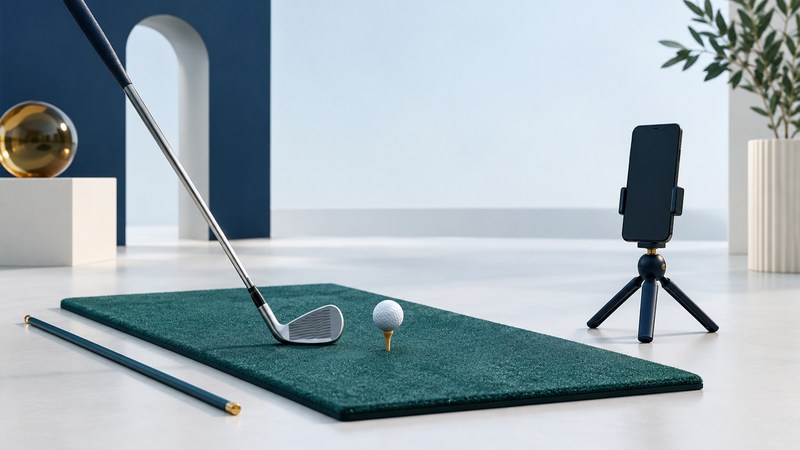
Useful swing practice answers a small question: can you produce a more repeatable contact or ball flight with a clear target? Choose one task, observe a baseline and change one thing at a time. A notebook and a consistent setup can tell you more than a bucket hit without a purpose.
Set a target before choosing a swing thought
Pick a visible target and a club you can control at a comfortable pace. Establish a clubface direction, then a balanced stance that gives you room to move. Grip and ball-position details vary with the club and task; work with a coach when those fundamentals are uncertain. For a right- or left-handed player, the useful question is whether the setup matches the intended shot.
A rod placed flat on the ground, safely outside the club’s path, can provide a reference for body alignment during practice. Aiming the feet at the target while ignoring the clubface can make the observation confusing. PGA coaches’ alignment guidance connects setup checks with a pre-shot routine.
Keep practice aids to practice sessions and check the facility’s rules. Choose a hitting bay with adequate space, and place phones or tripods where they cannot be struck or obstruct others.
Track contact, start direction and curve separately
Swipe the table, or focus it and use the arrow keys to see every column.
| Observation | Write down | Avoid jumping to |
|---|---|---|
| Contact | Thin, heavy, central or visibly off-center | A full swing diagnosis from one strike. |
| Start direction | Left, near target or right of intended line | A body-position correction without checking aim. |
| Curve | Left, little visible curve or right | Assuming every similar-looking flight has one cause. |
| Finish | Usable target area or miss | Judging only the best shot in the set. |
Use the same reference line for each set. A shot can start left and curve right; recording only “right miss” loses useful information. Strike location, face delivery and club path interact, and wind can complicate what you see. A coach or appropriate measurement can help test a hypothesis.
Try a focused 30-minute session
- First five minutes: ease into comfortable swings and identify today’s target and task. Keep the pace suited to your readiness.
- Next five minutes: hit five baseline shots with the same club. Record contact, start direction and curve without trying to fix each shot.
- Next ten minutes: work on one agreed setup or movement cue. Pause between small sets and compare the pattern with the baseline.
- Next five minutes: change targets and go through your full routine before each shot. This checks whether the task survives a decision between shots.
- Final five minutes: write the result and one question for next time. End while you can still concentrate.
This is a sample time allocation, not a required workload. Reduce it when concentration or comfort fades. PGA professional Brendon Elliott’s practice advice recommends purposeful goals, journals and practice that connects with the course. The record matters because it makes the next session a continuation of learning.
Compare a pattern, then take it to the course
A close camera can distort angles. For video, ask a coach for the views they need and keep camera placement consistent between sessions. Preserve full-speed clips as well as slow motion. A frame that resembles a tour player’s position does not by itself establish better contact.
On the course, use a simple routine and a playable target. Save detailed mechanical experiments for practice. Record recurring misses after the round, then bring the observations and a small sample of clips to a lesson.
Keep the record short enough to use
Download the golf practice log (plain text). It includes the task, target, five-shot observations, one change and a next-session check. The log records what happened; it does not assign a medical or mechanical diagnosis.
If the pattern stays confusing, get a coach to observe it before adding more cues. Pain calls for stopping the activity and appropriate professional advice; a golf drill is not a treatment. For a separate short-game session, use the putting guide.