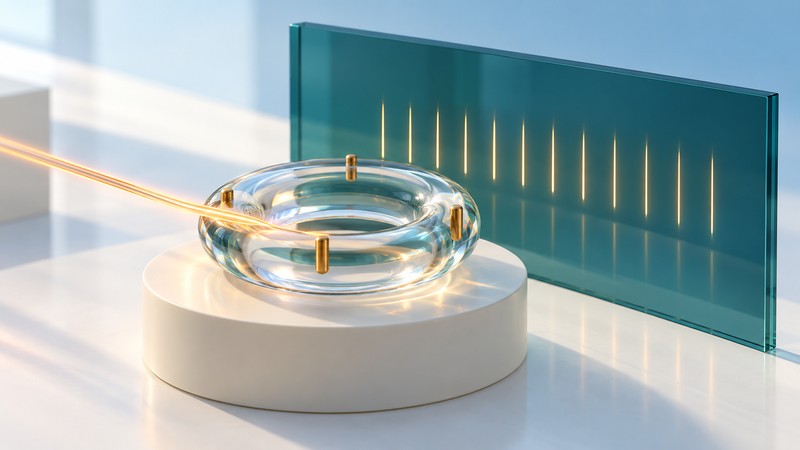
An optical frequency comb is a light source with many evenly spaced spectral lines. On a graph, those lines look like the teeth of a comb. In practice, they can act like an optical ruler, linking time, frequency, distance, and molecular fingerprints with exceptional precision.
Frequency combs have been important in precision metrology, atomic clocks, spectroscopy, communications, calibration, ranging, and sensing. The challenge is that many comb systems have historically required bulky lasers, careful stabilization, and substantial power. Microlaser frequency combs aim to shrink that capability onto compact photonic platforms.
NIST’s frequency-comb introduction explains the measurement idea: known frequency spacing supplies repeatable markers for comparing light. Precision also depends on how those markers are stabilized and calibrated.
What the teeth of a comb mean
Imagine a ruler with evenly spaced marks. A frequency comb supplies marks along a frequency axis, and a measurement compares an unknown optical signal with them. Equal frequency intervals correspond to unequal wavelength intervals because frequency and wavelength have an inverse relationship.
Why Smaller Combs Matter
A laboratory frequency comb can be extraordinarily precise, but size and power determine where it can be used. A compact, low-power comb could fit into field instruments, portable chemical sensors, chip-scale optical systems, medical devices, communications hardware, or eventually consumer-scale sensing platforms.
Reducing threshold power is especially important. A device that needs watts of optical pump power may be realistic in a lab rack but awkward in an integrated system. A device that operates at milliwatt levels is much closer to electronics-friendly packaging, battery operation, and dense photonic integration.
The USC Viterbi Demonstration
In 2017, researchers at the University of Southern California's Viterbi School of Engineering reported that gold nanorods attached to the surface of a microlaser could help produce a frequency comb using far less power than conventional approaches. The work was led by Andrea Armani, with Vinh Diep, Rigoberto Castro-Beltran, and collaborators, and was published in ACS Photonics.
The team used gold nanorods on a microcavity laser surface. The nanorods enhanced the local optical field, increasing the intensity of light circulating in the resonator. A polymer coating on the nanoparticles provided a nonlinear optical contribution, helping the system generate additional wavelengths from the original light.
Gold as a Photonic Tool
Gold is useful in nanophotonics because nanoscale gold structures can support plasmonic resonances. In simple terms, electrons in the metal can oscillate collectively when driven by light. Those oscillations concentrate electromagnetic fields into very small volumes, producing strong local interactions.
In many lasers, metal near an optical cavity would be expected to increase loss. That is one reason the result was interesting: the nanoparticles did not merely degrade the microlaser. Properly used, they helped the nonlinear process begin at lower pump power.
Kerr Frequency Combs
Many microresonator combs rely on the Kerr effect, a nonlinear optical response in which the refractive index of a material changes with light intensity. When light circulates inside a high-quality microresonator, that nonlinearity can convert a single input wavelength into many new wavelengths with regular spacing.
The balance is delicate. The cavity must confine light efficiently, the pump must be strong enough, dispersion must be controlled, and loss must be low enough for nonlinear conversion to build. Adding plasmonic nanostructures changes that balance by boosting local field intensity, but it must be done without overwhelming the cavity with absorption.
What the Nanorods Changed
The 2017 paper abstract reports parametric-oscillation thresholds ranging from 148 µW to 1.5 mW as nanorod concentration changed, and describes a threshold 15 times lower than uncoated silica devices with similar optical performance. It reports a near-infrared comb spanning about 300 nm. These are experiment-specific optical measures, not total electrical power consumption of a complete instrument.
Without the nanorods, the comb could not be generated at the same power. That comparison is the heart of the result: the surface material was not decorative. It changed the operating threshold of the microlaser by modifying how strongly light interacted with the device.
The USC announcement also used a broader comparison with larger comb technology. For evaluating the material change, keep the paper’s uncoated-device comparison separate from that system-level publicity comparison.
| Measure | What it tells you | What it leaves to verify |
|---|---|---|
| Optical threshold | Pump power at onset of the specified nonlinear process. | Total electrical demand, coupling and operating margin. |
| Spectral span | Frequency or wavelength range covered. | Useful line power, spacing and signal-to-noise ratio. |
| Line stability | How reliably frequency markers stay in place. | Calibration, thermal drift and long-term operation. |
| Coating response | How materials change local optical interaction. | Actual coating chemistry, repeatability, absorption and heating. |
Applications
Low-power combs are attractive for spectroscopy because many molecules absorb or scatter light at specific wavelengths. A broad comb can interrogate many wavelengths at once, helping identify gases, liquids, biological markers, or environmental chemicals.
Other possible uses include optical communications, precision timing, navigation, distance measurement, calibration of astronomical instruments, cybersecurity-related optical systems, and compact sensors for industrial monitoring. The exact application depends on comb stability, line spacing, bandwidth, noise, packaging, and whether the device can be integrated with detectors and electronics.
Limits and Engineering Questions
A low threshold demonstration is not the same as a finished product. Practical comb systems need stable operation, controlled spectra, repeatable fabrication, thermal management, robust packaging, and predictable behavior over time. Gold nanorods introduce additional variables: particle size, shape, density, orientation, coating chemistry, and attachment uniformity.
There is also a tradeoff between enhancement and loss. Plasmonic structures can make fields intense, but metals absorb light. The engineering task is to place the enhancement where it helps nonlinear conversion while keeping absorption, heating, and variability under control.
A Materials Strategy for Photonics
The broader lesson is that integrated photonics is not only about shrinking conventional optical components. It is also about using materials at surfaces and interfaces to change what tiny optical devices can do. Gold nanorods, organic coatings, resonator geometry, and nonlinear response can be designed together.
That is why gold nanoparticle-enhanced microlasers remain an instructive example. They show how nanomaterials can move an optical function toward lower power and smaller size, not by replacing the laser, but by changing the microscopic environment where light is stored and transformed.
Keep a research-reading record
Use the editable nanotechnology research worksheet (Markdown) to record the material, measured outcome, units, comparator and remaining questions. It works in Obsidian or an ordinary text editor.