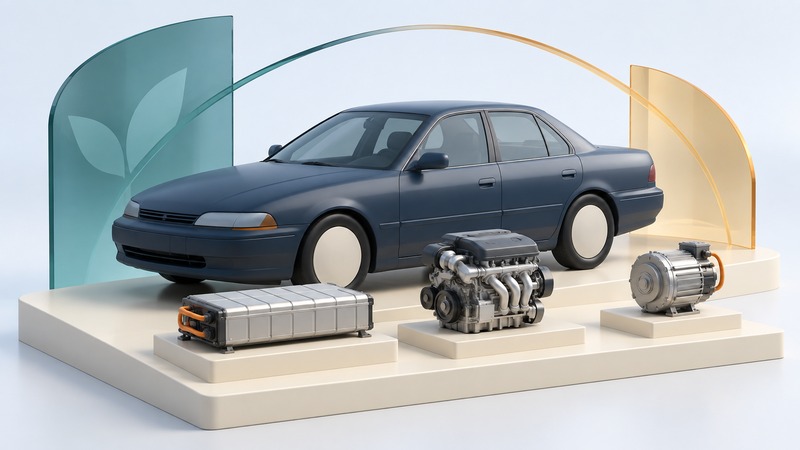
Coulomb offers a useful way to understand early plug-in hybrid research: a working prototype can embody a design idea while its announced performance goals still require test evidence. Read the UC Davis project as a documented engineering experiment, separating what the university described, what it aimed to achieve and what additional measurements would be needed to evaluate the result.
Place the prototype in its historical record
In its September 17, 2002 report, “FutureCar in Europe”, UC Davis described Coulomb as a Mercury Sable converted to gasoline-electric hybrid propulsion with a continuously variable transmission. The report announced plans to take it to the European Challenge Bibendum event and identified it as the university’s 1998–99 FutureCar competition entry.
The university described low-speed electric propulsion, a small gasoline engine providing additional power and maintaining battery charge, and the ability to recharge from an external electricity supply. These are the relevant design features for understanding the project. The report is a contemporary institutional account; its publication before the planned event defines what it can establish about that event’s outcome.
Follow the two energy sources
A plug-in hybrid has two externally supplied energy inputs: fuel and electricity. Stored battery energy can power an electric motor, while the combustion system supplies another route to propulsion and, depending on the design, battery charging. Exact power sharing, control logic and driveline connections depend on the vehicle.
Electricity path
External electricity → charging system → battery → electric drive → vehicle motion.
Fuel path
Gasoline → engine → propulsion and supported charging functions, according to the particular hybrid design.
These paths explain functions, not Coulomb’s detailed wiring or mechanical layout. The U.S. Department of Energy’s vehicle overview distinguishes plug-in hybrids from conventional hybrids, which recover and manage energy onboard without external charging. A fuel-economy figure for a plug-in vehicle therefore needs the electricity use and battery state as context.
UC Davis’s account of Andrew Frank’s research places student-built prototypes within the FutureCar and FutureTruck programs. Their educational value lies partly in making engineers integrate energy storage, propulsion, controls and the vehicle around them. Evaluating those interactions requires more than comparing individual component specifications.
Distinguish a target from a measured outcome
On a narrow screen, scroll the table horizontally. Keyboard users can focus its region and use the arrow keys.
| Statement type | What the report establishes | Evidence needed for a stronger conclusion |
|---|---|---|
| Prototype description | A university report identifies the conversion and its intended operating roles. | Detailed design records and test documentation for exact component behavior. |
| Fuel-economy goal | The report gives a design target of more than 50 miles per gallon. | Measured fuel and electricity use, test route or cycle, and starting/ending battery state. |
| Acceleration goal | It gives a 0–60 mph target of 11 seconds. | A dated test result with vehicle condition, method and repeatability. |
| Emissions goal | It states an aim to meet California SULEV standards. | Applicable certification or emissions-test evidence and its scope. |
| Planned event participation | It announces a future trip and competition appearance. | Contemporary event records to establish attendance and results. |
Those categories keep the history useful without converting an intention into a completed result. The source cited here does not provide the test dataset needed to verify the performance targets. Preserve that boundary when repeating a figure, especially if a later summary shortens “designed to achieve” into “achieved.”
Account for electricity in a mileage comparison
For a fair comparison, define the trip, vehicle loading, temperature and test procedure. Record whether electricity is measured at the wall or battery, since those boundaries differ. Establish the battery state at the beginning and end; using stored energy during a test without accounting for its replacement can make the liquid-fuel result look better than an equivalent sustained journey.
Fuel economy, tailpipe emissions and total energy use also answer different questions. A claim about one quantity needs its own units and measurement method. A historical design target is especially easy to overread when it appears beside modern certified ratings obtained under a different procedure.
Build an evidence trail for further reading
For each historical claim, save the author or institution, publication date, vehicle version, exact quantity and whether the document reports a design, target, test or retrospective interpretation. Prefer contemporary technical reports and event records for outcomes. A later recollection can add context while leaving the original measurement question open.
The lasting lesson is the integration problem: a practical vehicle must coordinate energy sources while carrying passengers, operating repeatedly and meeting its intended requirements. Coulomb’s documented design gives readers an early example to analyze. For a present-day purchase decision, use a current vehicle’s ratings, manual and your own charging routine; the plug-in hybrid ownership guide turns those inputs into a practical comparison.
Save a working record
Download the Coulomb Hybrid working record (plain text). Open it in a text editor, save a private copy and fill in the relevant prompts. Record unknowns explicitly and attach the evidence that supports each conclusion. The file includes instructions, source links and this article’s address.