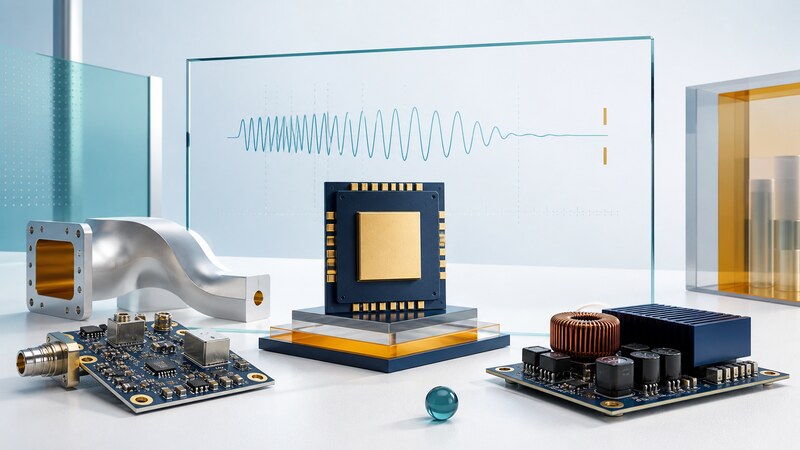
Gallium nitride (GaN) is a semiconductor material used in devices for radio-frequency amplification and efficient power switching. These applications share a material technology, but they ask different questions of the transistor and surrounding circuit.
An RF device is selected for behavior across a frequency band and operating condition. A power-switching device is selected for a converter's voltage, current, switching, and thermal requirements. The GaN label alone does not make devices interchangeable or establish the performance of a finished system.
Separate the application before comparing specifications
| Consideration | RF amplifier | Power converter |
|---|---|---|
| Main job | Increase RF signal power with the required fidelity. | Transfer and regulate electrical energy through switching. |
| Important measures | Gain, output power, bandwidth, linearity, and efficiency. | Loss, regulation, transient behavior, and power density. |
| Circuit environment | Bias and impedance matching at the operating frequencies. | Gate drive, switching loops, magnetics, and control. |
| Measurement context | Frequency, modulation, compression, and duty cycle. | Input voltage, output load, switching frequency, and temperature. |
Qorvo's amplifier resources illustrate the RF application space. Texas Instruments' GaN resources focus on power conversion. Use application-specific documentation before comparing a headline figure from one category with another.
Worked example: define which efficiency you mean
Qorvo's PAE, dissipation, and junction-temperature calculator is a useful resource for exploring these relationships. Thermal estimates also require the correct thermal model and boundary temperatures.
For comparison, a fictional DC converter delivering 100 W at 95% efficiency draws 100 / 0.95 = 105.26 W and loses about 5.26 W. At 97%, it draws 103.09 W and loses about 3.09 W. Those hypothetical efficiencies do not prove a GaN advantage; they show why the loss difference matters to cooling.
Read RF claims with their operating conditions
A transistor's output power is meaningful alongside frequency, bias, input drive, thermal conditions, and whether the result is pulsed or continuous. A brief pulsed result cannot be treated as a continuous-power rating.
For modulated signals, the required linearity may lead to operation below maximum output. Compare gain and efficiency at the intended operating point rather than at unrelated peaks. Matching networks and package parasitics influence bandwidth, stability, and delivered power.
Ask what the datasheet, reference circuit, and characterization actually establish. A result at one frequency and load condition is evidence for that condition; wider claims require wider measurements.
Power switching makes layout and drive part of the choice
GaN power devices can support fast switching with favorable loss characteristics, but the benefit depends on the complete converter. Increasing switching frequency may reduce some passive-component requirements while increasing other losses or electromagnetic interference.
TI's discussion of GaN gate driving distinguishes device structures and their driver requirements. Use the exact device's recommended gate conditions and reference layout; a driver intended for another transistor technology is not automatically compatible.
Compare conduction loss, switching loss, reverse-conduction behavior, gate-drive consumption, magnetics, and cooling under the same conditions. On-resistance changes with operating conditions, and fast transitions make parasitic inductance and measurement technique important.
An integrated power stage can simplify some connections. It does not remove the need to follow its layout, decoupling, thermal, and operating requirements. Evaluate documented reference designs before adapting a power stage.
Make a comparison that can be reproduced
Define the required operating range and select a shared comparison point. Record the exact parts, conditions, measurement boundary, and uncertainty. Include the support circuitry, cooling, and implementation effort in the decision.
AI-assisted review can extract conditions from supplied datasheets, normalize units, and check efficiency calculations. Require it to flag incomparable figures, such as pulsed and continuous results, rather than rank them as though they were equivalent.
Is GaN always the best choice?
No. Silicon, silicon carbide, and other technologies can fit different voltage, frequency, cost, and application requirements. Select the device and system implementation that meet the stated need with verified evidence.
For a smaller example of how efficiency affects heat, see LED current control and driver dissipation.