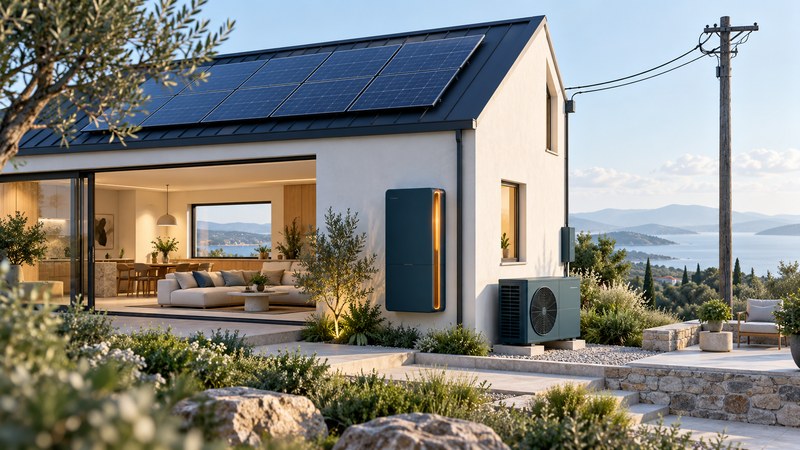
A more capable energy home connects three things: a comfortable building, equipment suited to its needs, and an electricity system that can support it. The next useful improvement may be better insulation, a well-designed replacement system, or a way to shift demand to a more convenient time.
Heat pumps, rooftop solar and batteries already provide options in many markets. Their suitability and economics depend on the building, climate, tariffs, installation and local service. This guide helps you identify those conditions before treating a technology trend as a household plan.
Begin with the building and the service you need
Record what you want to improve: winter comfort, summer cooling, running cost, reliability during outages, or the ability to charge a vehicle. Gather energy use over a full year where available, equipment age, comfort problems and the timing of likely replacements.
Heat pumps move heat between places. For a specific home, capacity at local design temperatures, installation quality and distribution matter alongside a published efficiency rating. ENERGY STAR’s air-source heat pump guidance links to certified equipment and advises working with a professional installer to select a suitable model.
Ask a qualified contractor how the proposed system fits the building’s heating and cooling loads, existing ducts or emitters, electrical capacity and any backup arrangement. Have the scope and assumptions written down. This is especially useful before an urgent equipment failure leaves little time to compare options.
Renters can start with comfort records and questions for the property owner about planned replacements and shared services. Changes to fixed equipment require the relevant owner and professional involvement.
Separate power, energy and backup
On a small screen, scroll the table sideways. Keyboard users can focus the table region and use the arrow keys.
| Quantity or feature | Meaning | Question for a proposal |
|---|---|---|
| Power, measured in kW | How quickly energy can be supplied at a moment. | Can the system support the selected simultaneous loads and starting demands? |
| Usable energy, measured in kWh | How much energy is available within operating limits. | How long could the selected loads run under the stated assumptions? |
| Backup capability | A designed arrangement for serving loads during an outage. | Which circuits are supported, and how is safe separation from the grid provided? |
| Charging conditions | The sources and operating rules that replenish storage. | Can it recharge during the expected outage conditions? |
| Warranty and service | The terms governing long-term support and performance. | What use limits, exclusions and local service arrangements apply? |
The next connection is between timing and value
The IEA’s Electricity 2026 analysis of flexibility describes households and businesses shifting or reducing demand in response to grid or market signals. Depending on the local program, participants may receive incentives or use a tariff that rewards different timing. The practical question is whether the arrangement meets your needs after fees, restrictions and control terms are included.
A household might schedule an eligible load within an agreed window. A larger aggregation can coordinate many such loads. The enabling pieces are reliable controls, useful price or grid information, clear consumer terms and the ability to preserve necessary comfort and service.
Before joining a program, ask who can control equipment, how to override a change, what happens during outages, what data is shared and how compensation is calculated. Read the actual local tariff or agreement; a national example cannot establish your savings.
What to watch over the next several years
For the next one to three years, watch installed quotes, replacement cycles, qualified installer availability and real local flexibility programs. These can determine practical adoption even when the hardware is familiar. A useful milestone is a complete proposal that explains performance, responsibility and service.
Over a three-to-seven-year planning window, watch grid connection work, coordination among household systems and evidence that customers can use it reliably. The IEA’s May 2026 review of battery deployment describes storage taking on several roles in power systems. Those grid-level roles do not automatically translate into the same value for an individual home.
For longer-term possibilities, watch new storage approaches and more coordinated neighborhoods through independently documented demonstrations and sustained operation. Keep research capabilities separate from products with an installation manual, warranty and local service network.
Make a replacement plan that can adapt
- List the next likely equipment replacements and the service each must provide.
- Record a year of bills, tariff details and recurring comfort or outage problems.
- Ask for a whole-system assessment where equipment interacts with the building or electrical supply.
- Compare complete installed options, including maintenance and any required service changes.
- Choose a trigger to revisit the plan: equipment deterioration, a verified tariff change, a suitable quote, or completed local infrastructure.
Keep decisions staged when possible. Information gathered now can reduce rushed choices later. For detailed explanations of individual technologies, explore the Energy library; use this page to connect them to a household’s future needs.
Continue exploring
- Test a household decision across several futures
- Evaluate total ownership cost
- Explore the Energy library
- Explore the Future library
Evidence and links reviewed October 17, 2026. Future developments remain conditional on the evidence and circumstances described.