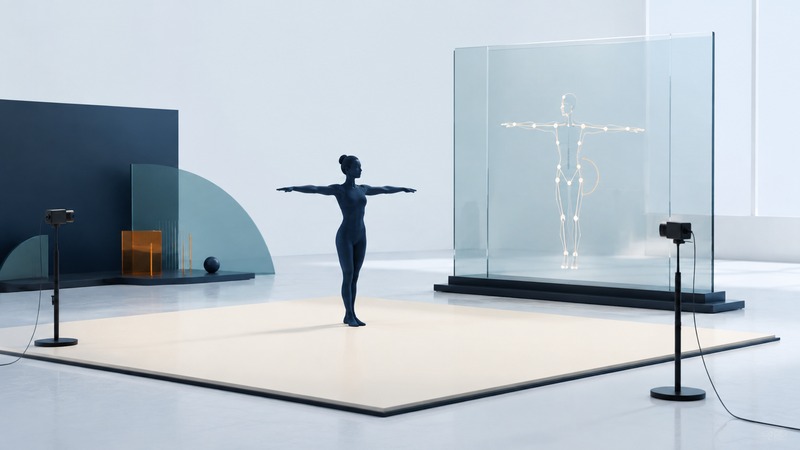
Fujitsu’s Judging Support System (JSS) helps artistic-gymnastics officials examine a performance through reconstructed body positions and movement. Its value is in making a difficult element easier to inspect: the system supplies evidence that judges interpret under the sport’s rules.
From a proposed system to competition use
The federation and Fujitsu began their collaboration in 2017. At the 2019 World Championships in Stuttgart, multi-angle views supported reviews on rings, pommel horse and men’s and women’s vault. The federation’s JSS history records those early uses, including inquiries and blocked scores, and a vault element-recognition application in 2020.
A later milestone changes how the technology should be described. In their October 2023 joint announcement, Fujitsu and the federation reported competition introduction across all ten apparatus categories at the Antwerp World Championships. That version used camera-based image analysis in place of the earlier sensor-based approach.
The ten categories comprise six men’s events—floor, pommel horse, rings, vault, parallel bars and horizontal bar—and four women’s events—vault, uneven bars, balance beam and floor. Shared apparatus names still represent separate competition categories. The 2023 milestone establishes breadth of coverage; an event’s own arrangements determine how the system is available there.
Four steps between a camera and useful evidence
- Find the performing gymnast. Cameras also see officials, coaches and other athletes. The software must follow the correct person through the relevant performance.
- Combine the views. Calibrated cameras provide different perspectives from which movement in three dimensions can be reconstructed.
- Estimate body pose. The resulting joint positions and segments describe how the athlete’s body is arranged over time.
- Present the movement for review. Officials can examine the relevant element and measurements in the context of its recognition criteria.
A 2025 research paper by the system’s developers describes a tracking implementation with four calibrated RGB cameras. It explains challenges including occlusion, lighting, similar uniforms and cases where useful detections come from opposing views. Its tracking improvements concern a specific stage of the analysis; they should be interpreted alongside the subsequent pose estimation and judging process.
This distinction helps explain why an ordinary television replay and a reconstructed view answer different questions. A broadcast camera records one perspective. A reconstructed view depends on several observations and a model connecting them. Both can be useful, with different evidence to examine.
Where the judges fit
Artistic gymnastics separates difficulty from execution. The D score concerns the recognized content and applicable composition requirements; the E score reflects execution deductions. Other deductions can affect the final score. Consult the federation’s 2025–2028 men’s Code of Points for the detailed men’s framework; women’s artistic gymnastics has its own code.
JSS is especially understandable as a way to inspect the evidence behind element recognition. An angle or body position becomes meaningful when attached to the correct instant, body segments and rule. Assigning difficulty, applying execution deductions and resolving a formal review remain parts of the officiating framework. A plausible-looking body model alone establishes neither a complete score nor an entitlement to change it.
On a narrow screen, scroll the table sideways. Keyboard users can focus it and use the arrow keys.
| Evidence shown | Useful question | What to check next |
|---|---|---|
| An element label | Which movement has been recognized? | Its definition and recognition requirements in the relevant code. |
| A joint angle | Which body segments and instant define it? | The corresponding views, timing and measurement definition. |
| A reconstructed pose | How well was the athlete observed? | Obstructed views, identity tracking and visible evidence. |
| A proposed score change | Which component and rule are involved? | The event’s authorized review procedure and officials’ decision. |
Read an analysis as a chain of evidence
For a coach evaluating a motion-analysis product, ask to see a complete example with the original views, measurement definitions and an explanation of uncertain frames. Compare repeated recordings of the same drill under similar conditions. Keep the original video so an unexpected result can be revisited. These are practical evaluation questions, separate from any claim that a consumer recording setup reproduces competition JSS.
For a spectator, begin with the disputed element and the score component. Then look for the official explanation of what was credited. The most useful technology makes that relationship easier to understand: observed movement, applicable criterion and the resulting decision.