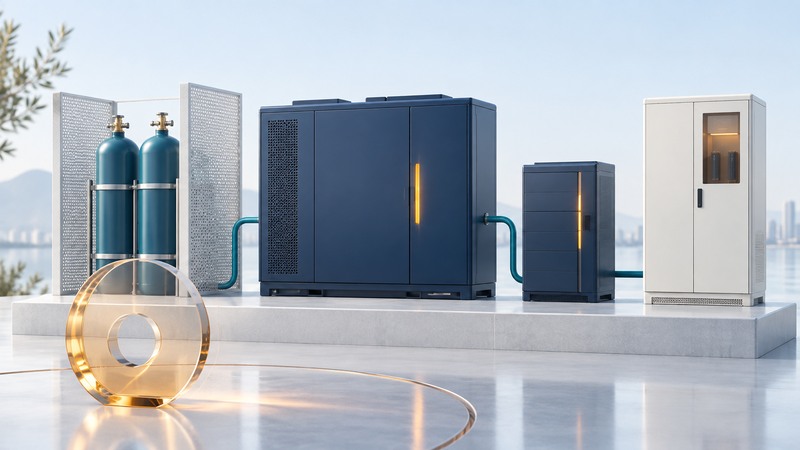
A fuel-cell backup system is useful when it can maintain a defined electrical service through an outage. Start with the critical load, its tolerated interruption and the required duration. Then assess the fuel cell, battery, power conversion, stored fuel and service arrangements as one system.
This guide helps facility and utility teams prepare an evaluation with their electrical engineer and equipment supplier. Bring a load schedule, the proposed system manual and a description of the site. The focus is essential control and communications equipment; the backup-generator guide provides a broader starting point for organizing loads.
Define the service at the load
Record the voltage range, AC or DC supply, continuous power, peak demand and permitted interruption for each essential device. Include communications equipment needed to receive alarms. Identify the measurement point: a stack's electrical output, the system's DC terminals and an AC load after an inverter have different boundaries.
On a narrow screen, scroll the table sideways. Keyboard users can focus the table region and use the arrow keys.
| Requirement | Record | Evidence to request |
|---|---|---|
| Continuity | Maximum interruption and minimum acceptable voltage | A transition test measured at the critical load |
| Sustained output | Continuous and peak demand, including auxiliaries | Net-output and load-response data under relevant conditions |
| Duration | Outage target and reserve policy | Usable fuel quantity and consumption at the intended duty |
| Environment | Temperature, exposure and access constraints | Manufacturer limits and a site-specific installation review |
A requirement such as “keep the control bus energized for eight hours” becomes testable when the bus voltage, load profile and acceptable excursions are specified. Resolve uncertain load data before comparing equipment ratings.
Follow the outage and recovery sequence
A battery can support the load while the fuel cell starts and stabilizes. The fuel cell then supplies sustained energy, with the battery handling any supported transient role. During recovery, controls must manage the return of the primary supply and restore battery readiness for the next event.
DOE's backup-power technical-target table explicitly separates fuel-cell startup time from the uninterrupted service expected of a hybrid battery system. The table reports historical status and research targets; use the actual supplier's tested data for a purchase.
Ask for a time trace showing loss of input, battery response, fuel-cell startup, load acceptance and restoration. Record the lowest load-terminal voltage, startup duration, alarms and the battery condition at the end. A successful fuel-cell start alone leaves continuity at the load unverified.
Calculate energy at a stated boundary
Use net usable electrical energy delivered at the load, or a documented fuel-consumption curve that includes the system's auxiliary demand. If a supplier gives stack efficiency, ask how air handling, cooling, controls, conversion and startup change the usable result. Reserve fuel and unavailable fuel belong outside the usable quantity.
Fictional eight-hour assessment
A critical load uses 1.5 kW for eight hours: 1.5 × 8 = 12 kWh. Suppose a supplier's hypothetical consumption model gives 13.2 kWh usable at the same load terminals after the specified reserve. The energy margin is 1.2 kWh, equivalent to 48 minutes at 1.5 kW.
If demand rises to 1.8 kW and usable energy remains 13.2 kWh, the arithmetic endurance is 7 hours 20 minutes. The eight-hour requirement is unresolved. Confirm the revised consumption and net-power capability; this constant-energy example is a screening calculation, not a product rating.
Use a separate battery assessment for startup and any required fallback interval, including age, temperature and supported discharge limits. Keep the fuel-cell runtime and battery duty explicit so energy is counted once.
Close the operational gaps
Ask who replenishes fuel, how much can be delivered during a regional outage, and who can access the site. Review documented inspection, maintenance, alarm transmission and failed-start response. A readiness record should identify equipment, test conditions, measured results, deficiencies, corrective action and the responsible person.
DOE's historical cost definition includes equipment, installation, operation, maintenance, fuel and storage. Use that complete boundary when assembling a current quote; add the site-specific battery and power-conditioning responsibilities explicitly.
Have qualified designers and the relevant authority determine storage, ventilation, electrical integration and operating requirements for the exact installation. This brief supports their review. Finish with an accepted-evidence list and dated owners for unresolved items. For a different facility backup pathway, compare the service requirements with diesel-generator duty and readiness.
Fuel-cell backup system brief
Fuel-cell backup system brief — plain-text download. Save a copy and fill it in with your own information. The file includes instructions, assumptions and references so it can be used independently.