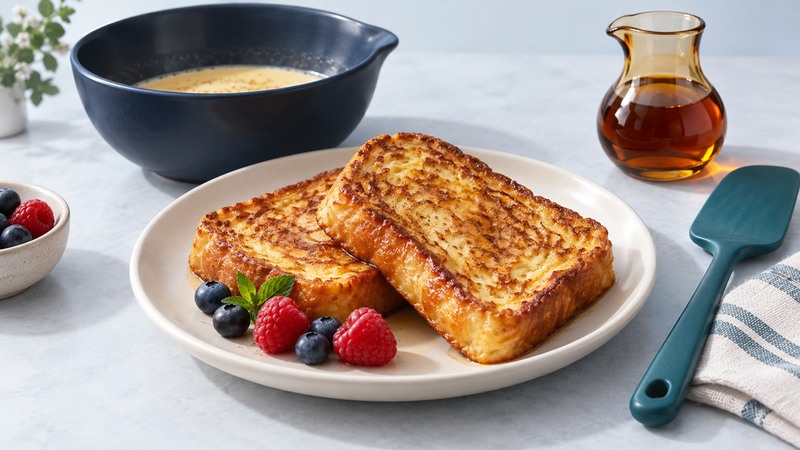
For French toast with a cooked center and an evenly browned surface, start with moderately thin, slightly dry bread and a pan over medium heat. Cook the first slice as a check, then adjust the heat or dip time for the remaining batch.
A four-slice batch
Makes: four slices, about two breakfasts with sides. Allow: 15–20 minutes including two pan batches. Have a shallow dish, fork or whisk, a large skillet, broad spatula and a thin-tip food thermometer. Ingredients use US measures.
- 4 slices whole-wheat sandwich bread, about ½ inch thick and 35–45 g each (140–180 g total)
- 2 large eggs
- ½ cup milk
- ¼ teaspoon cinnamon
- ½ teaspoon vanilla extract
- About 2 teaspoons butter or neutral oil, divided, for the pan
The egg, milk, spice and bread proportions follow Oregon State University Food Hero’s French toast. The bread dimensions and small-batch pan routine are added guidance. Very thick brioche or a dense artisan loaf absorbs and cooks differently; use a recipe developed for that style instead of stretching this timing.
Dip, cook and check the center
- Wash hands, then beat eggs, milk, cinnamon and vanilla together in the shallow dish until the mixture is uniform. Heat the skillet over medium heat and spread half the butter or oil into a thin film.
- Dip both faces of a bread slice. Begin with about 5 seconds per face for soft bread, or 10–15 seconds for drier bread. Lift with support and let loose mixture drip back. The slice should be moistened yet strong enough to move intact.
- Cook without crowding, about 2–3 minutes on each side as a starting range. Turn once the underside is golden and releases easily. Lower the heat if the surface darkens too quickly.
- Check the center with a thin-tip thermometer inserted from the side; this egg-containing dish should reach 160°F. Continue gently if needed. Cook the remaining slices with the rest of the fat, adjusting from the first slice.
The 160°F center check follows FDA’s home egg-safety guidance. Browning is a useful surface cue, while temperature checks the center. Keep raw egg mixture away from finished toast and clean serving utensils. Discard leftover dipping mixture; the bread need not absorb all of it. Yenra has not kitchen-tested this adaptation.
Use the first slice to tune the batch
Scroll the table sideways. With a keyboard, focus the table and use the arrow keys.
| Result | Adjustment |
|---|---|
| Golden outside, wet center | Lower the pan heat and cook longer; use the stated thickness next time. |
| Slice breaks while lifting | Shorten the dip, support it with a spatula and choose firmer bread. |
| Dry center despite enough cooking | Give the next slice a slightly longer dip; dense bread may need a different recipe. |
| Dark patches or burned fat | Reduce heat; carefully wipe out scorched fat once the pan is safe to handle, then add fresh fat. |
Fresh soft sandwich bread needs a brief dip. Slightly dry bread is often easier to handle, which is also Food Hero’s recommendation. If preparing for several people, double the ingredient quantities but preserve the small pan batches; crowding makes browning harder to control. Allow extra cooking time for the additional batches.
Finish simply and store extras
Top a two-slice serving with about 75 g prepared berries or sliced banana. Offer syrup separately so each person chooses the amount. Fruit, syrup, nut butter and yogurt each change the meal’s composition; use the actual portions and labels for a nutrient calculation. The base contains wheat, egg and milk. Use a recipe designed for a required allergen substitution, since both structure and browning can change.
Refrigerate promptly in shallow covered containers within two hours, or one hour when the surroundings exceed 90°F. Keep at 40°F or below and use within 3–4 days, or freeze. Reheat cooked leftovers to 165°F. USDA’s leftover guidance explains cooling and reheating.