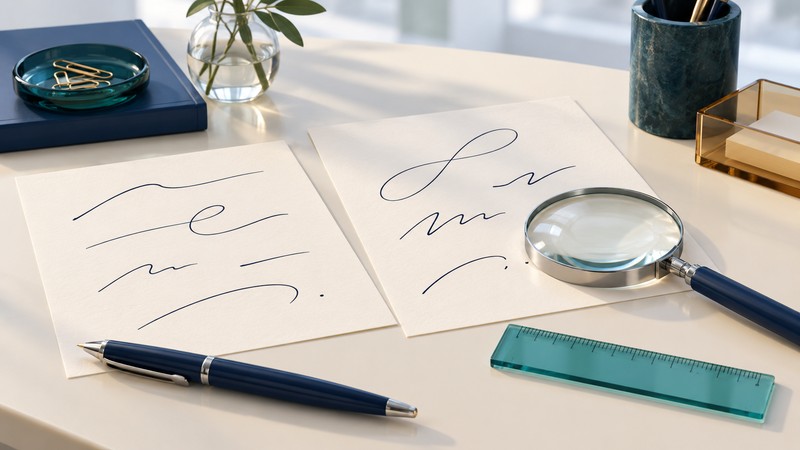
A useful handwriting analysis starts with what is visible: letter shapes, spacing, alignment and how easily a reader can follow the words. Those observations can help you compare samples or improve legibility. Inferring honesty, ambition or intelligence from a stroke requires a different kind of evidence.
This guide offers a free observation exercise you can do with your own writing. It also explains how to assess a personality report and how forensic document examination differs from graphology.
Choose the question before choosing the method
“Handwriting analysis” can refer to several activities. Establish the purpose first so that the answer is useful for the decision you actually face.
On a narrow screen, swipe the table sideways, or focus it and use the arrow keys.
| Task | Useful question | Appropriate limit |
|---|---|---|
| Legibility and visual observation | Which words are hard to read, and which features vary between samples? | Describe the marks and the writing conditions. |
| Forensic handwriting examination | How do questioned and known writings compare when assessing possible authorship? | Requires suitable material, expertise, an examination process and explicit uncertainty. |
| Graphology | Can handwriting features reveal personality or predict behavior? | Require independent validation of each claimed inference before relying on it. |
NIST's work on forensic handwriting examination addresses comparison, reporting, human factors and the risk of error. Its recommendations concern forensic practice. They do not validate personality interpretations or turn an informal comparison into an expert opinion.
What evidence would support a personality claim?
A method needs to produce reasonably consistent judgments and measure the characteristic it claims to measure. Agreement between two readers is reliability; correspondence with a suitable independent measure concerns validity. A compelling story about one writer establishes neither.
In two studies published in 2009, Carla Dazzi and Luigi Pedrabissi compared graphological evaluations with personality measures. The first involved 101 university students and the second 102. The results failed to validate the graphological method as a personality measure; agreement between graphologists was also very low in the first study. The authors' university repository record provides the abstract and publication details. These findings give readers a concrete reason to question confident trait claims.
For an important decision, ask for evidence from people and tasks comparable to yours. A report about a large signature should identify how its prediction of confidence was tested, what counted as a correct prediction and how often it was wrong. Testimonials and a long list of famous writers leave those questions unanswered.
Keep employment, educational and relationship decisions grounded in relevant behavior and appropriate assessment. Treat a handwriting-based personality narrative as an unverified interpretation. Changing a pen stroke is not an established treatment or a demonstrated way to change character.
Make a descriptive record of your own writing
You need paper, a pen and a short passage you are comfortable sharing with yourself or a willing reader. Use an everyday sentence rather than a signature, account information or another person's private correspondence.
- State the goal. For example: “Make my meeting notes easier to read a week later.” This gives you a practical criterion.
- Write a sample and record the conditions. Note the date, pen, paper, writing position and whether you were copying or composing. Use a comfortable pace.
- Describe visible features. Mark crowded word boundaries, letters that look alike, changing line alignment or places a reader hesitates. Keep observations tied to particular words.
- Ask for a reading check, if useful. A willing reader can circle uncertain words without guessing what they reveal about you. Keep the original so you can compare later.
- Change one practical feature. Try more space between words or a different pen. Write a fresh sample under similar conditions and check whether the intended reader finds it clearer.
Download the handwriting observation sheet (plain text). Open it in a text editor or copy the fields into your notes. It has no personality score and uploads nothing.
A photograph adds uncertainty: lighting, image compression and camera angle can change apparent darkness or shape. Describe a mark as darker in the image rather than treating it as a direct measurement of writing pressure. If writing has become painful or unexpectedly difficult, discuss the functional change with an appropriate healthcare professional; a personality report cannot assess its cause.
Worked example: turn an impression into a useful question
Record both improvements and remaining problems. If a new pen makes the line smoother but the ambiguous words remain, the next adjustment may concern letter formation or spacing. Choose the next step from the observation, not from a personality label.
Before trusting an online or AI-generated report
- Separate the visible observation from the claimed trait. “Letters lean right” and “the writer is outgoing” are different statements.
- Look for independent tests, defined outcomes, error rates and limitations. Professional-looking language is not a validation study.
- Check whether the report learned facts from the written content or details you supplied. That can make an interpretation seem more handwriting-specific than it is.
- Protect names, signatures and private correspondence. Obtain permission before sharing someone else's sample, and read the service's storage and reuse terms.
- Choose a method suited to the task. For readability, test readability. For a disputed document, seek qualified document-examination advice. For a personal concern, use the relevant professional route.
For more help following evidence, use the guide to APA research and reference resources. The psychology and AI guide explains why validation and human oversight also matter when a report is generated by software.
Sources and related reading
Sources are linked beside the relevant explanations. Information and resource routes checked October 7, 2026. Worked scenarios are illustrative.