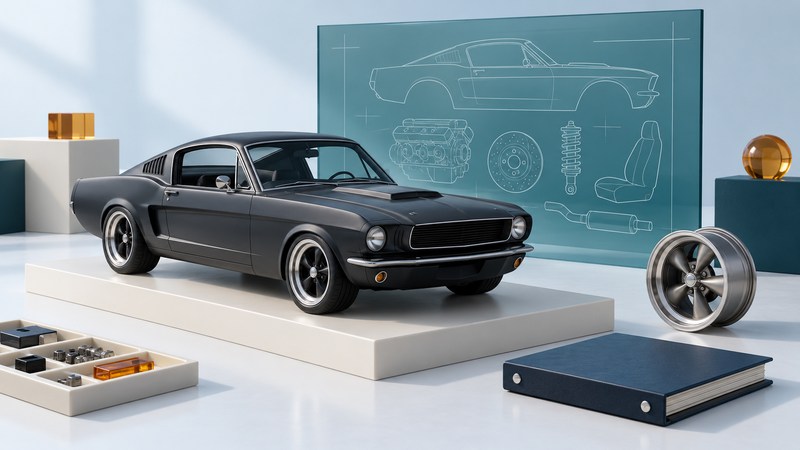
Fastforward Fastback is a specific custom Mustang project, not a factory trim or a ready-made restoration recipe. Its useful lesson is how a recognizable classic body becomes a coordinated build with a documented identity. Start with the builder’s account, keep uncertain chronology visible and separate inspiration from a parts list you could safely reproduce.
What the builder actually records
The Rad Rides by Troy project archive identifies a 1967 Mustang Fastback built for eBay Motors. It lists a modified 351 crate engine with a supercharger and power cooler, a Bowler 4R70W four-speed automatic, and two charcoal-silver paint colors. The archive also provides photographs of the completed car. These establish a documented project configuration; they do not establish the condition or components of a different Mustang advertised under a similar description.
Read a build credit as a source with a scope. It can identify the builder and selected specifications while leaving out fabrication dimensions, calibration files, component revisions or the sequence of later changes. Those omissions matter if you are evaluating provenance or planning work of your own.
Keep the date discrepancy visible
Yenra’s original announcement is dated November 2, 2003 and described a forthcoming SEMA debut. The builder’s current page lists “Year Built: 2004.” Those records do not by themselves explain the difference. A show announcement date, completion date and later archive label can describe different events, but assigning that explanation here would be an inference without supporting records.
The earlier article also announced a future charity auction. The builder page reviewed for this guide does not document the auction result, sale price or current owner. This retrospective therefore does not supply those outcomes. A planned event should remain a planned event until a dated result can be identified.
Read photographs alongside the specification
Use the builder’s gallery to examine the overall silhouette, wheel placement, exterior detailing and cabin treatment. Caption observations precisely: “visible in the builder’s gallery” is different from “specified by the builder” or “measured on the car.” A photograph can reveal a design choice without proving its materials, dimensions or road behavior.
Scroll horizontally on a narrow screen. Keyboard users can focus the table region and use the arrow keys.
| Evidence | Useful for | Insufficient on its own for |
|---|---|---|
| Builder specification | Named components and credited work | Every revision, part number or installation detail. |
| Dated build photographs | Visible fabrication and design stages | Hidden interfaces, structural adequacy or certification. |
| Invoices and provenance records | Who supplied or performed documented work | The present condition of the installation. |
| Inspection and test records | Defined checks of a particular configuration | Universal claims about all similar builds. |
Translate inspiration into a bounded project brief
For your own restomod, first write the intended use: a road cruiser, a show-focused build or another clearly defined purpose. Then document the starting car’s identity, structure, condition and registration context. Ask a qualified builder which work is necessary to make the proposed components function together and what approvals apply where the car will be used.
Create a component record with a job for each part, its exact identity, physical and electrical interfaces, supporting work and evidence of fit. For a transmission change, for example, “fits a Mustang” is not the whole specification: mounting, driveline, controls, cooling and the intended engine combination need consideration. These are questions for a complete design review, not installation instructions.
Preserve the completed build’s identity
Keep the approved plan, changes, dated photographs, invoices, wiring information where supplied, calibration records and test results together. When a part changes, record which earlier document it supersedes. A future owner should be able to distinguish the original custom build from later repairs or modifications.
Fastforward’s value as a case study lies in connecting a named builder, a particular car and documented design choices. Use that discipline for your project while resisting the temptation to infer an entire engineered assembly from a short specification sheet.
Save a working record
Download the working record (plain text). Open it in a text editor and save a private copy. Fill in the prompts, write “unknown” where evidence is missing, and attach the documents behind each conclusion. It includes this article’s address and source links.