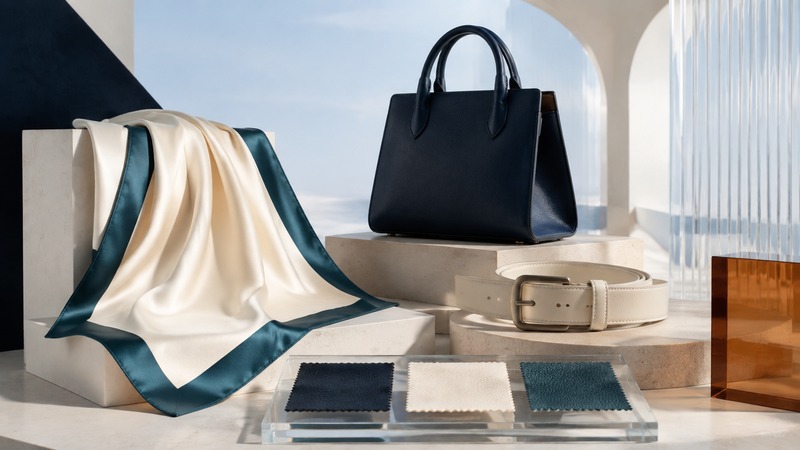
French fashion accessories can be interesting for their design, materials, and finishing without requiring a claim that one national style suits everyone. A scarf, bag, or belt becomes useful when its shape and care needs fit the way you dress.
Read “French” carefully. It may describe a brand’s identity, a design studio, manufacturing origin, or simply a seller’s styling language. Those are different statements, and none by itself establishes the quality or suitability of the particular item.
Separate a French brand from a French-made item
Look for product-level information about manufacturing origin rather than inferring it from a Paris address, brand history, or collection name. A brand can offer products with different origins. Even an origin statement is not a complete map of where every fiber, hide, component, and production step came from.
French customs explains origin marking under the applicable non-preferential origin rules. Its guidance distinguishes origin from trademarks and private labels, and notes that destination countries can use different rules. This is why a brand name, an origin mark, and a certification should be read separately.
As a documented example, Hermès’ Le Pommier Sellier scarf page separately identifies silk twill, hand-rolled edges, and manufacture in France. These are specific claims about that item. They are more informative than a general description such as “Parisian quality,” but they do not tell you whether you will like its weight, colors, or dimensions.
Translate vocabulary into a buying question
On a small screen, scroll the table sideways to read all columns.
| Term | What it describes | Useful follow-up |
|---|---|---|
| Carré | A square scarf; check the stated dimensions. | Can you fold or tie it the way you intend? |
| Soie / silk | A fiber, which may appear alone or in a blend. | What is the full fiber composition and care instruction? |
| Twill | A weave, rather than a fiber name. | What fiber is used, and how does the fabric drape? |
| Maroquinerie | Leather goods as a product category. | What are the main material, lining, and trim on this item? |
| Cuir / leather | A material description that still needs detail. | Which leather and finish, and what care does the maker specify? |
| Toile / canvas | A fabric description that does not establish one fiber. | Is it cotton, polyamide, another fiber, or a coated combination? |
For example, Longchamp’s Le Pliage Original S product information specifies recycled polyamide canvas with an inside coating. “Canvas” should therefore not automatically be read as cotton. Read the trim and care sections as well: a mixed-material bag is not maintained solely according to its largest panel.
A recycled-content statement is also narrower than a claim that an entire product has little environmental impact. The FTC’s Green Guides summary explains the need for specific, qualified environmental claims. Ask which component and percentage a statement covers, rather than turning one material attribute into an overall ranking.
Inspect the actual accessory
For a scarf, examine the edge finish, visible pulls, print placement, and how the fabric feels against the clothing you will wear with it. A hand-finished edge is a construction detail, not a guarantee of condition. On a secondhand item, look for stains and past repairs as well as the appealing overall photograph.
For a bag, check handle attachments, seams, corners, closure, lining, and access with your own contents. For a belt, verify width through the intended trouser loops and how the maker measures its length. A length to a fastening hole is not necessarily the total end-to-end length. Ask about buckle replacement and size adjustments rather than assuming both are available.
Photographs can help you notice a question, but a convincing label or neat stitching cannot conclusively authenticate an item. Keep seller identity, return terms, condition disclosures, and any authentication service’s scope distinct. An AI image assessment may point out visible features; it cannot reliably certify origin, authenticity, or hidden condition.
Try combinations with what you own
Choose a role for the accessory. A scarf can add color near the face or change the balance of a plain outer layer. A small structured bag can be appealing but unsuitable for a day that requires a bottle and notebook. Start with the job, then test the proportions in a mirror with an actual outfit.
Invented styling example: someone already owns navy trousers, an ivory shirt, and a teal cardigan. An ivory-and-teal scarf repeats familiar colors without requiring new shoes or a new bag. The same person may prefer a plain belt if a patterned scarf already provides the detail they want. This is an optional combination, not a formula for “dressing French.”
Try a knot or fold while checking comfort and the item’s care instructions. Remove accessories that can catch before using machinery or doing activities where loose fabric is unsuitable. Avoid stretching a scarf or treating decorative fabric as a load-bearing bag strap.
Plan care before a spill happens
Use the instructions for the exact material and finish. Hermès’ scarf example recommends protecting it from water and chemicals, storing it flat and untied, and using a professional dry cleaner when needed. That advice belongs to the specified scarf; it is not a universal washing rule for every silk blend.
Hermès’ leather-care guidance discusses moisture, heat, color transfer, storage, and professional attention. It also cautions against unsuitable treatments. Do not assume a household cleaner, conditioner, or waterproofing spray is appropriate because it worked on another leather item.
For repair, send clear photographs and ask what can be done, the likely appearance afterward, cost, shipping arrangements, and whether an assessment is required. A replaceable part is useful only if a service can actually obtain and fit it. Keep the product reference and care information with the receipt.
Download the accessory materials and care record (CSV) to keep those details together. Recording what is known, what is a seller’s claim, and what remains unconfirmed makes a later purchase or repair decision easier.
Related resources
- Compare handbag capacity, construction, and care
- Evaluate designer shoes beyond the label
- Build outfits from clothes already in use
- Explore all fashion resources
Researched and updated September 6, 2026. Sources are linked beside the relevant information. Brand examples illustrate specific features or care instructions; they are not product rankings.