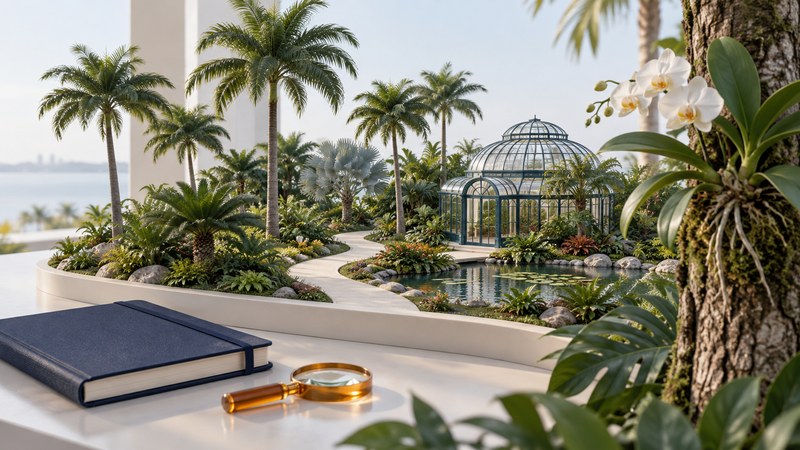
Fairchild Tropical Botanic Garden is a place to look closely at tropical plants and the work involved in conserving them. Plan a visit around a few questions: how do these plants grow, where do they come from, and what helps their populations persist? A focused visit can connect the pleasure of a garden walk with the science behind the collections.
Plan the practical details first
The garden is at 10901 Old Cutler Road, Miami, Florida. Check the official hours and admission page for your intended date, including holiday arrangements and any separately ticketed event. Use the current garden map to choose priorities before arriving.
Fairchild suggests allowing at least three hours for a broad visit. Its visitor and accessibility information describes wheelchair loans, accessible trams, assistive listening equipment and an assistance shuttle. Wheelchairs are first come, first served; ask about the day's tram and shuttle arrangements on arrival. If a particular accommodation determines whether the visit will work, contact the garden beforehand.
Bring water, dress for outdoor conditions and allow for sun, insects and rest stops. Give yourself permission to shorten the route. A visit with two well-observed stops can be more satisfying than rushing to see every collection. Check current notices again before leaving home, especially after severe weather.
Choose what you want to notice
Use this as an observation menu. Locate the relevant collection on the current map and ask staff which areas are accessible and interesting that day. Flowering, exhibit operations and tour schedules vary.
Plant architecture
Compare the leaf arrangement, trunk and overall silhouette of several palms and cycads. Read each label before deciding that two similar-looking plants are closely related. Draw one outline and record the name beside it.
Plants and animals together
Fairchild's visitor page highlights the Wings of the Tropics butterfly and hummingbird exhibit. Ask about access, then observe where an animal rests or feeds. Record what you actually see; use the exhibit's interpretation to understand the relationship.
Living collections
A label gives you a starting point for a plant's identity. Compare its scientific name, family and origin with the visible plant. Ask a guide how the collection's records help staff care for and conserve it.
Landscape choices
Notice how paths, shade and open views shape your walk. Sketch one arrangement you like, then write down the conditions that would need checking before adapting it to your own garden.
The garden's collections account connects plant holdings with research, propagation, reintroduction and monitoring. That gives the visit a second layer: a specimen can be beautiful on display while also contributing to a longer conservation effort.
Follow an orchid from propagation to the landscape
The Million Orchid Project brings native orchids back into South Florida's urban landscapes. Fairchild describes a process involving laboratory germination, seedling care and planting, supported by scientists, students and volunteers. Many of the region's native orchids grow on trees as epiphytes.
Think of conservation as a sequence of questions: can a plant be propagated, can it establish at the chosen site, and what happens to it afterward? A count of planted seedlings answers a different question from a record of surviving, flowering plants. When reading project updates, look for the species, planting location, observation period and measure of success.
During a visit, ask where you can learn about the project. Public access to a laboratory or a particular activity should be confirmed with staff. For growing a purchased orchid at home, use the orchid group and care guide to connect its name and growth habit with appropriate care.
See how an observation becomes research
Fairchild's Growing Beyond Earth program involves middle and high school students in classroom plant experiments supporting NASA's crop research. Its growing habitats are modeled on the space station's Veggie system; the work contributes to early crop screening. Classroom measurements take place on Earth, so interpreting them means keeping the test conditions in view.
That is a useful habit for any gardener: record the growing conditions before comparing results. A vigorous plant in one setting suggests a question to investigate in another. It becomes more informative when the variety, light, watering and observation period are recorded.
Educators can use the program's official resources to investigate participation requirements. Visitors interested in the people behind collections can also explore public-garden careers and entry routes.
A flexible three-hour visit
Bring home one useful observation
Use a phone note or small notebook to record five things:
- Identity: the scientific name from the label and the collection or location.
- Observation: a visible feature, such as leaf arrangement or a flower visitor.
- Conditions: the date, weather and setting you could actually observe.
- Question: something to verify with a guide or a reliable plant reference.
- Next step: one idea to investigate at home, with your climate and space in mind.
Photograph the label and plant together when permitted, and leave plant material in the garden. If a planting arrangement inspires you, the garden-design guide helps translate the idea into a plan based on your own site.