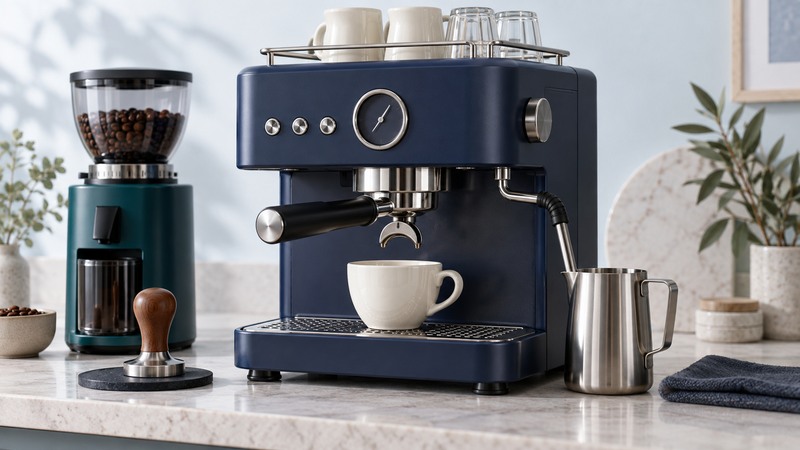
Choose a home espresso machine around the drinks you want and the work you want to do. Someone making one straight espresso has different priorities from a household making four milk drinks in succession. Count preparation, recovery between drinks and cleanup alongside the machine itself.
Decide which work you want to control
On a narrow screen, scroll the table sideways. Keyboard users can focus the table region and use the arrow keys.
| System | Your involvement | What to verify |
|---|---|---|
| Portafilter machine | Grind, dose, distribute, tamp and start or stop the shot; milk workflow varies | Basket type, grinder adjustment, warm-up and back-to-back drink routine. |
| Automatic bean-to-cup machine | Fill beans and water, select drinks, empty waste and maintain brew/milk paths | Available adjustments, cleaning frequency and access to service. |
| Capsule espresso machine | Insert compatible capsule and select a serving; add separate milk work if needed | Exact capsule family, drink sizes, recurring cost and disposal options. |
Controls vary within each group. A volumetric stop can automate shot ending while leaving all puck preparation to you. Automatic milk steaming can reduce one task while still requiring prompt cleaning. Read the manual's full drink sequence to understand what a button actually replaces.
Budget for the basket and grinder together
A single-wall basket relies heavily on the prepared coffee bed to resist water flow. A pressurized or dual-wall basket adds another restriction and can accommodate a different preparation approach. Match the basket to the manufacturer's intended coffee and dose.
For a concrete model example, the US Bambino Plus manual distinguishes single-wall baskets for freshly ground coffee from dual-wall baskets that can also be used with pre-ground coffee. That guidance applies to the baskets described in that manual; check what is supplied with the regional machine you are considering.
For a single-wall workflow, reserve money for an espresso-capable grinder and a scale that fits the tray. A large advertised pump-pressure number tells you little about whether your grinder can make a useful small adjustment. The grinder guide explains what to compare.
Make the first recipe repeatable
- Complete the machine's initial setup and warming procedure. Choose a basket and dose within its specified capacity.
- Weigh the dry coffee, prepare it evenly and use the manufacturer's fitting and brewing procedure.
- Measure the drink mass in the cup and elapsed time. Record whether time starts at pump activation or first drops.
- Taste the shot after it cools enough to assess. Keep notes specific: thin, sour, bitter, drying, balanced or pleasant.
- Change one variable on the next shot. With dose and target yield fixed, a grind adjustment gives a more interpretable comparison.
Baratza's dialing-in explanation connects grind, dose and yield. A very fast or slow shot gives you something to investigate, while uneven flow also calls for a check of puck preparation. Repeatedly changing dose, grind and yield together makes learning harder.
Time the whole milk-drink sequence
Write out a realistic order for your household: prepare the first shot, steam its milk, serve it, then repeat. Ask whether the machine can brew and steam together, requires a transition, or has an automatic milk system. Test the total sequence when possible, including recovery and the cleanup between drinks.
Check pitcher clearance, cup height and the reach to the controls. Follow the manual for steam-wand operation and milk-path cleaning; hot steam and retained pressure make improvised procedures inappropriate. The Bambino Plus cleaning-cycle tutorial illustrates why maintenance instructions need an exact model match.
Plan for ongoing ownership
Before buying, find the water-quality guidance, descaling procedure, routine cleaning products and service route. Descaling mineral deposits and removing coffee oils are different jobs, with model-specific procedures. Add their time and supplies to your comparison.
Save a recipe in the brewing log, including dose, drink mass, time and basket. A setup earns its place when you can make the drinks you want repeatedly and comfortably maintain it.