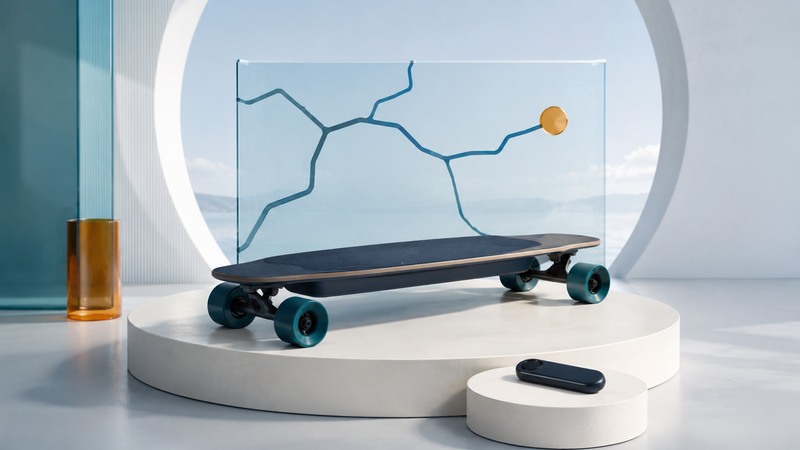
Choose an electric skateboard by checking whether its documented braking behavior, usable range, carrying weight, and support fit your route. A top-speed figure answers only one small part of that decision. Start with the exact board, remote, battery, and manual revision you would receive.
This guide replaces Yenra’s 2017 EPIKGO launch coverage with a comparison method for prospective owners. Old advertised prices, hill-climbing claims, and range figures should be treated as period advertising. Current candidates need current evidence.
Write the route before comparing the boards
Record the whole round trip, the longest descent, surface changes, crossings, and places where you would have to carry the board. Include a practical way home if weather, a warning, or a mechanical problem ends the ride. Carrying a board upstairs or onto transit can matter more often than its maximum speed.
Check the rules for each road, path, campus, park, and transit system involved. Vehicle definitions matter: California Vehicle Code §313.5, for example, defines an electrically motorized board using dimensions, single-person design, average propulsion power below 1,000 watts, and a powered maximum speed of no more than 20 mph on paved level ground. That California definition is only the starting point; operating and local access rules require separate checks. A seller calling a product a skateboard does not settle its classification.
Swipe the table sideways, or focus it and use the arrow keys.
| Requirement | Record for your route | Evidence from the maker |
|---|---|---|
| Access | Road, trail, campus and transit segments | Dimensions, power and speed definitions needed for the local rules |
| Control | Descents, crossings and stopping areas | Braking, warning and fault instructions for this board and remote |
| Distance | Round trip plus plausible detour | Test conditions behind the advertised range |
| Weather and carrying | Surface conditions, storage and stairs | Use restrictions, dimensions and actual carry weight |
| Support | Repair location and backup transport | Compatible battery, charger, remote and consumables |
Fill every row for each candidate. Put “unknown” beside an unanswered question and ask the manufacturer for a model-specific written answer. Treat route access and documented control behavior as requirements to resolve before purchase.
Understand the complete control system
Ask what the board does when the remote loses connection, its battery is low, the board battery is depleted, or the controller reports a fault. Find the prescribed response to each warning in the exact manual. “Regenerative braking” describes energy recovery during braking; the phrase alone does not establish stopping distance or fault behavior.
As a specific manufacturer example, Backfire USA’s FAQ warns against descending with a full or nearly full battery because regenerative braking can cause overvoltage; it describes possible protective shutdown if warnings are ignored. Apply the instructions for the actual model and revision. Do not deliberately provoke a connection loss, shutdown, or overvoltage condition to test a board.
Read the manufacturer’s model manuals before a supervised demonstration or first ride. Arrange appropriate training and protective equipment, then practice the specified controls in a permitted, suitable area within your ability. A successful low-speed demonstration is evidence that you can operate those controls under those conditions; it supplies no assurance about a steep public-road descent.
Compare the conditions behind the range number
Record rider and carried load, wheel setup, route profile, temperature, riding mode, and speed. Backfire’s FAQ describes its usual advertised-range basis as a 165-pound rider on flat ground, mostly using Eco mode with some Sport mode and limited acceleration and braking. That is a named manufacturer’s test basis, not a universal electric-skateboard standard.
Battery watt-hours describe stored electrical energy on a stated basis. They help compare pack size, while efficiency and usable energy still determine travel distance. Keep amp-hour figures paired with voltage; comparing amp-hours alone can mislead when pack voltages differ.
Buy the support path along with the board
Ask for the approved replacement battery and charger part numbers, compatible remote, wheel and drive-system consumables, warranty terms for your seller and country, and the process for repair. For a used board, request serial-number photographs, damage and water-exposure history, original charger identification, and service receipts. Price a supported repair before accepting an uncertain battery.
The U.S. CPSC’s charging guidance explains that a connector fitting the socket does not establish charger compatibility. Use the supplied charger or a replacement tested and approved for the device, remain present while charging, avoid charging while asleep, and disconnect when the charge cycle finishes. Follow the maker’s storage instructions.
Check the model and battery against CPSC recalls and product warnings and the manufacturer’s notices, recording the date and any required action. Follow any applicable stop-use instruction. A search result covers published notices; it cannot certify the condition of an individual board.
Download the editable board and route comparison. Use one copy per candidate, preserve source links and dates, and close the outstanding questions before deciding.
Researched and updated September 7, 2026. Recheck applicable model documentation, support resources, and local or event rules before acting.