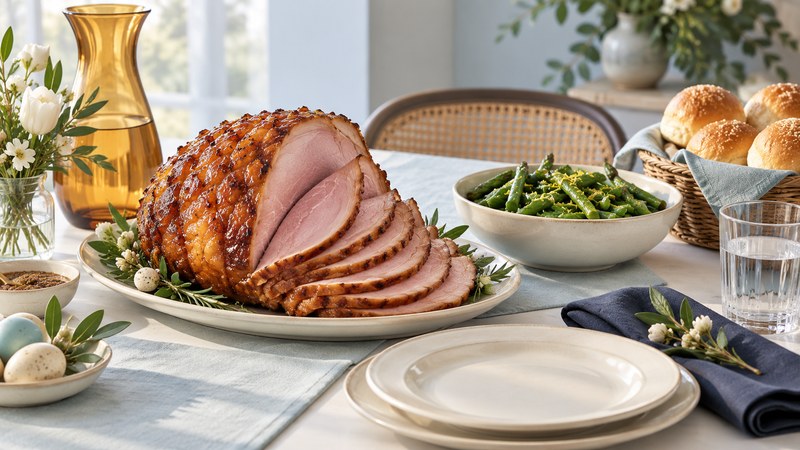
A purchased honey-baked ham can simplify a holiday meal when you plan the portions, side dishes, and serving time together. First identify the exact product and whether it is fully cooked. Then build the meal around its instructions and the kitchen space you have.
Identify the product before planning heat or storage
The Honey Baked Ham Company's preparation and serving instructions describe its signature hams as fully cooked and ready to eat. It recommends serving them without heating the whole ham, which can dry the slices. If warming is desired, its guidance favors individual portions. Keep the package directions for the exact item you buy.
“Honey-baked” can also describe another maker's glazed ham. Check the label for the product type, bone-in or boneless cut, weight, storage directions, and whether it says fully cooked or cook before eating. This guide is for organizing a meal around a purchased fully cooked ham. A raw or cook-before-eating ham needs its own complete cooking method.
Before collecting or receiving the order, clear refrigerator space and have a way to keep it cold on the trip home. If it arrives frozen, allow refrigerator thawing time according to the product instructions. HoneyBaked currently suggests two to three days for its bone-in ham and one to two days for its boneless ham; check the current directions for your size and product. Never thaw it on the counter.
Estimate portions, then check the seller's serving range
Count the guests who will eat ham, whether another main dish is available, and how many extra portions you genuinely want. The USDA's ham buying guide gives a starting estimate of ¼–⅓ pound per serving for boneless ham and ⅓–½ pound per serving for bone-in ham. Treat these as planning ranges and check the seller's guidance for the exact cut.
Ask the seller what its quoted serving count assumes. A buffet with small tastes, a plated dinner, and a meal intended to provide several days of leftovers have different needs. Include tax, delivery or collection costs, and sides when comparing complete meal options.
Work backward from the serving time
- Several days ahead: confirm the guest count and dietary needs, identify the exact ham, arrange collection or delivery, and plan thawing if needed. Record the package's use-by and storage instructions.
- The day before: check refrigerator space, serving dishes, utensils, and containers for leftovers. Prepare only those components whose recipes support advance preparation.
- Before cooking sides: write down each recipe's start time, oven temperature, and finish time. Put the longest task first and include time for setting out the meal.
- Near serving: finish the sides and set out a modest platter of ham, keeping the rest refrigerated. Record when each perishable dish leaves temperature control.
- After the meal: divide and refrigerate leftovers promptly, label them, and decide what will be eaten soon or frozen.
For example, if dinner is at 1 p.m. and your chosen side needs 45 minutes in the oven plus 15 minutes of preparation, its work begins by noon, with any preheating time allowed separately. The ham's ready-to-eat status lets you schedule the oven around that side. Check the actual recipe rather than treating this example as its cooking time.
Keep serving and leftover decisions clear
Serving a fully cooked spiral ham cold is an option supported by USDA. If you choose to reheat it, use a food thermometer and the appropriate instructions: USDA distinguishes ham packaged in an inspected processing plant, reheated to 140°F, from leftovers or ham repackaged outside the plant, reheated to 165°F. Confirm which category applies; appearance alone cannot establish it.
USDA's spring holiday guidance calls for cold food at 40°F or below and hot food at 140°F or above. Refrigerate perishable food within two hours outside temperature control. Keep replenishment portions cold instead of leaving the entire supply on the table.
When the surroundings exceed 90°F, the outside-temperature-control limit is one hour. Discard food that exceeds the applicable limit. Divide leftovers into shallow containers and refrigerate promptly. USDA's general leftover guidance gives three to four refrigerated days and a reheating temperature of 165°F. Keep any earlier product deadline in force; serving or reheating does not restart its storage life.
Plan a use for each leftover portion—such as sandwiches or a cooked dish—or freeze it promptly within its safe storage period. Record the contents and date so a future meal begins with usable information.
For a family activity alongside the meal, see Easter Egg Dye. Return to Holidays for other traditions and planning guides.