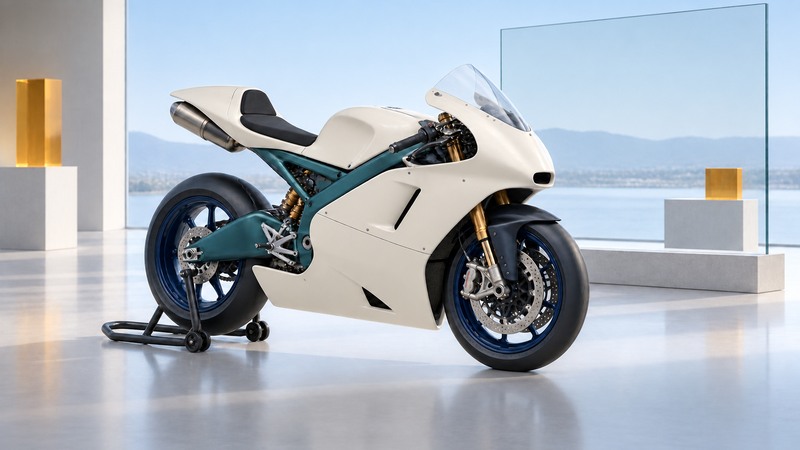
Ducati’s early Desmosedici project is a useful case study in how racing ideas become working machines. Read the 2002 engine announcement as a set of design choices and proposed tests, then compare it with the GP03’s documented 2003 season. This separates engineering intent, installed hardware and results on track.
A design choice with alternatives still to test
In its February 4, 2002 announcement, preserved by Mototribu, Ducati described a 989 cc, four-cylinder Desmosedici engine and plans for its 2003 MotoGP entry. The release discussed the power demands of the new rules and the choice of four round pistons over the alternatives it had considered.
The proposed Twinpulse arrangement grouped combustion events in pairs. Ducati also planned to test a traditional firing arrangement, with track testing and rider feedback informing the racing choice. Its technical sheet explicitly labeled its maximum power and torque figures as expected.
This is an unusually helpful source because it exposes a decision still in progress. Preserve words such as “expected” when taking notes. Record the alternative, the hoped-for benefit and the test that would decide between options. A launch drawing can establish the proposed layout while leaving the final race configuration to later evidence.
Compare the proposal with documented competition
Ducati's GP03 heritage record identifies Filippo Preziosi as the designer and Loris Capirossi and Troy Bayliss as the riders. Capirossi reached the podium at the 2003 season opener at Suzuka and won at Catalunya, the sixth round. Ducati finished second in the Constructors' championship in its first MotoGP season.
The same record describes the liquid-cooled, four-stroke engine with desmodromic timing. It also documents a practical cooling response: perforations around the front number area of Capirossi's fairing for hot conditions. Ducati says the solution was later abandoned and remains visible on the museum motorcycle.
The cooling example shows why the date and physical configuration of a photographed bike matter. A museum exhibit can preserve a particular solution from development. For a specific race or test, look for evidence from that event before treating one photographed component as universal across the season.
Ask what a change helps, and what it costs
Swipe this table sideways, or focus it and use the arrow keys.
| Design topic | Useful question | Evidence to seek |
|---|---|---|
| Combustion timing | What delivery and rider response were engineers trying to obtain? | Dated design statement, configuration and test feedback |
| Cooling | How was heat managed in the relevant conditions? | Cooling arrangement, operating conditions and reliability observations |
| Aerodynamics | What shape, rider posture and test conditions were compared? | Consistent measurement method and full configuration |
| Race performance | How did the complete machine perform over the event? | Results, running status and contextual race reports |
These topics interact. A change that improves one measured behavior must still work with the rest of the motorcycle and with its rider. Assess the complete test question: which configuration changed, what stayed comparable, what was measured, and under which conditions?
NASA's drag-equation explanation shows why shape and test conditions belong beside aerodynamic claims. Drag depends on air density, reference area, drag coefficient and the square of airspeed. The coefficient also needs a stated reference area for a meaningful comparison.
Make a short, traceable history
Organize notes in three columns: a dated proposal, evidence of the configuration used, and an observed result. When a link supplies only one of those, leave the other columns open. Describe a missing test result as an open question, and avoid filling it with an assumption from the finished machine's appearance.
For this project, the February 2002 release supplies the proposed engine choices; the GP03 heritage record supplies selected 2003 hardware and results. Together they support a history of development without turning an early performance target into a measured outcome.
Continue with the gravity-racer explanation for another worked treatment of drag and energy. For a road motorcycle whose model identity and condition drive a buying decision, use the 2010 MV Agusta F4 guide.
Researched and updated September 20, 2026. Use the linked sources for applicable documents and current service, access or event information.
Explore all motorsports guides.