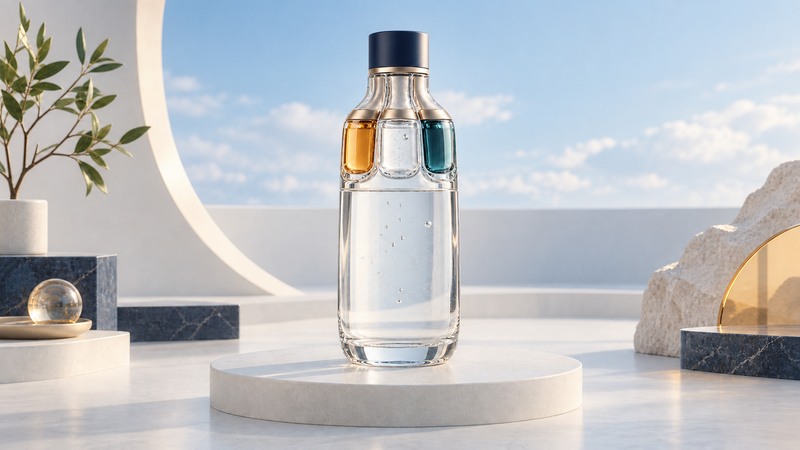
A programmable beverage container lets the user choose which stored additives enter a base drink. In the Ipifini concept, “programming” describes a physical choice among sealed chambers. Understanding the mechanism is straightforward; judging a proposed product also requires evidence about release accuracy, sealing, mixing and the final drink.
Follow the liquid path
The primary reference is patent publication US20120298532A1, published in 2012 and tracing earlier application history to 2006. It describes additive chambers associated with a main beverage container, with user activation allowing selected contents to enter the drink. The document includes several embodiments, so one drawing should be read as an example of a proposed arrangement.
The useful mental sequence is store separately → select → release → mix. Before activation, barriers separate additives from the base liquid. Activation creates a route into the main volume. The selected ingredients then need to disperse sufficiently for the intended use. Container design, formulation and directions all affect that last step.
A patent explains an invention and its claimed arrangements. Commercial availability, production yield, food-contact suitability and measured performance require evidence beyond the patent. Treat an illustration here as conceptual, with the actual engineering to be established by a developer’s documentation and testing.
Count combinations with stated assumptions
Suppose there are three chambers, A, B and C. Each can be released once or left closed, independently of the others. Under those assumptions there are 2 × 2 × 2 = 8 choices, including leaving every chamber closed.
On narrow screens, scroll the table sideways. Keyboard: focus the table and use the arrow keys.
| Number of independent on/off chambers | Choices including no release | Choices with at least one release |
|---|---|---|
| 3 | 8 | 7 |
| 5 | 32 | 31 |
| 20 | 1,048,576 | 1,048,575 |
The general count is 2ⁿ, where n is the number of independent binary choices. Subtract one if the untouched base drink is excluded. This is a mathematical count of selections, not a count of distinct, pleasant or commercially validated flavors.
Several real design choices change the interpretation. Identical ingredients in two chambers may produce the same final composition through different selections. Mutually exclusive choices reduce the allowed set. Chambers that release several measured increments need a different model. A claim of “millions of drinks” is most informative when it states which of these possibilities it is counting.
Keep quantity separate from choice
Hypothetical volume example: a container holds 200 mL of base drink and three chambers each hold 5 mL of additive. Activating one gives a nominal 205 mL; activating all three gives 215 mL, assuming the liquid volumes add as stated. A nutrient amount in the base or a chamber must then be assessed in the final serving.
For example, a purely fictional total of 10 g sugar in 200 mL is 5 g per 100 mL. Adding 15 mL of sugar-free liquid would make it approximately 4.65 g per 100 mL, while the container still holds 10 g total sugar. A concentration change and an amount change are different claims. Actual formulations need measurement because the simple volume assumption may be imperfect.
For ingredients with meaningful dose limits, the developer must consider allowed combinations and foreseeable repeated activation. This guide supplies no home mixing or caffeine-dosing procedure.
Ask for evidence at each stage
On narrow screens, scroll the table sideways. Keyboard: focus the table and use the arrow keys.
| Design question | Evidence a buyer or evaluator should request |
|---|---|
| Do contents remain separated? | Seal integrity and leakage results under the intended storage and transport conditions |
| Does a selection release the intended amount? | Measured delivery distribution, including partial or failed activation |
| Does the drink become sufficiently uniform? | Mixing instructions supported by tests of the final beverage |
| Are all permitted combinations suitable? | Formulation review and applicable food-contact and ingredient documentation |
| Can a user understand the result? | Clear ingredient, quantity and activation information tested with users |
| What happens after use? | Material identification and disposal guidance for the actual assembled package |
Ask how tests cover aged products and realistic handling, not just a fresh demonstration unit. Define acceptance criteria before evaluating samples: what amount, leakage rate or mixing result counts as acceptable for the intended product? The numbers belong to the specific application and its qualified review.
Evaluate the benefit against the added complexity
The design may help where users value a choice at the moment of drinking or where components benefit from remaining separate. Compare that benefit with extra materials, filling steps, instructions and failure modes. A simpler separate sachet or premixed beverage may serve some uses; the choice depends on the actual task and tested performance.
For another example of packaging that changes interaction with a drink, see promotional can tabs. Both subjects become easier to assess when the proposed user action, physical mechanism and supporting evidence are described separately.