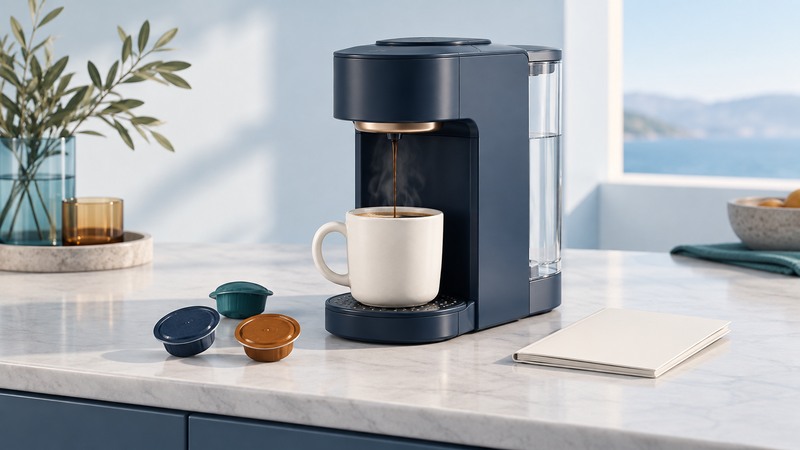
A useful single-serve beverage maker fits the drinks you prepare, the supplies you can obtain and the cleaning you will actually do. Before buying a machine—or putting an older one back into service—identify its exact model and market, find its manual and price the complete drink you intend to make.
Start with the machine and its supplies
Write down the model number from the rating label, along with the manufacturer's support page and the country for which it was sold. Electrical requirements, supported parts and instructions belong to that model. An imported machine's appearance alone cannot establish suitability for your kitchen.
Tassimo's defining example is the T DISC, a beverage disc with a barcode the machine reads to control preparation. Its service disc is a maintenance accessory, separate from drink ingredients. For older owners, a useful starting document is the Bosch TAS20 UC manual; match the actual model before applying its directions. The Tassimo name covers multiple generations and markets.
Before committing to a system, find the exact compatible coffee, tea, chocolate or milk components you want. Check the ingredient panel and preparation sequence for the finished drink. A box containing multiple types of disc may produce fewer complete drinks than its total disc count suggests.
Compare ownership, not just the machine price
On narrow screens, scroll the table sideways. Keyboard: focus the table and use the arrow keys.
| Question | What to record | Why it changes the decision |
|---|---|---|
| Which drinks will I make? | Exact compatible drink packs and ingredients | A broad menu claim may exceed your local supply |
| What fits on the counter? | Footprint, lid clearance and tank-removal space | Refilling can require more room than brewing |
| What does one drink use? | All discs, milk and other additions | Count a complete serving |
| What needs regular care? | Cleaning parts, service disc and approved descaler | Maintenance affects time and running cost |
| Can I keep it supported? | Manual, parts and manufacturer contact | Particularly important for a used machine |
For a fictional cost example, a $9.60 package makes eight complete drinks using sixteen discs. The ingredient cost is $9.60 ÷ 8 = $1.20 per drink. Dividing by sixteen gives the cost per disc, which understates the cost of that two-disc drink. At 30 drinks, those ingredients cost $36. Add your own actual milk, cleaning supplies, electricity and machine cost separately.
The brewer ownership checklist gives you a compact place to record these details. Use current local prices; the example is a calculation method, not a price quote.
Separate everyday cleaning from descaling
Cleaning removes drink residue and keeps removable parts ready for use. Descaling addresses mineral buildup in the water path. One does not replace the other. Tassimo's cleaning guidance distinguishes the service-disc cycle and removable-part care; its descaling page links model-specific instructions.
Use your manual to identify the correct service disc, allowed cleaning method for each part, specified solution, collection-container size and rinse sequence. Follow the appliance's electrical and hot-water precautions. Do not substitute a guessed vinegar recipe, force a brew head open or defeat an interlock. The linked TAS20 manual explicitly excludes vinegar-based descaler; confirm requirements for your own machine.
Keep a record of the date, indicator observed, procedure followed and result. A completed cleaning cycle and a completed descaling cycle are useful separate entries. Buy replacements by the specified part number, including a lost service disc, rather than by color or a seller's photograph alone.
Troubleshoot from the observation
If the machine declines to brew, note the indicator pattern and check the model's troubleshooting section. Record whether the tank is seated, the correct disc is present and the barcode area is clean as instructed. Avoid diagnosing every fault as limescale.
If cup volume changes, first confirm the intended drink and preparation sequence, then follow the manual's checks. If water escapes somewhere unexpected, discontinue use and seek the manufacturer's guidance rather than running repeated cycles near electrical parts. A cracked tank or damaged latch needs an appropriate replacement or service assessment.
When a milk-containing disc or drink is involved, follow that product's handling instructions. A machine's ability to prepare a beverage supplies no storage-life guarantee for the ingredients or finished cup.
Decide whether the system fits
Make a sample drink if possible, measure the counter space and confirm a realistic supply route. A machine earns its place through the drinks and routine it supports. For a stovetop alternative with adjustable tea, spice and milk, see measured chai latte.