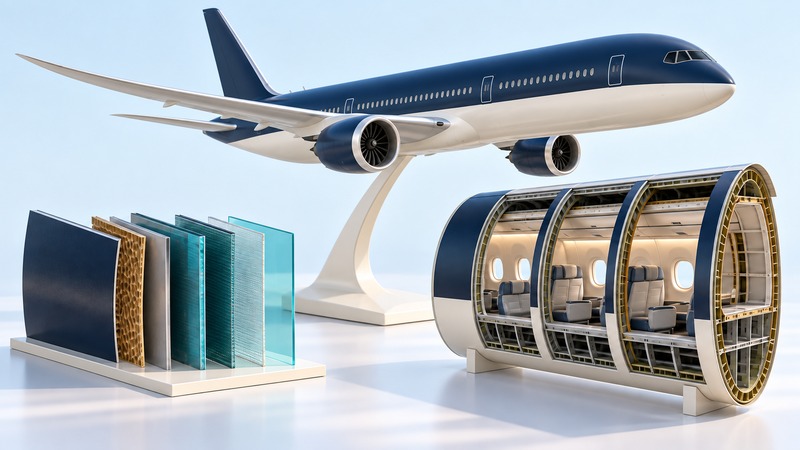
The Boeing 787 Dreamliner is a family of twin-engine widebody aircraft. Its structure, systems and cabin environment explain why it interests airlines and passengers; the particular seat, legroom and service still depend on the airline and configuration. Read the aircraft specification and the airline seat map as two related sources with different jobs.
On a narrow screen, scroll tables sideways. Keyboard users can focus a table and use the arrow keys.
Distinguish the three main variants
Boeing lists the 787-8, 787-9 and 787-10 in its 787 technical overview. Their fuselage lengths increase across the family while the published wingspan is shared. The figures below are manufacturer reference dimensions checked on September 11, 2026.
| Variant | Length | What the label tells a traveler |
|---|---|---|
| 787-8 | 56.7 m | The shortest of these three variants; read the airline map for its cabin mix. |
| 787-9 | 62.8 m | A longer fuselage, with cabin space allocated by the operator. |
| 787-10 | 68.3 m | The longest fuselage of the three; the seat count still depends on configuration. |
Boeing gives a 60.1 m wingspan for all three. Published range and seating figures depend on the specification and assumptions, so a family brochure is a reference for aircraft capabilities rather than a promise about the route or seat you have booked. Check the operating airline for its installed configuration.
What the structure and systems contribute
In its 787 design explanation, Boeing describes an airframe that is about 50 percent composite material by weight, alongside aerodynamic, engine and more-electric-system choices. Carbon-fiber composites are structural materials combining reinforcing fibers with a surrounding matrix. Their use changes how parts can be designed and built.
Fuel comparisons need a stated baseline. A manufacturer's reduction against aircraft typically replaced is a comparison under its stated conditions; it does not tell you the fuel used by your particular journey. Route, payload, weather and seating density affect how an aircraft-level claim relates to a passenger trip.
For readers comparing technology claims, keep three questions together: which aircraft are being compared, what operating assumptions are used, and whether the number is per flight, per seat or per passenger. Two percentages with different denominators can both be accurate while answering different questions.
Understand the cabin features
Boeing describes a cabin pressurized to an equivalent altitude of about 6,000 feet, higher humidity and electronically dimmable windows. Cabin altitude expresses an equivalent atmospheric pressure, not the aircraft's height above the ground. The airplane can be cruising much higher while its pressurization system maintains a different environment inside.
Dimmable windows regulate transmitted light rather than using only a conventional physical shade. Lighting, seat position and crew control can affect the view. These design features are useful context, but an individual's comfort also depends on seat fit, sleep, flight timing and other factors. Avoid reading a cabin feature as a guarantee about how you will feel after a long flight.
The airline decides how to use the cabin
A concrete example is the Qantas 787-9: its published layout totals 236 seats, divided into 42 Business, 28 Premium Economy and 166 Economy seats. That is one airline's configuration of one variant. Another airline can allocate the same aircraft's space differently.
Use the corresponding Qantas map to see cabin boundaries, aisles, toilets and galleys. When comparing your own flights, obtain each airline's matching map and seat specifications.
- Width: check how the airline measures it, especially where consoles or fixed armrests occupy space.
- Pitch: the distance between a point on a seat and the same point on the next row; actual usable legroom also depends on the seat structure.
- Access: inspect how many seats separate you from an aisle and what lies beside your row.
- Equipment: verify power, entertainment and Wi-Fi separately for the aircraft and service.
Make a passenger comparison that survives an aircraft change
The Qantas business-class guide demonstrates a more detailed cabin-selection method. For any airline, let the current booking and official map supply the seat-level facts, and use the manufacturer's material to understand the aircraft itself.