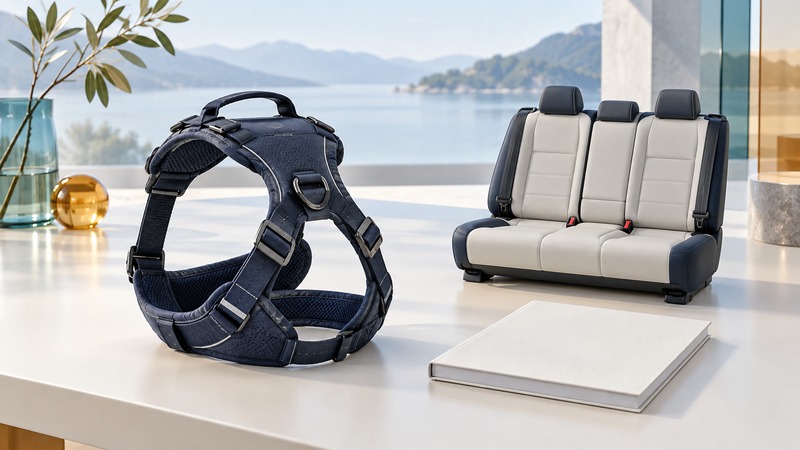
Choose a restraint by checking three things together: evidence for the exact product, a suitable fit for your dog, and a supported installation in your vehicle. A convenient attachment or strong-looking strap gives you too little information to judge crash protection.
Find evidence for the exact model
The Center for Pet Safety certified-product directory is a starting point for independently evaluated harnesses, carriers, and crates. Its certification program is voluntary. Check the specific model, product category, size limits, and current listing; a brand name alone does not establish that every item it sells has the same evidence.
Save the listing and the manufacturer’s current manual before buying. Identify whether a test claim concerns a component, a complete restraint, or the product installed with particular hardware. Ask the manufacturer to resolve any mismatch between the model sold and the model documented. Test performance describes specified conditions and does not guarantee the outcome of every collision.
Compare the complete setup
On a small screen, focus this table and use the arrow keys, or swipe, to read all columns.
| Check | Evidence to collect | What an unresolved answer means |
|---|---|---|
| Exact product | Model, revision, size, independent listing or published test details. | A similar name or older version needs clarification. |
| Dog fit | Current weight and the body measurements requested by that model’s sizing guide. | Choose another supported size or product; avoid guessing between limits. |
| Vehicle installation | Required belt type, seat position, attachment hardware, and restrictions in the manual. | Ask the manufacturer about your exact vehicle and seat configuration. |
| Daily use | A calm fitting trial and a correctly installed setup you can reproduce. | Practice or select a more workable supported option. |
| Service condition | Inspection, replacement, and post-collision instructions. | Obtain the instructions before relying on the product. |
Keep an evidence column for each candidate. “Unknown” is a task to resolve, not a favorable score. A carrier or crate also needs the attachment system specified for that model; its enclosure and its connection to the vehicle work together.
Avoid improvised extensions and anchor points
The Center for Pet Safety’s extension-tether advisory warns that extension tethers can negate crash-protection performance and allow dangerous movement. Do not add a tether or zipline to make a tested installation more convenient. Use the exact configuration supported by the product instructions.
Read the separate cargo-area connection advisory when considering a crate or cargo installation. Luggage tie-downs and other convenient connection points need evidence appropriate to the intended use. Get a documented answer about attachment compatibility instead of inventing a route through nearby hardware.
Barriers and ordinary walking equipment may help manage movement for particular purposes; assess any crash-protection claim against the complete restraint’s evidence. Follow both the restraint and vehicle manuals where they specify compatible seating or attachment arrangements.
Check fit before making a journey
- Measure the dog using the product’s own sizing instructions and confirm the permitted range.
- Read the full installation procedure, including warnings and required accessories. Keep the manual accessible in the car.
- Fit the equipment calmly outside the pressure of a departure. Practice the supported setup in the parked vehicle.
- Inspect adjustment, hardware, and attachment routing against the manual before each trip. Follow its inspection and replacement guidance.
If your dog cannot settle or appears uncomfortable, resolve fit and acclimation before extending the journey. Discuss travel distress with your veterinarian and the equipment’s use with its manufacturer.