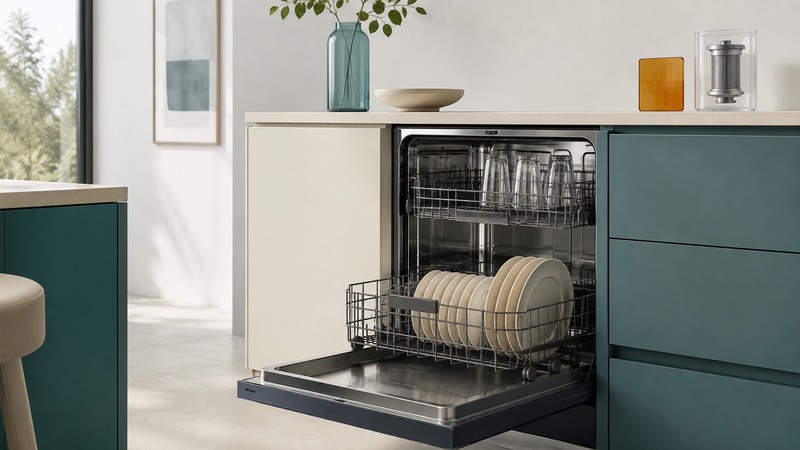
A useful dishwasher fits both the cabinet opening and the way your household cooks. Before replacing one, separate capacity or layout frustrations from problems caused by loading, maintenance, or a cycle that does not suit the dishes.
Updated September 7, 2026. U.S. household guidance; equipment instructions and local requirements vary.
Buy for the kitchen and the real load
Measure the opening and compare the manufacturer’s installation drawing before ordering. Check width, available height above the finished floor, depth, door clearance, service connections, and the path used to bring the appliance into the home. A nominal size alone does not confirm that a machine can be installed or later removed.
Use your awkward items as the capacity test: a dinner plate, tall glass, baking tray, and frequently used pan. Inspect rack adjustment, cutlery placement, and whether an upper rack can move while still leaving useful clearance below. A larger place-setting number may not solve your particular loading problem.
On a narrow screen, scroll this table sideways. Keyboard users can focus the table region and use the arrow keys.
| Decision | What to compare | What to record |
|---|---|---|
| Fit and installation | Manufacturer dimensions and installation requirements. | Opening measurements, floor height, connections, and installation quote. |
| Noise | Published dBA rating and the conditions behind it. | Exact model rating; avoid promising how it will sound in a different room. |
| Efficiency | EnergyGuide label and ENERGY STAR certification. | Comparable model labels and the assumptions behind cost estimates. |
| Drying and care | Drying options, rack design, accessible filters, and manual. | What your dishes need and which recurring tasks the owner must perform. |
ENERGY STAR’s buying guidance recommends comparing the yellow EnergyGuide labels and choosing suitable capacity and cycle options. Label costs are estimates, not a household bill prediction. Do not transfer one model’s water use or features to an entire brand.
Give water a path to every item
Scrape off food and run a full, sensibly spaced load when practical. ENERGY STAR advises scraping instead of routine hand prerinsing. “Full” should still allow spray to reach the dirty surfaces; tightly nested bowls can remain dirty even in an otherwise capable machine.
- Check whether each item is dishwasher-safe and follow any rack restriction on it.
- Place items so their dirty surfaces face the spray and their cavities can drain.
- Separate nested spoons and bowls. Keep tall items clear of the spray arms and detergent dispenser.
- Confirm that the selected cycle matches the soil and material, then let it complete.
Manufacturer rack diagrams take precedence over a universal loading pattern. Whirlpool’s cleaning troubleshooting identifies loading, blocked spray arms, and filter problems as common places to investigate. Use detergent intended for automatic dishwashers, in the amount directed for your model, detergent, and water conditions.
Drying is a separate part of the result
Clean but wet plastics do not necessarily mean the wash failed. Material, orientation, retained puddles, rinse aid, and the drying option all affect the result. Some machines use heated drying; others use different approaches, including models that open the door automatically. Check the exact machine’s manual before changing settings or assuming a feature is present.
Whirlpool’s drying guidance discusses rinse aid, load orientation, plastics, and model-dependent options. If the manual calls for rinse aid, check its level and adjust the setting only as directed. Record one change at a time so you can tell whether it helped.
The Bosch rinse-aid guide also distinguishes water spotting from streaking that may call for a different dispenser setting. More product is not automatically better. Photograph the result on a representative glass rather than changing detergent, cycle, and rinse aid together.
Use symptoms to choose the next check
On a narrow screen, scroll this table sideways. Keyboard users can focus the table region and use the arrow keys.
| Symptom | First owner-level check | What to avoid |
|---|---|---|
| Food remains | Load spacing, spray-arm clearance, cycle, and manual-specified filter care. | Repeatedly increasing detergent without identifying the cause. |
| Wet items or puddles | Item orientation, rinse-aid level, and selected drying option. | Assuming all materials dry alike. |
| Film or spots | Water conditions, detergent instructions, and rinse-aid setting. | Treating every cloudy glass as the same problem. |
| Odor | Trapped food and the cleaning procedure in the owner’s manual. | Mixing cleaners or dismantling components beyond owner maintenance. |
| Leaks, repeated errors, or failure to drain | Record the error and stop repeated trial cycles; follow the manual’s service instructions. | Opening electrical panels or reaching into pump mechanisms. |
Find out whether your machine has a user-cleanable filter. If it does, use its removal, washing, and locking instructions; do not assume every dishwasher has the same assembly. Whirlpool’s basic problem guide links symptoms to possible causes and service options. A symptom table narrows questions; it cannot confirm which component has failed.
Keep a compact service note: model and serial number, symptom, cycle, detergent, recent changes, and the maintenance already completed. If you have changed kitchen plumbing or fitted a new machine, include that timing. This makes a repair conversation more useful than “it never works.”
Sanitizing is not the same as sterilizing
NSF/ANSI 184 certification verifies a residential dishwasher’s sanitizing performance on the designated sanitizing cycle: at least a 99.999 percent reduction of bacteria under the standard’s test conditions. That claim does not apply automatically to every cycle, interrupted run, or object placed inside.
Cleaning removes soil; a certified sanitizing cycle adds a defined performance claim. Neither is a blanket promise to sterilize miscellaneous household items. Follow both the item’s care instructions and the machine’s manual. Do not use the dishwasher as a general cleaner for chemical-contaminated objects, electrical items, or products without compatible care instructions.
If sanitizing matters to your household, verify the exact model’s certification, select the required cycle and options, and check the completion indication described by its manufacturer. A hot-feeling plate is not a substitute for that evidence.