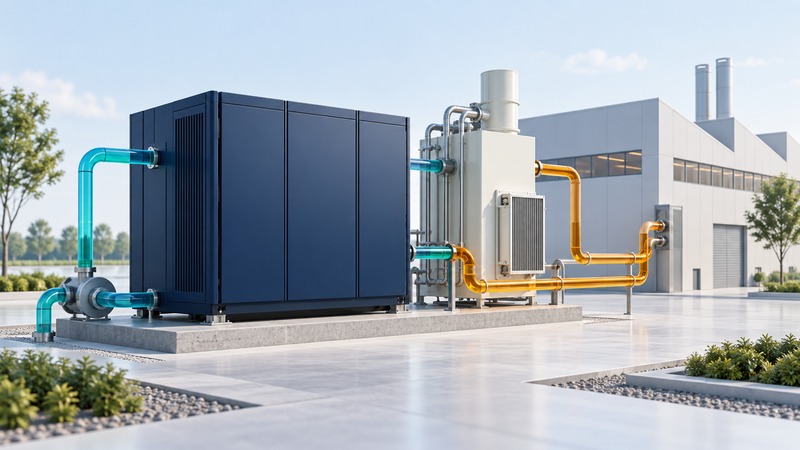
A stationary fuel-cell power plant can supply electricity and recoverable heat from a continuous fuel supply. Its value to a facility depends on the net electricity delivered, the heat that the facility can actually use and the operating obligations of the complete installation.
Prepare an hourly electricity and heat-demand profile before comparing proposals. A headline combined-efficiency percentage is useful only when its fuel basis, measurement boundary and useful-heat assumption are explicit.
Identify the fuel-cell system
FuelCell Energy's 2005 annual filing describes Direct FuelCell as its commercial carbonate fuel-cell technology. In this context, direct refers to reforming a supplied fuel within the high-temperature system. The separate direct-methanol technology used in some portable-power applications has a different chemistry and operating role.
EPA's fuel-cell chapter in the CHP technology catalog explains the differences among carbonate, solid-oxide, phosphoric-acid and polymer-electrolyte systems. High-temperature systems can support internal reforming and useful heat recovery, while startup behavior, fuel treatment and materials durability shape their applications. The catalog's dated product tables are historical context; obtain current model documentation for an actual project.
Ask the supplier to identify the stack chemistry, accepted fuel composition, treatment equipment, auxiliary loads and heat-recovery arrangement. A natural-gas-fueled system still has carbon emissions: evaluate the fuel pathway and complete plant, including supplementary equipment.
Measure useful outputs at the facility boundary
EPA's CHP efficiency method adds net useful electrical energy and net useful thermal energy, then divides by fuel energy input. Put every term in compatible energy units and use one heating-value basis throughout. Higher heating value (HHV) and lower heating value (LHV) account differently for water-vapor heat and produce different numerical efficiencies.
On a narrow screen, scroll the table horizontally. Keyboard users can focus the table and use the arrow keys.
| Item | Specify | Why it changes the comparison |
|---|---|---|
| Electrical output | Net AC output after defined auxiliaries | Stack power can exceed the electricity available to the site |
| Useful heat | Temperature, pressure, flow and coincident demand | Recovered energy only helps when a compatible use exists |
| Fuel input | Quantity, composition and HHV or LHV basis | Different boundaries can make quoted efficiencies incomparable |
| Operating profile | Part-load performance, starts, downtime and degradation | Annual service differs from a single rated operating point |
Test the heat-use assumption
Fictional one-hour energy balance
A proposed plant takes in 1,000 kWh of fuel energy on an HHV basis, delivers 450 kWh of net electricity and offers 300 kWh of recoverable heat. If the facility uses all 300 kWh, total useful-energy efficiency is (450 + 300) ÷ 1,000 = 75%. Electrical efficiency is 450 ÷ 1,000 = 45%.
If only 100 kWh of that heat matches demand, useful-energy efficiency becomes (450 + 100) ÷ 1,000 = 55%. The electrical output is unchanged in this simplified example. The difference is heat utilization, not a change in stack efficiency.
Repeat the calculation over representative operating intervals and sum the annual energies. Keep heat rejected to the environment outside the useful output. A facility with summer heat demand different from winter demand needs that seasonal distinction in its assessment.
Compare the alternative service
The EPA CHP overview describes the comparison with separate electricity and heat supply. Establish the electricity purchases and boiler fuel the project would displace, then account for fuel purchases, maintenance, stack service, backup supply and interconnection. Value exported electricity using the applicable agreement.
For emissions, compare the same annual electrical and thermal services with explicit assumptions about electricity and fuel. Record upstream emissions separately when included. Low emissions of a particular local pollutant and low lifecycle greenhouse-gas emissions answer different questions.
Ask for guaranteed performance conditions, availability definitions, service exclusions and acceptance measurements. If outage support is required, have the design team verify islanding, startup and critical-load continuity explicitly. The fuel-cell backup guide addresses that separate duty. A completed review ends with a demand match, an annual energy balance and a dated list of unresolved supplier commitments.
Fuel-cell CHP comparison worksheet
Download the fuel-cell chp comparison worksheet (plain text). Save a copy and fill it in with your own evidence. Instructions, units, assumptions and the fictional example are included.