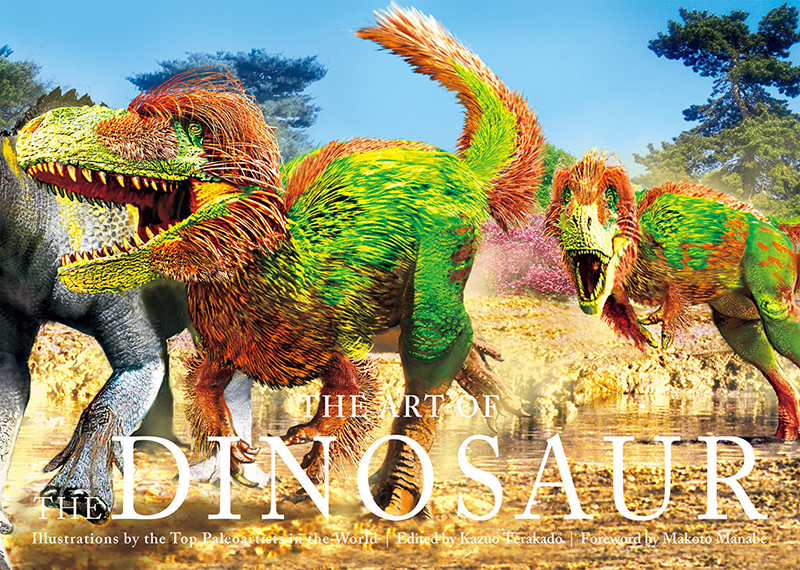
The cover of the 2017 collection reflects Luis V. Rey's exuberant approach to feathered dinosaurs, using intense color and active poses to challenge older images of uniformly gray, sluggish reptiles.
Paleoart is not simply dinosaur painting. It is a form of evidence-based visual reconstruction: artists study fossils, anatomy, living animals, ancient environments, and the interpretations of paleontologists, then make the creative decisions needed to turn incomplete evidence into a believable living world. When the science changes, the image may have to change with it.
Nine artists were brought together in the 2017 collection The Art of the Dinosaur: Illustrations by the Top Paleoartists in the World. The book is now best understood as a snapshot of their work at that moment. Since then, these artists have continued to publish, teach, build museum experiences, illustrate new discoveries, and expand paleoart into books, scientific journals, sculpture, animation, and immersive media.
James Kuether
Natural-history painter, author, and visual storyteller
James Kuether creates both full prehistoric environments and close animal portraits, with a digital style that emphasizes scale, atmosphere, and physical presence. His current online galleries range from single-species studies to a broader “Life on Earth” series, placing dinosaurs inside the longer story of natural history.
Kuether’s recent major project is Dinosaurs for Kids: An Introduction to Dinosaur Paleontology, published in 2024. He wrote and illustrated the guide, which introduces fossils and the Mesozoic before presenting 150 dinosaurs and other prehistoric animals. It extends his role from image-maker to educator: the pictures are not decoration around the science, but one of the ways young readers learn how to imagine from evidence. Explore James Kuether’s galleries or see his 2024 book.
Emily Willoughby
Feathered-dinosaur specialist, writer, and behavioral-genetics researcher
Emily Willoughby is especially associated with feathered theropods drawn as alert, expressive animals rather than movie monsters. Her background in biology and her study of living birds inform the fine structure, posture, display behavior, and color choices in her reconstructions.
Willoughby’s current practice spans paleoart, bird illustration, photography, writing, and research in behavioral genetics and cognitive psychology. Her recent paleoart gallery includes new treatments of Deinonychus, Utahraptor, Vectidromeus, Daurlong, Rahonavis, and Shuvuuia. Her book Drawing and Painting Dinosaurs also makes her working method available to other artists, moving from anatomy and reference gathering through traditional and digital media. Visit Emily Willoughby’s art and recent-work archive.
Luis V. Rey
Colorist, provocateur, and champion of energetic dinosaurs
Luis V. Rey helped push dinosaur imagery away from gray, heavy reptiles and toward brightly colored, feathered, active animals. His mixed-media practice combines acrylic, ink, airbrush, colored pencil, modeling, and digital tools. Even at its most exuberant, the work is rooted in anatomy and in a willingness to test plausible but uncertain ideas.
Rey’s art remained at the center of public dinosaur interpretation in 2024, when he served as artist and exhibition curator for Dinosaur rEvolution at London’s Horniman Museum. The show used his detailed graphics alongside fossils and animatronic models to explore feathers, quills, spikes, color, and the dinosaur-bird connection. Read Luis V. Rey’s paleoart blog or see the museum’s exhibition overview.
Zhao Chuang
Scientific reconstruction artist and co-founder of PNSO
Zhao Chuang works where research illustration, public education, and product design meet. Through PNSO, the scientific-art organization he co-founded, his reconstructions have helped turn paleontological research into images, books, exhibitions, and highly detailed prehistoric-animal models.
His latest high-profile scientific image reached beyond dinosaurs. Zhao created the cover art for the November 13, 2025 issue of Nature, reconstructing the Jurassic mammal relative Polistodon chuannanensis for research on the convergent evolution of mammalian jaw joints. The commission is a concise example of what scientific artists do: translate a new anatomical argument into an animal and environment readers can see. See Zhao Chuang’s 2025 Nature cover.
Davide Bonadonna
Scientific illustrator, sculptor, and builder of three-dimensional evidence
Davide Bonadonna moves between medical illustration, natural history, paleoart, and digital sculpture. Small physical models and three-dimensional studies help him solve anatomy, posture, lighting, and spatial relationships before a final scene is made. That workflow gives his animals the sense of weight and contact that has become a hallmark of his work.
Bonadonna continues to collaborate with museums, theme parks, traveling exhibitions, scientific publications, and magazines including Nature and National Geographic. In November 2025, the University of Pavia’s Kosmos natural-history museum featured him in “Paleoillustrare,” a public program about interpreting extinct life with paleontologists rather than inventing it without evidence. Explore Davide Bonadonna’s portfolio or read about the 2025 museum program.
Sergey Krasovskiy
Ukrainian realist with roots in gouache and watercolor
Sergey Krasovskiy brings the discipline of a traditional art-school education to prehistoric animals. Although he also works digitally, his realism is grounded in drawing, gouache, and watercolor. Theropods remain a particular interest, but the appeal of his images often lies in controlled composition and natural behavior rather than spectacle alone.
Krasovskiy and his family relocated from Donbas to Kharkiv after war made their former home unsafe. He has continued to work as a freelance paleoartist, and a current artist feature for Colouring Heaven presents his dinosaurs as line art while also preserving his reflections on art, materials, and building a paleoart tradition in Ukraine. Read the Sergey Krasovskiy artist feature.
Rodolfo Nogueira
Designer of a repeatable method for reconstructing extinct animals
Brazilian paleoartist Rodolfo Nogueira approaches reconstruction through industrial design. He calls his method “Paleodesign”: a documented process for moving from fossil evidence and comparative anatomy to the proportions, surfaces, and behavior of a finished animal. Through Prehistoric Factory, he applies that process to illustration, sculpture, exhibitions, books, parks, and educational experiences.
Nogueira’s recent public work continues to center Brazil’s prehistoric life and museums. A 2025 visit to the Fernandópolis Paleontology Museum highlighted a career that now includes more than 200 reconstructed species and three Lanzendorf PaleoArt prizes, awarded in 2015, 2018, and 2021. His wider projects have included characters for the Dinos do Brasil virtual-reality exhibition and design work for the Uberaba Geopark. Read the 2025 museum profile or see an overview of his reconstruction projects.
Masato Hattori
Research collaborator working across CG, animation, AR, and VR
Masato Hattori’s reconstruction work is closely tied to new Japanese fossil research. He began shifting from acrylic painting to digital creation in 2005 and now produces still images, moving CG, and increasingly immersive work. His detailed environments can incorporate evidence as small as broken shells as well as the anatomy of the featured animal.
In 2025, Hattori reconstructed a large Late Cretaceous sturgeon and its coastal ecosystem for the paper reporting the first dinosaur-age sturgeon fossil from East Asia. The work followed museum imagery such as his 2023 confrontation between the armored dinosaur Zuul and Gorgosaurus, while recent commissions have expanded into AR and VR. See the 2025 sturgeon reconstruction and research or look inside Hattori’s digital process.
Raúl Martín
Hyperrealist painter of animals, ecosystems, and scientific hypotheses
Raúl Martín’s paintings are known for precise anatomy, restrained realism, and complete environments. He works in acrylic, oil, pastel, pencil, and digital media, drawing on hyperrealist painting while collaborating with paleontologists. His reconstructions of giant crocodilians, sauropods, and the Spanish theropod Concavenator have become enduring reference images.
Martín’s work continues to circulate as active scientific imagery. His reconstruction of Nanotyrannus attacking a juvenile Tyrannosaurus rex accompanied renewed coverage of the disputed small tyrannosaur in 2024, while his Turiasaurus reconstruction appeared in a 2024 account of the dinosaur discoveries transforming Teruel, Spain. A current gallery also makes a selection of his classic animal portraits available as fine-art prints. View Raúl Martín’s featured gallery or see his art in recent scientific coverage.
A 2017 snapshot
The collection edited by Japanese science journalist Kazuo Terakado remains a useful introduction to these nine distinct visual languages. But paleoart does not stand still long enough for any book to be definitive. New fossils are described, old specimens are reinterpreted, technologies change, and artists revisit earlier assumptions. The lasting story is the continuing work of the artists who make scientific change visible.