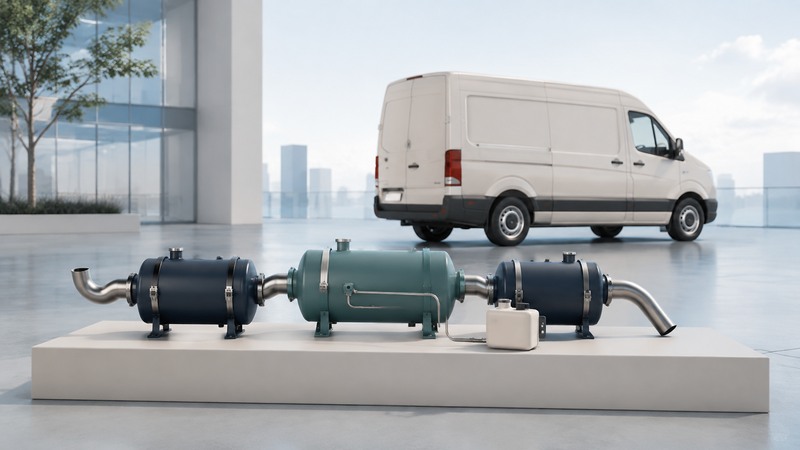
A diesel engine uses compression ignition: air is compressed, and injected fuel burns in the hot compressed air to produce power. Evaluate a modern diesel as a complete system of engine, approved fuel, controls and exhaust treatment. Its suitability depends on what it will do each day and how that system is maintained.
For an existing vehicle or machine, start with its model year, engine identifier, emissions label, market and operating manual. Passenger cars, highway trucks, off-road machinery and stationary engines belong to different equipment and regulatory contexts.
Ask what an emissions claim measures
Fuel economy measures distance or useful work per fuel consumed. Particulate matter, nitrogen oxides and carbon dioxide are separate quantities. A claim about one requires its own measurement boundary and cannot stand in for all the others.
On a narrow screen, scroll the table sideways. Keyboard users can focus the table region and use the arrow keys.
| Claim | Evidence needed | Useful interpretation |
|---|---|---|
| Better fuel economy | Same route or work, payload, conditions and units | Compare the fuel needed to deliver the same service. |
| Lower particulate emissions | Engine class, test cycle, baseline and installed filter system | A reduction belongs to the tested configuration and pollutant. |
| Lower NOx emissions | Aftertreatment, temperature/duty conditions and test method | Check how representative operation supports the control system. |
| Lower lifecycle greenhouse gases | Fuel pathway, system boundary and CO2-equivalent method | Include fuel production as well as use on a consistent basis. |
EPA’s verified-technology list gives retrofit results with engine and application restrictions. Use those restrictions when interpreting a percentage. An old retrofit result for a particular engine group is useful evidence for that scope, not a universal rating for current diesel equipment.
Understand the roles of exhaust treatment
A diesel oxidation catalyst helps treat carbon monoxide and hydrocarbons. A diesel particulate filter, or DPF, captures particulate matter and needs a process to remove accumulated soot. Selective catalytic reduction, or SCR, targets nitrogen oxides using a reducing agent. EPA’s technology overview explains these different functions.
Where an engine uses diesel exhaust fluid, it has a dedicated supply system. EPA’s DEF information provides the U.S. regulatory and technology context. Obtain the required fluid quality, storage instructions and dashboard-message meanings from the exact equipment manual. Keep fuel and DEF separate and use their designated filling points.
A vehicle’s certification and service instructions describe its own integrated system. Retrofitting older equipment requires a separately verified application and professional assessment. Removing or defeating emissions controls undermines the system and is not an operating remedy.
Match the duty cycle and maintenance
Record typical trip length, load, idle time, low-speed operation, ambient conditions and how often the machine reaches its normal working state. Ask the supplier to explain how the proposed system handles that duty and what operator actions its manual requires.
EPA’s May 2010 DPF operation and maintenance bulletin distinguishes soot regeneration from the removal of accumulated ash and emphasizes engine maintenance. This remains useful background for understanding a filter; use the current exact-model schedule and fault guidance for service.
When a warning appears, record the message or code and conditions, then follow the manual’s specified response or contact qualified service. A generic “drive faster” instruction can conflict with a particular fault or machine. Do not improvise regeneration near people, combustible materials or unsuitable surroundings.
Compare the actual work delivered
Fictional delivery comparison: a route uses 8 gallons to move 4 tons over 100 miles. That is 12.5 vehicle-miles per gallon and 50 ton-miles per gallon. If a different run carries 2 tons over the same distance on 6 gallons, it achieves about 16.7 vehicle-miles per gallon but only 33.3 ton-miles per gallon.
The second run uses less fuel, while the first moves more freight per gallon. Choose the service metric that matches the decision and retain both payload and distance. These invented runs isolate the arithmetic; they do not establish a real engine’s performance or a causal effect of load.
Request a representative demonstration or documented comparable-duty record. Include service access, scheduled maintenance, fluid use, downtime and the cost of the approved fuel. For biodiesel or renewable-diesel offers, use the fuel compatibility guide. A complete comparison explains which equipment fits the job and the operating evidence behind that conclusion.