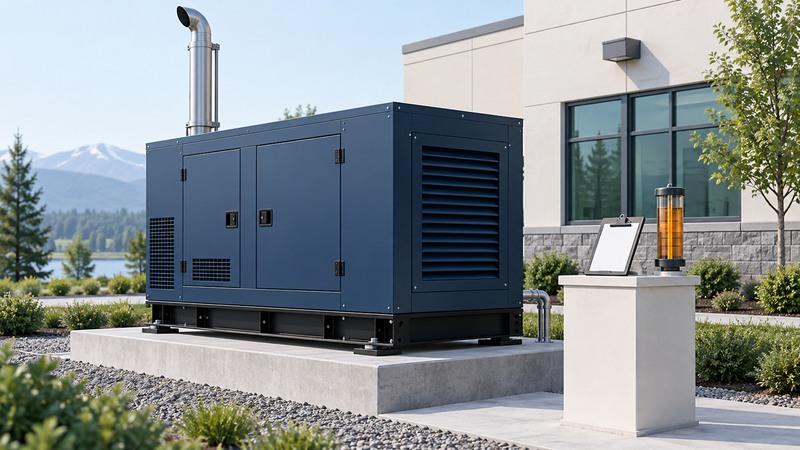
A useful diesel-generator assessment starts with the service a facility must keep running. Define the required loads, acceptable interruption and expected operating pattern, then ask suppliers to demonstrate that the complete generator system can meet them at the actual site.
This guide helps facility managers prepare a selection or readiness review with their electrical engineer and service provider. Have the load schedule, generator data sheet, site conditions and recent service records available. For an initial equipment inventory, start with backup-generator load planning.
Match the rating to the duty
Standby, prime and continuous ratings describe different operating conditions. A model can have several published kW ratings, each tied to a load profile, permitted operation and manufacturer conditions. Standby categories generally address backup service during supply interruptions; prime ratings address a varying load as a main power source; continuous ratings address a substantially constant load over extended operation. Permitted hours, average load and overload capability belong to the particular rating definition. Ask the supplier to identify the exact rating being offered and explain how the proposed use fits its definition.
Cummins’ generator-selection presentation separates these rating categories and discusses ambient conditions, altitude and load steps. Its cover is dated March 19, 2023. Use the exact current model documentation for contractual ratings.
On a narrow screen, scroll the table sideways. Keyboard users can focus the table region and use the arrow keys.
| Decision | Evidence to request | Why it matters |
|---|---|---|
| Operating duty | Rating name, definition, expected annual operation and load profile | Outage standby and regular power production impose different duties. |
| Electrical load | kW, kVA, power factor, starting loads and load sequence | Steady demand alone leaves transient performance unresolved. |
| Site capability | Rated output at the site altitude, temperature and enclosure arrangement | Cooling and engine/alternator limits affect available output. |
| System response | Accepted voltage/frequency excursions and recovery, supported by a sizing study | Connected equipment must tolerate the transition and load steps. |
Record both kW and kVA where the load data provide them. Ask the engineer to reconcile motor starting, variable-speed drives, UPS inputs and other significant loads with the proposed alternator and controls. A larger nameplate number alone leaves this assessment unfinished.
Calculate an endurance range
Use fuel available for the intended operating period after the documented reserve and unusable quantity. Obtain the manufacturer’s consumption curve at relevant loads, then include the expected changing load profile. Tank nameplate volume and full-load consumption are insufficient substitutes for those two inputs.
Fictional fuel example
A facility has 1,200 litres available after its reserve and unusable fuel allowance. Assumed consumption of 60 L/h gives 1,200 ÷ 60 = 20 hours. At 75 L/h, endurance becomes 16 hours. These are invented inputs, not ratings for a Cummins or other generator.
If the service target is 24 hours, both scenarios need a revised fuel plan. A delivery promise must be assessed against access, supplier capacity and a regional outage. Keep the reserve outside the calculated available volume.
Ask the fuel-service provider for inspection and quality records, storage-system condition and the applicable maintenance plan. Have authorized personnel handle sampling, transfer and storage work under the exact equipment and site requirements.
Review the whole readiness chain
Trace the sequence from loss of utility power through start, transfer, load acceptance and eventual restoration. Request a dated commissioning or test record showing the conditions, loads exercised, results, deficiencies and corrective action. An engine run establishes less than a documented test of the required facility service.
- Starting and controls: service records for starting batteries, chargers, alarms and remote notification.
- Fuel, cooling and exhaust: inspection findings, unresolved restrictions and assigned corrective work.
- Transfer and distribution: current drawings, equipment identification and an engineer-approved test scope.
- People and response: named contacts, access arrangements, spare-parts support and an escalation path.
Ask the responsible professional to select the test method and schedule that apply to this facility. Keep operation, installation and load-bank procedures with qualified personnel and the relevant manuals.
Confirm the operating classification
In the United States, EPA’s stationary-engine guidance distinguishes engines by factors including ignition type, age, location and use. Have the supplier and permitting authority identify the applicable federal, state and local obligations for the actual installation. Record whether proposed testing or other operation fits that classification.
Close the review with a short list of accepted evidence and open issues: required service, selected duty rating, site-adjusted capability, fuel range, test findings and the person responsible for each unresolved item. A decision is ready when each requirement has a traceable document or an explicit condition to resolve.
Generator readiness brief
Generator readiness brief — plain-text download. Save a copy and fill it in with your own information. The file includes instructions, assumptions and references so it can be used independently.