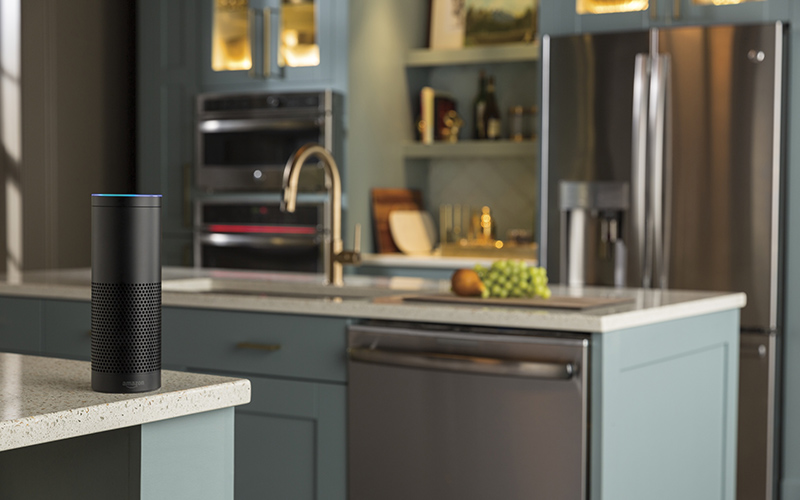
Connected appliances are ordinary household machines with a network layer. A refrigerator, oven, washer, dryer, dishwasher, range hood, water heater, air conditioner, or heat pump can report status, receive commands, coordinate with other devices, and sometimes respond to energy prices or utility signals.
The first wave of connected appliances emphasized remote control: start a cycle, preheat an oven, get an alert, order supplies, or check whether a door was left open. Those uses still matter, but the category is now broader. Connected appliances are becoming part of home energy systems, smart-home interoperability standards, maintenance diagnostics, accessibility features, and demand-response programs.
From App Control to Home Infrastructure
The 2017 connected-appliance push from GE Appliances, with integrations for voice assistants, Nest alerts, Amazon Dash Replenishment, IFTTT, and recipe platforms, was an early part of a much larger shift. Appliance makers were learning that connectivity could turn a machine into a service endpoint: reachable by phone, voice command, cloud routine, or partner platform.
Today, the more interesting question is not whether an appliance has Wi-Fi. It is whether the connection creates durable value. A useful connected appliance should make the product easier to use, cheaper to operate, safer to monitor, simpler to maintain, or better integrated with the rest of the home.
Kitchen Appliances
Connected ovens, ranges, microwaves, cooktops, and range hoods can support preheating alerts, guided cooking, remote status checks, timer notifications, ventilation coordination, and recipe-linked settings. A smart refrigerator may track door status, filter life, temperature changes, ice maker state, or energy use.
The most practical features are often modest. Knowing that an oven has reached temperature, a freezer door is ajar, or a filter needs replacement can be more valuable than elaborate recipe automation. In kitchens, reliability and clear controls matter more than novelty.
Laundry and Dishwashing
Connected washers, dryers, and dishwashers are useful when they reduce forgotten loads and poorly timed cycles. Alerts can tell a user when a wash is done, when a dryer vent may need attention, or when a dishwasher has completed. Remote cycle monitoring is especially helpful when machines are in a basement, garage, apartment laundry room, or shared space.
Connectivity can also support better scheduling. A washer, dryer, or dishwasher can run when electricity is cheaper, solar production is high, or the grid is under less stress, provided the user remains in control of timing and constraints.
Energy Management
Energy is becoming one of the strongest reasons for appliance connectivity. A connected appliance can report energy use, delay nonurgent work, coordinate with a smart thermostat or battery, and participate in utility demand-response programs when the owner opts in.
ENERGY STAR connected functionality and newer smart-home standards point in the same direction: appliances are not only consumers of electricity but flexible loads. Water heaters, heat pumps, EV chargers, dryers, refrigerators, and room air conditioners can all matter to grid stability if they respond intelligently and respectfully to household needs.
Matter and Interoperability
Smart homes have long suffered from platform fragmentation. Matter, developed through the Connectivity Standards Alliance, is intended to make devices work more consistently across ecosystems. Matter 1.3 added energy reporting and support for several major appliance categories, while later work expanded energy-management device types such as heat pumps and water heaters.
Interoperability does not make every appliance identical, and it does not guarantee that every advanced brand feature will work everywhere. It does, however, move the market away from one-off integrations and toward a more common language for status, control, and energy data.
Maintenance and Diagnostics
Appliances are expensive, heavy, and expected to last for years. Connectivity can help diagnose problems before a service visit, identify error codes, monitor filter life, update firmware, and guide owners through simple maintenance tasks.
For manufacturers and service teams, remote diagnostics can reduce unnecessary truck rolls and help technicians arrive with the right parts. For consumers, the benefit depends on transparency: the appliance should explain what is wrong in plain language and not turn basic repair into a subscription maze.
Accessibility and Safety
Connected appliances can improve accessibility for people who have mobility, vision, hearing, or memory challenges. Phone alerts, voice control, large-screen interfaces, and automation routines can make it easier to monitor appliances without standing beside them.
Safety features are also important. Smoke alerts, leak detection, temperature warnings, door-open alerts, forgotten-burner reminders, and remote shutoff for appropriate devices can reduce risk. These features should be designed conservatively, with local controls and clear failure behavior if the internet connection is down.
Privacy and Security
Appliances can reveal household patterns: when people cook, sleep, do laundry, leave home, or use energy. That makes privacy more than a checkbox. Manufacturers should minimize data collection, explain what is collected, protect accounts with strong authentication, and support devices with security updates for a clearly stated period.
Owners can reduce risk by using strong passwords, enabling multifactor authentication when available, keeping firmware current, disabling unused integrations, using a guest or IoT network where practical, and resetting appliances before selling or transferring a home.
Longevity and Right to Repair
A refrigerator or washing machine should not become worse because an app is abandoned. Connected appliances need long software-support windows, local controls that keep core functions working, available parts, and service information that does not disappear when a cloud platform changes direction.
This is one of the central tensions in the category. Appliance lifespans are measured in years or decades, while app ecosystems and cloud services often change much faster. The best connected appliances keep essential operation local and treat cloud features as enhancements rather than dependencies.
What to Look For
A good connected appliance should offer useful local controls, clear privacy settings, stated software-support expectations, strong account security, compatibility with the user's preferred smart-home platform, and features that match the appliance's real job.
For many buyers, the most valuable features will be simple: cycle-complete alerts, leak warnings, energy reports, maintenance reminders, remote diagnostics, and scheduling that respects household routines. A connected appliance succeeds when it quietly reduces friction, not when it turns every task into an app session.
The Connected Home Role
Connected appliances are becoming part of a larger home operating system that includes thermostats, solar panels, batteries, EV chargers, water heaters, lighting, security, and utility programs. The long-term value is coordination: cooling before peak rates, drying clothes when solar output is high, delaying a dishwasher when the grid is stressed, or warning a homeowner before a small appliance problem becomes expensive.
The promise is a home that is easier to run and less wasteful. The condition is trust. Connected appliances must remain understandable, secure, repairable, and useful even when the cloud is imperfect.