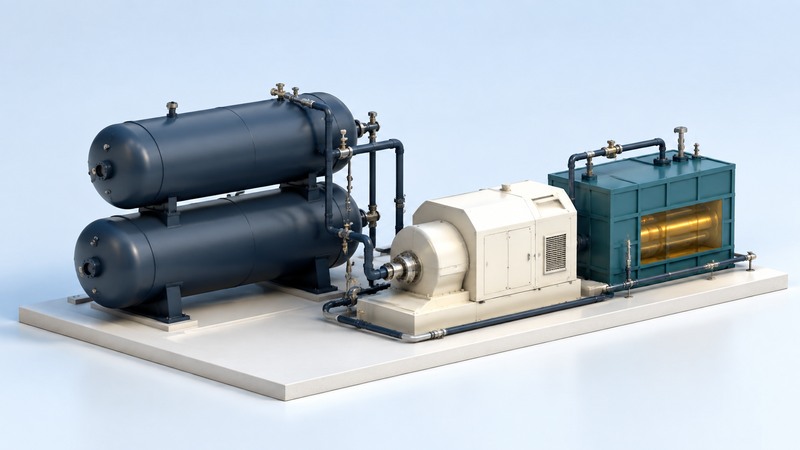
Compressed-air energy storage uses energy to compress air, stores it under pressure, and later expands it through machinery to produce electricity. Heat management is central to the design. Before comparing efficiency or cost, identify every electricity, heat and fuel input and the net electricity delivered at the chosen boundary.
This guide helps readers evaluate technology descriptions and proposals. Pressure vessels, underground storage and high-power machinery require qualified design, approvals and operation.
Identify how the design handles heat
Compressing air raises its temperature; expansion cools it. The DOE 2023 compressed-air technology assessment organizes designs around their treatment of this thermal energy. Names are useful shorthand, but the actual flow diagram and energy ledger establish what a project does.
On a narrow screen, scroll the table sideways. Keyboard users can focus the table region and use the arrow keys.
| Approach | Thermal concept | Question for a comparison |
|---|---|---|
| Diabatic | Compression heat is rejected or partly recovered; fuel may reheat air during discharge. | What fuel or external heat is included in the stated efficiency? |
| Adiabatic / advanced adiabatic | Compression heat is retained for later use, often in a thermal store. | What heat is recoverable after the stated storage interval? |
| Near-isothermal | Heat is exchanged during compression and expansion to limit temperature changes. | What equipment, heat exchange and parasitic energy achieve the claimed result? |
A technology label does not establish commercial readiness. Distinguish laboratory results, a proposed project, commissioning tests and sustained operation. A small backup concept and a large underground plant have different equipment, storage volumes and intended services.
Define net power and usable duration
Record rated discharge MW and usable delivered MWh under the same conditions. Dividing MWh by MW gives duration only if that output can be sustained. Specify the initial state, allowable pressure range, ambient conditions and whether output falls during discharge.
Define the electrical boundary: generator terminals, plant bus or grid connection. Pumps, compressors, controls, cooling and conversion equipment can consume electricity. Ask whether the quoted output already subtracts these loads and whether charging energy includes all auxiliaries.
Sandia’s energy-storage performance-testing chapter emphasizes measured power, energy and efficiency under stated conditions. Use its system-testing perspective to request evidence for the actual operating duty, including storage time and repeat cycles.
For a complete cycle, compare equivalent starting and ending energy states. Drawing down previously stored pressure or heat can make a short test appear better than a repeatable operating cycle.
Check a complete energy ledger
Fictional fuel-free case: a complete cycle consumes 100 MWh of grid electricity, including auxiliaries, and returns 60 MWh net at the same connection. With equivalent starting and ending storage states and no external fuel or heat, electrical round-trip efficiency is 60%. If the 60 MWh can be delivered steadily at 20 MW, the duration is three hours.
Separate fictional fuel-assisted case: 100 MWh of charging electricity plus 50 MWh of fuel energy on a lower-heating-value basis yields 90 MWh of net electricity. Dividing 90 by charging electricity alone gives 90%, but leaves out the fuel. Electricity output divided by total stated energy input is 90 ÷ 150 = 60%.
The second ratio combines electrical and fuel inputs on an energy basis; it is not a fuel-free electrical round-trip efficiency or an exergy analysis. These examples are arithmetic illustrations, not performance predictions for either design. Keep fuel cost and emissions in the comparison too.
Ask for site and project evidence
Establish what holds the air: engineered vessels or a characterized underground formation. Request the professional assessment of integrity, usable volume, pressure range, access, permitting and monitoring. Check the thermal store, water needs, noise, footprint and grid connection as applicable.
Sandia’s storage procurement chapter supports defining the service and responsibilities before evaluating offers. Obtain guaranteed net output, duty limits, maintenance obligations, acceptance tests and the assumptions behind lifecycle cost.
Compare alternatives at the same service: required MW, hours, cycles per year, response and reliability. A low cost per stored kWh may be less useful than dependable delivered energy at the needed time. Include charging opportunity, fuel where used, replacements and operating staff in the cost boundary.
For other system comparisons, see hydrogen power and electricity demand. For ordinary computer backup, the UPS guide addresses a different, equipment-level task.
Compressed-air storage evidence sheet
Compressed-air storage evidence sheet — plain-text download. Save a copy and fill it in with your own information. The file includes instructions, assumptions and references so it can be used independently.