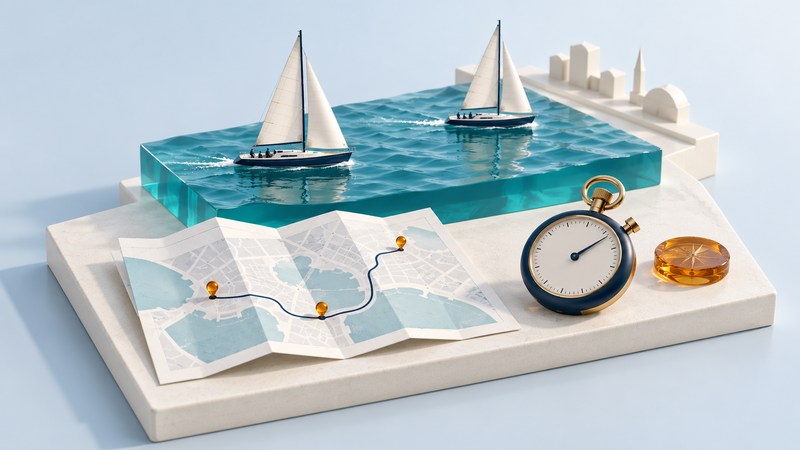
A competitive activity adds a shared objective to a trip: solve clues, race another crew or finish a team challenge. Choose the format by what everyone can enjoy, then check the actual demands and operating arrangements before paying.
Decide what kind of competition you want
Survivor-style island contests helped popularize competitive vacations in the early 2000s. The 2002 Island Quest promotions belong to that history. For a trip today, work from a current operator, specific departure and written terms.
On a narrow screen, scroll this table sideways. Keyboard users can focus it and use the arrow keys.
| Format | Where the competition comes from | Most useful fit check |
|---|---|---|
| Crewed sailing regatta | Two boats compete while guests take crew roles. | Boarding, balance, available low-effort roles and weather policy. |
| City scavenger hunt | Teams solve location-based clues and photo tasks. | Walking distance, steps, phone requirements and pause options. |
| Self-organized destination puzzle | Your group sets a route and scoring rules. | Public access, manageable distances and a reliable meeting point. |
Agree on the tone first. Some groups enjoy a visible leaderboard; others prefer finishing together with a playful score. Let people decline strenuous roles without having to explain themselves publicly. A memorable shared afternoon is a better design target than making every traveler compete in the same way.
Two current examples to investigate
12 Metre Regatta in Sint Maarten advertises head-to-head racing in Great Bay, with skippers and crew guiding guests. Participants can help with tasks or ride along. Its experience description includes tender transfer to the yachts and says the race boats have no washrooms. Those details matter when deciding who can comfortably join.
Confirm eligibility directly before booking children: the operator’s public pages have shown different minimum ages. Ask about the actual departure, boarding assistance, seating and the role suitable for each participant. For a cruise visit, also use its cruise passenger information and obtain a clear meeting and return plan.
Let’s Roam’s city hunts use phone-based riddles, trivia and photo challenges. Its general description estimates about two hours and one to two miles of walking. Check the individual route, ticket terms, phone access and group arrangement; a general description cannot establish that a particular route is step-free or suitable in every weather condition.
Screen the activity before scoring it
Start with requirements that must be met: participation eligibility, access, supervision and enough time to return. If one remains unresolved, keep the activity off the paid shortlist until the operator answers. Then compare enjoyment, effort and price.
- Participation: what does each person actually do, and can they change roles or pause?
- Physical demands: how much standing, walking, climbing, lifting or exposure is involved?
- Support: who leads the activity, how do participants contact them, and what happens if someone stops?
- Conditions: who decides whether weather permits the activity, and does cancellation lead to a refund or a rescheduled slot?
- Costs: what must be added for transport, equipment, lockers, photographs, food or booking fees?
Download the challenge comparison sheet (plain text). It separates essential requirements from preferences so an appealing score cannot hide an unsuitable activity.
Work backward from the real deadline
Use the full meeting-to-return period, including check-in, equipment, transfers and the journey back. On a cruise day, distinguish local time from ship time and plan around the ship’s stated all-aboard deadline. Ask the operator for the return location, not just the activity’s duration.
Illustrative schedule: an activity meeting at 10:00 and finishing at 12:30, followed by a 45-minute transfer, puts you back at 13:15. A 15:00 deadline leaves 1 hour 45 minutes. Check whether that margin is appropriate for the route, traffic and operator’s delay plan; the arithmetic alone does not guarantee a comfortable return.
Keep the competition enjoyable
For a city puzzle, give points for completed clues and teamwork instead of speed across streets. Use public routes during suitable opening hours, respect property boundaries and ask consent before including strangers in photographs. Set a regrouping place and a rule for what happens when a phone loses charge.
Afterward, leave time for a meal or a quiet break. If the group wants different intensity levels, pair an optional challenge with a shared later activity. That keeps the trip together while allowing the competition to remain a choice.
Related travel resources
Researched and updated October 3, 2026. Check the linked official information for your dates, party and booking terms.