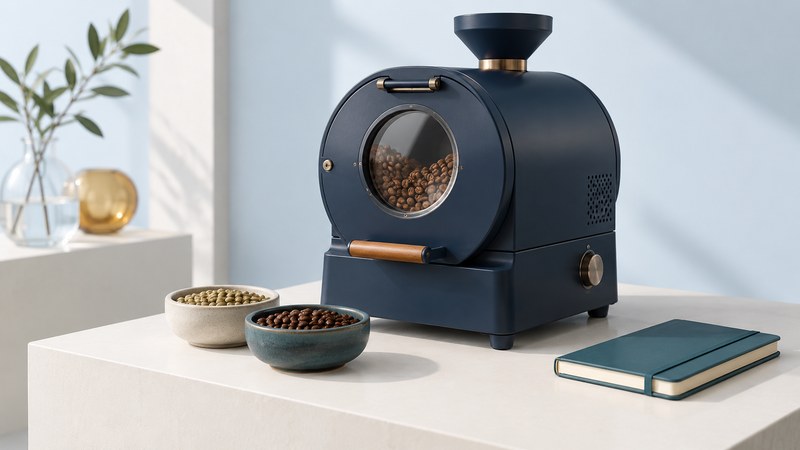
A home coffee roaster makes sense when you want to choose green coffee and spend time learning how roasting changes its flavor. Start with the space, supervision and weekly quantity you can manage. Then compare machines by their documented operating limits and by the work of a complete batch, including cooling and cleanup. This is an equipment and recordkeeping guide; Yenra has not tested or ranked the machines.
Choose around the whole roasting session
Write down how many grams of roasted coffee you use in a week, how often you can roast, and where the manufacturer permits the machine to operate. Obtain the manual before buying. A maximum green-bean capacity alone leaves out the permitted batch range, roast-level restrictions and time between batches.
On a narrow screen, scroll the table sideways. Keyboard users can focus the table and use the arrow keys.
| Decision | Evidence to request | Why it matters |
|---|---|---|
| Batch size | Minimum and maximum green-coffee loads for your intended roast | A small weekly requirement may fit poorly with a large minimum load. |
| Location | Clearance, ambient conditions, electrical supply and ventilation instructions | Smoke suppression still comes with location and supervision requirements. |
| Controls | What the owner can change and what the machine records | A numbered profile is useful only within that machine and its instructions. |
| Cooling and cleanup | Cooling method, chaff removal and maintenance schedule | These are part of the time and effort for every batch. |
| Support | Manual for the exact model, spare parts and service access | Replacement glass, trays or seals can affect long-term usefulness. |
Ask how a seller calculated an advertised batch count per hour. Include loading, cooling, cleaning and any required rest between cycles in your own schedule. If you prefer very dark coffee, confirm explicitly that the chosen machine supports that endpoint.
Use the manual as the operating boundary
For a concrete example, the Behmor 2000AB 120 V manual currently linked by the manufacturer is marked V30, October 21, 2024. It requires continuous attendance, explains that beans can ignite, and excludes Vienna, French and Italian roast levels. Its safeguards, load limits and cooling procedures apply to that model; another roaster may have different instructions.
Never leave a running roaster unattended. Read the entire safety section before the first batch, including the manufacturer’s response to an abnormal roast. Presets and smoke-control features still require an attentive operator. Follow the specified chaff-cleaning routine and permitted setup; avoid improvised ventilation or modifications.
Build a baseline you can repeat
- Identify the coffee and machine. Record green-coffee lot, process, model, configuration and manual revision. Keep the supplier’s lot information.
- Weigh the green load in grams. Choose a starting batch and profile within the manual’s instructions. Record the actual settings, not just “medium.”
- Observe without interrupting supervision. Note start time, setting changes and observable milestones when practical. After the cycle, complete the prescribed cooling and cleaning.
- Weigh the cooled output. Record roasted mass and any handling loss. Keep comparable measurements across trials.
- Compare in the cup. Record days since roasting, storage, brew method, coffee dose, water amount and grind setting. Change one planned roast variable for the next comparison.
Temperature readings belong to a particular sensor position and machine. Two displays showing the same number can describe different conditions. Use your record to compare your own repeat batches; transfer another person’s recipe only with the manufacturer’s limits and configuration in view.
Plan quantity with measured yield
If two batches taste different, first compare the lot, load, settings, storage and brewing records. Repeat the baseline before changing several controls. A darker appearance or higher mass loss alone cannot tell you which batch you will prefer.
Download the editable roast and tasting record. It includes the yield calculation and space for the next controlled comparison.