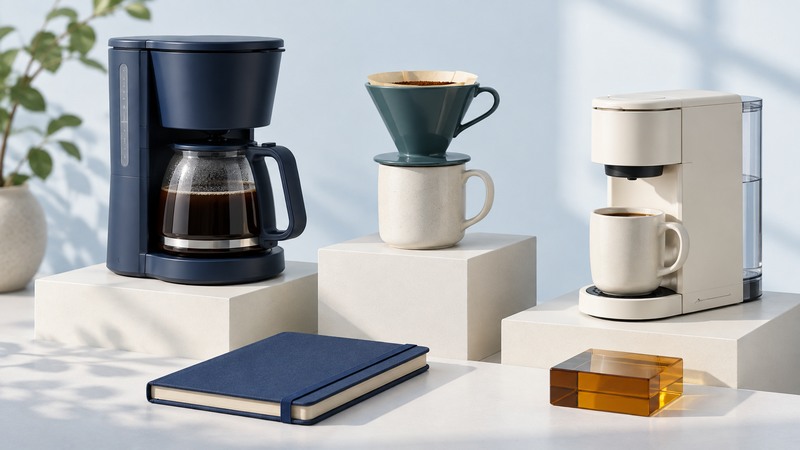
The most useful coffee-maker review starts with your morning: how much coffee you need, when you drink it, and how much preparation and cleaning you want to do. Use the framework below to compare candidates. It is a buying and evaluation guide; Yenra has not conducted a hands-on test of the models discussed here.
Write the job before the shortlist
Measure your usual drink in milliliters or US fluid ounces. Brewer markings called cups can be much smaller than a mug. Record the smallest and largest batches you actually need, including guests, and whether the coffee will be served immediately or held.
On a narrow screen, scroll the table sideways. Keyboard users can focus the table region and use the arrow keys.
| Approach | Useful when | Work to include in the comparison |
|---|---|---|
| Automatic filter brewer | Several people want coffee together | Fill, weigh grounds, load a filter, wash basket and carafe; check small-batch behavior. |
| Manual pour-over | You enjoy making one or two servings deliberately | Heat water, weigh ingredients, pour and dispose of the filter; include kettle and grinder space. |
| Pod brewer | Different people make separate drinks at different times | Buy compatible capsules, fill water and clean the machine; compare each serving cost. |
| Espresso system | Concentrated shots and milk drinks are the goal | Allow for grinding, preparation, milk handling and cleaning between drinks. |
Set three essential requirements, such as a 600 mL morning batch, an accessible water tank under a cabinet, and a carafe you can wash easily. Reject candidates that fail these before scoring optional features.
Separate a specification from a tested result
A product page tells you what the maker claims; a manual reveals limits and required procedures. A useful independent review explains its water, coffee, dose, batch size and repeat count. Look for those conditions before applying its taste judgment to your own routine.
The Specialty Coffee Association certified home brewer list provides evidence that listed brewers meet its program's brewing requirements. Check the exact model. Certification is one useful brewing criterion; noise, counter fit, repair service and whether you enjoy the coffee need separate evaluation.
When a review says a machine is fast, find out whether timing begins at a cold start and includes filling and cleanup. When it praises a thermal carafe, look for measured holding conditions. If a method is absent, record the statement as an impression and leave that criterion unresolved.
Compare ownership with explicit assumptions
Use first-year cost = purchase price + accessories + servings × consumable cost + other annual costs. For shared households, count drinks actually made, including discarded coffee. A large batch that goes unfinished changes the economics.
The coffee-maker comparison worksheet records evidence, missing facts, dimensions and costs for three candidates. Its blank fields help keep unknowns visible instead of turning them into favorable assumptions.
Check the machine as you would use it
- Read the exact regional manual for minimum and maximum fill, filter type, electrical requirements and cleaning instructions.
- Measure counter depth and height with the lid open. Include the route used to remove the tank and carafe.
- Price the required filters, replacement carafe and routine cleaning materials. Check where service is available.
- If you can try the machine, use a representative batch and record the recipe. Taste at a comfortable temperature, pour the last serving, and complete cleanup.
- Decide which compromises you accept. A timer may matter more than custom temperature; easy tank access may matter more than another drink preset.
For a controlled brewer with several modes, the Breville Precision Brewer guide demonstrates how to establish a baseline before experimenting. If a single mug is the real requirement, compare the separate single-cup workflows before buying a larger system.