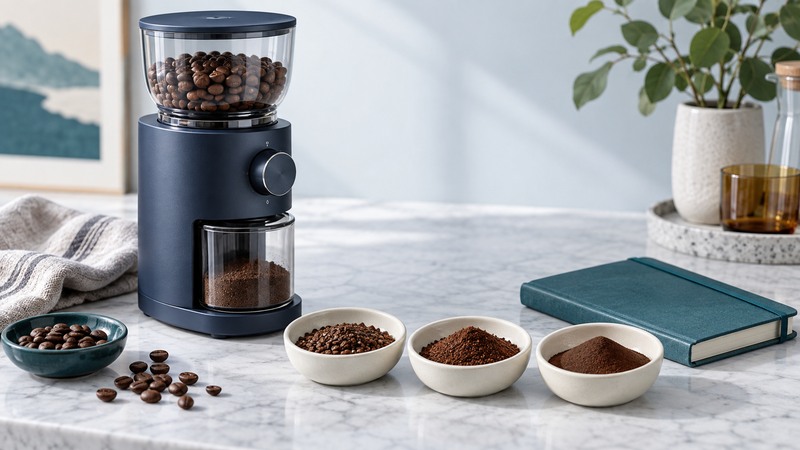
A good grinder gives you control over the size of the grounds and lets you return to a useful setting. Start with the coffee you actually make: a large pot of filter coffee, one pour-over, or espresso. Then choose the adjustment range, capacity and daily workflow that fit that job.
Choose for the brewing method
Burr grinders pass beans between grinding surfaces with an adjustable gap. Blade grinders chop for a chosen duration, making a repeatable particle size harder to control. A burr grinder is a practical starting point when the aim is to improve consistency; its suitability still depends on its adjustment range and the way you use it.
On a narrow screen, scroll the table sideways. Keyboard users can focus the table region and use the arrow keys.
| Your routine | Prioritize | Check before buying |
|---|---|---|
| Filter coffee most days | Repeatable medium-range adjustments and easy cleaning | Can the catch cup hold the largest dose you use? |
| Espresso with a single-wall basket | Fine adjustment steps near espresso settings | Does the manufacturer support this use and explain how to dial it in? |
| One small serving, limited counter space | A hand grinder or compact electric model | Try the required turning effort or check actual clearance with the hopper open. |
| Several brew methods | A clearly marked, repeatable adjustment system | How much coffee remains inside when switching settings or beans? |
Count usable adjustments in your brewing range, rather than choosing by the total number printed on the box. Espresso often needs smaller changes than filter brewing. A grinder with many settings may devote most of them to a range you rarely use.
Establish a recipe before adjusting
Use a scale, your usual brewer, one bag of beans and the correct filter. Record the coffee mass, water amount, grinder model and setting. For pour-over, also record the pouring routine; for an automatic brewer, record its mode and batch size. Keep these steady during a comparison.
The Baratza Encore manual gives method-specific starting settings and explains that the actual setting varies with beans and preferences. Treat a manufacturer's number as a starting point for that exact grinder. A setting of 18 on one model has no fixed equivalence to 18 on another.
Use taste and flow together
For a draining filter brew that runs unusually quickly and tastes thin or sharply sour, try a small move finer. If it drains very slowly and tastes harsh or drying, try a small move coarser. These are useful tests, not diagnoses: beans, water, filters and pouring can produce similar symptoms. A blocked filter or unevenly wetted bed needs attention before another grind change.
For espresso, hold the basket dose and target drink mass steady while adjusting grind. Baratza's espresso dialing-in guide uses dose, yield and elapsed time together. Check distribution and tamping when flow is uneven; chasing a target time alone can obscure the real problem.
Follow your grinder's instructions on whether the motor should run during adjustment. After a change, account for any old grounds retained inside using the manufacturer's procedure. Keep a short note of the best setting for each bean and method, then recheck it when the coffee changes.
Maintain the result
A clean collection cup and clear grounds path make repeated doses easier to compare. Use the manual's cleaning method, unplug before permitted disassembly, and keep water away from parts the manufacturer specifies should remain dry. Check replacement burrs, parts and service support when comparing long-term ownership.
Save the plain-text brewing log and duplicate its trial block for each brew. It includes the units, observations and one-change comparison used here. Your useful endpoint is a cup you enjoy and can make again, with a recorded recipe that explains how.