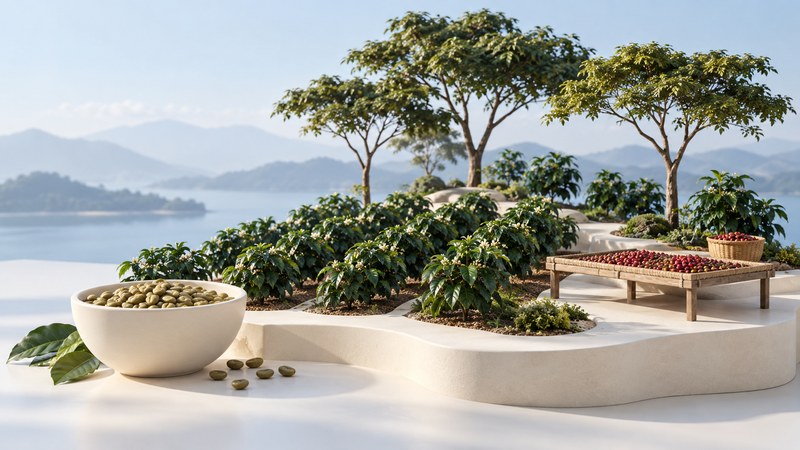
Coffee farming connects a living crop, seasonal labor, processing facilities and a buyer. The bean in a bag is a seed that has passed through several decisions before it reaches the roaster. For coffee drinkers and new buyers, understanding those decisions makes origin stories and farmer-support claims easier to assess. Growers should pair this overview with local agronomic advice.
Read variety and place together
Species, variety and origin describe different things. Arabica and canephora are coffee species; a variety identifies a more specific type of plant; origin identifies where the coffee was grown. A country name alone leaves considerable variation in climate, farm management and processing.
The World Coffee Research catalog explains traits including yield potential, quality potential, stature, disease susceptibility and suitable growing conditions. Treat these as a way to ask informed questions. A high quality potential still depends on the environment and how the crop is managed.
For a purchase, ask for the variety or mixture if known, the harvest period, and whether the lot represents one farm, a producer group or a broader regional blend. “Unknown” is useful information: it marks the limit of traceability without inviting a guess.
Understand the farm’s constraints
A farmer must balance the crop’s performance with labor, inputs, weather and the time it takes an investment to pay back. Replanting can mean a period with reduced production, while a different variety can require changes in management and access to suitable planting material.
World Coffee Research’s breeding, field-trial and nursery programs address different parts of this chain. Testing a plant in several environments and supplying healthy, correctly identified plants are separate tasks. A promising trial result becomes useful to a farmer when planting material and locally relevant guidance are available.
Shade is another site-specific decision. Ask which trees are used, how they are managed and what the farm is trying to achieve. The Shade Catalog is a starting point for learning about tree choices. A general label such as “shade grown” needs a description of the actual system to be informative. Planting density, nutrition and pest treatment require local diagnosis and recommendations.
Follow the fruit after harvest
Harvested coffee fruit is commonly called a cherry. Processing separates its seed from the surrounding fruit and prepares coffee for storage and trade. The International Coffee Organization’s development report describes natural and honey processing, among other approaches. These names describe broad pathways; individual producers use different equipment and controls.
On a narrow screen, scroll the table sideways. Keyboard users can focus the table and use the arrow keys.
| Label | Basic pathway | Useful follow-up question |
|---|---|---|
| Natural | The whole cherry is dried before the dried outer material is removed. | How are drying and lot separation managed? |
| Washed | Fruit is removed, including the mucilage around the seed, before drying the parchment coffee. | Which removal and washing steps does this producer use? |
| Honey / pulped natural | The skin is removed and some mucilage remains during drying. | What does that label mean for this particular lot? |
After drying and subsequent preparation, green coffee can be graded, traded and roasted. A process name helps explain handling; tasting the finished coffee tells you how that lot performs in your cup. Keep variety, harvest, process and roast information together when comparing two purchases.
Ask what farmer support actually changes
Training, new equipment, planting material and improved market access can address different problems. Evaluate a program by the need producers identified and the result it measures. The Coffee Quality Institute’s processing courses, for example, describe specific learning goals and levels; course participation is one activity to record, while business outcomes need separate evidence.
- Who chose the priority? Look for farmer or producer-group involvement in defining the problem.
- What changed? Ask about adoption, rejected lots, costs, payment timing or net earnings, with a baseline and date.
- Who bears the cost? Include labor, maintenance, inputs and time spent training.
- How long was it followed? One harvest can reflect unusual weather or market prices.
For a useful buying record, save the lot name, harvest period, producer or group, variety, process, source of each fact and one question still unanswered. Use the fair trade coffee guide to interpret certification and trade-price claims alongside those details.