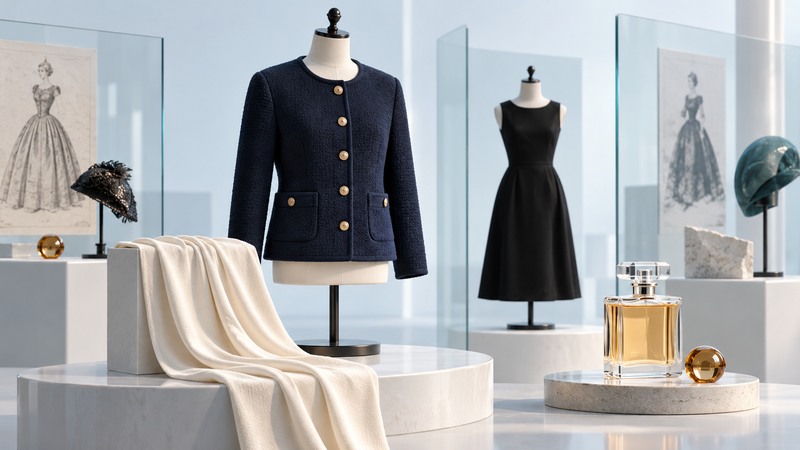
Coco Chanel’s design history becomes clearer when familiar symbols are connected to dated garments and their construction. Jersey, a black dress, a cardigan-like jacket and coordinated accessories are useful starting points. Examine what each object does, when it was made and who is credited with it before applying a broad label such as “timeless.”
A short chronology with distinct objects
The National Gallery of Victoria’s exhibition labels for Gabrielle Chanel: Fashion Manifesto (PDF) connect her early use of jersey with supple clothing and freedom of movement. They document No. 5 in 1921, the black dress publicized by Vogue in 1926, her return to couture in 1954, the 2.55 bag in 1955 and two-tone shoes in 1957. These are separate developments, not one outfit invented at one moment.
The same museum account makes a valuable distinction: Chanel helped establish the black dress as fashionable, but she was not the only designer working in black. A claim about influence is more defensible than a claim that an entire garment category had no predecessors.
For a specific object, consult the Metropolitan Museum of Art’s spring/summer 1954 ensemble record. Its season and attribution anchor discussion in an actual collection object. Record those details when comparing it with a later suit bearing the house name.
Look at the design, not only its symbols
On small screens, scroll horizontally. Keyboard users can focus the table area and use the arrow keys.
| Form | What to examine | Why it matters |
|---|---|---|
| Jersey garment | How the fabric hangs, where it stretches, and how seams shape it. | A fabric name alone does not explain the finished silhouette. |
| Black dress | Length, neckline, sleeve, surface and intended setting. | Color unites very different kinds of dress. |
| Suit | Jacket line, edging, pockets, skirt proportion and lining. | Construction and balance explain more than a familiar button. |
| Accessory | Scale and placement in relation to the whole outfit. | A bag, shoe or necklace can change how the clothing is read. |
The NGV labels describe the postwar suit through its cardigan-shaped jacket, straight skirt and carefully considered details, including braid, pockets and a chain at the jacket hem. Use a museum’s construction description to direct your eye, then identify which details are actually visible in the photograph. An exterior image cannot reveal every internal feature.
When studying a museum display, read the object label before the room’s larger theme. A broad exhibition title may span decades. The small label is where the maker, date, material and lender usually become specific.
Keep the designer, the house and wartime history distinct
Gabrielle Chanel’s lifetime work and later work produced by the Chanel house belong to a connected history, but they are not interchangeable attributions. Write the named designer, season and house when the collection record supplies them. If the record says “House of Chanel,” retain that wording unless the individual designer is also documented.
A responsible account also addresses Chanel’s wartime conduct. AP’s 2023 report on the V&A exhibition discusses her role as a Nazi informant and disputed evidence concerning Resistance activity. Design achievements do not remove the need to examine that political history.
Separate an object’s formal qualities from claims about its maker’s character. A jacket can be technically interesting while the biography demands critical scrutiny. Keeping both in view produces a fuller history than a celebratory sequence of brand symbols.
Use a two-object comparison
Keep a second column for interpretation: what you think the form suggests about movement, formality or coordination. Check that interpretation against the label, additional views and scholarly discussion. If a feature is hidden, mark it unknown. A useful final note contains the object title, maker, date, museum, accession or record link, and a few precise observations.
Museum photographs and labels support historical study. They do not authenticate a resale garment. For an item you might buy, provenance, condition and specialist inspection are separate questions.