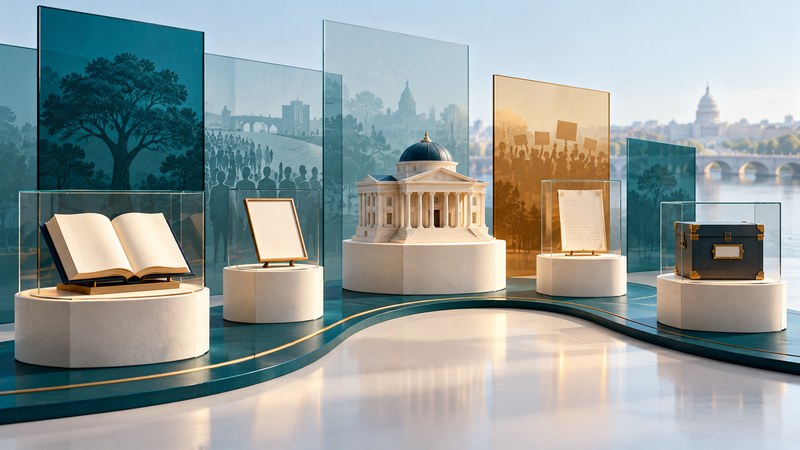
The modern U.S. civil-rights movement joined community organizing, litigation, protest and political action to challenge racial exclusion. A useful history connects those methods: people organized to change institutions, laws created new tools, and communities continued working to make those changes real. Use this guide to build a timeline and then examine the evidence behind it.
Begin with a question and a time frame
The years 1954–1968 offer a manageable starting frame for studying school desegregation, direct action, voting rights and federal legislation. They sit within a much longer struggle. Earlier organizing and Reconstruction-era constitutional changes shaped the possibilities; later campaigns continued work on housing, economic opportunity and political participation. The National Archives' timeline leading to Brown helps establish those antecedents.
Choose a question narrower than “What happened?” For example: How did students turn local grievances into campaigns? What changed when a demand became law? What resources did organizers need between public demonstrations? These questions make a timeline explanatory rather than a list of famous names.
Follow events, methods and evidence
| Period | Event and historical significance | Source and reading question |
|---|---|---|
| 1954 | Brown v. Board of Education rejected racial segregation in public education under the Fourteenth Amendment. Litigation produced a landmark ruling; implementation required further struggle. | Brown decision and transcript: What legal question does the Court answer, and what practical questions remain? |
| 1955–1956 | The Montgomery bus boycott made sustained collective action a means of challenging segregation. Rosa Parks’s arrest was part of a wider organizing history. | Library of Congress primary-source set: What can an arrest record tell you, and what requires organizers’ accounts? |
| 1960–1961 | Student sit-ins and the Freedom Rides challenged segregation through direct action, coordination and exposure of resistance. | Civil Rights Era exhibition: How did activists connect a specific place or journey to a broader demand? |
| 1963 | The Birmingham campaign and March on Washington drew attention to racial exclusion and demands for jobs and freedom. | Campaign documents and March materials: Which demands appear in the records beyond the most familiar speech? |
| 1964 | The Civil Rights Act created major federal protections concerning public accommodations, education and employment, with different provisions and enforcement mechanisms. | Civil Rights Act of 1964: Which title addresses the setting you are studying? |
| 1965 | The Voting Rights Act supplied federal tools against discriminatory barriers to voting, following years of organizing and resistance. | Voting Rights Act of 1965: What problem is a provision designed to address? |
| 1968 | The Fair Housing Act extended the legislative struggle into housing discrimination. Its enactment belongs in a history of both legal change and continuing implementation. | HUD historical account of the Fair Housing Act: How does a housing protection differ from a school or employment protection? |
This is a selected historical timeline. Consult current official guidance for present-day rights and procedures, because later legislation and court decisions can change how a law operates.
Look for the work behind the milestone
Follow organizations and local networks as well as prominent speakers. The Library of Congress civil-rights exhibition includes material on the NAACP, student organizing and campaigns that crossed local and national boundaries. Different organizations brought different strategies, resources and priorities.
The Civil Rights History Project collects interviews with participants. Such accounts can reveal the ordinary work behind a public event: finding transport, holding meetings, sharing information, raising funds and keeping people involved. Search for participants whose role differs from the central figure in your textbook.
When studying a campaign, make a four-column note: goal, people and organizations, method, response. Add a fifth column for consequences. This keeps a march, boycott or lawsuit connected to the conditions that made it possible and the resistance it encountered.
Distinguish a demand, a ruling and a result
A campaign leaflet tells you what organizers wanted readers to do. A judicial opinion establishes a court's reasoning and decision in a particular case. A statute records legal provisions. A participant's later account offers remembered experience and interpretation. Each answers a different question.
Use the Supreme Court reading guide for help distinguishing a holding from other judicial writing. For evaluating testimony, continue to Studying Civil Rights Through Firsthand Accounts.
Build a small, balanced reading set
Start with one overview, one contemporary document and one participant account. Read the overview to orient yourself, inspect the document to test a specific claim, and use the participant account to discover questions the overview leaves open. Record contradictions and gaps instead of smoothing them away.
Diane McWhorter's A Dream of Freedom: The Civil Rights Movement from 1954 to 1968 offers a route into the subject for younger readers. Scholastic's civil-rights discussion guide includes work with the book. Pair a secondary narrative with sources that readers can inspect, and discuss how the author selected events and voices.
For a classroom or family discussion, agree on one question, let each reader bring one piece of evidence, and end by naming what remains unresolved. Explain the historical context of discriminatory language in sources and give readers an appropriate way to engage with difficult material. The objective is a supported account that recognizes both human agency and the institutions being challenged.
Sources and next reading
Sources checked October 17, 2026. Follow the linked primary sources for their scope, dates and any later changes. Explore the Civil Rights library and official-help guide.