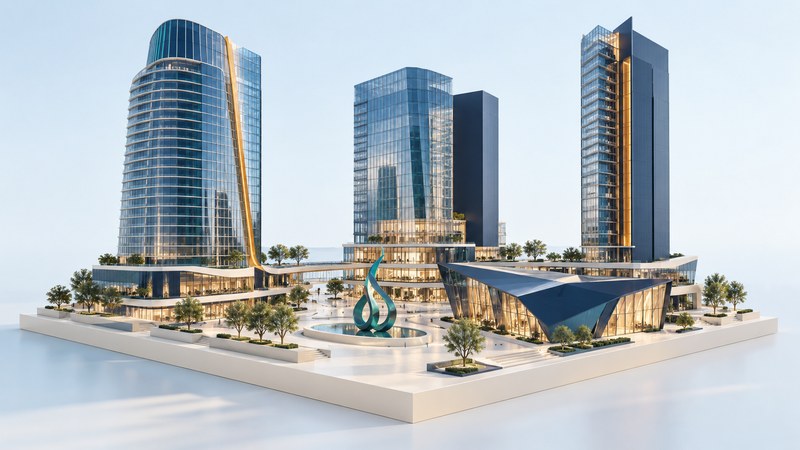
CityCenter is a useful place to explore how architecture, art and everyday movement share the Las Vegas Strip. Plan a small set of public spaces and artworks, with time to notice the buildings around them. The most rewarding visit can be a few well-chosen stops rather than a complete circuit.
MGM now uses ARIA Campus for the development area associated with ARIA, Vdara, Crystals and Veer Towers, according to its CityCenter FAQ. Keep the specific property or artwork name in your directions: “CityCenter” describes an area, not a single entrance.
From an ambitious proposal to a built district
The early CityCenter vision emphasized density, mixed uses and pedestrian activity within a large resort development. The useful historical distinction is between a design ambition and the spaces that opened. A promotional rendering or proposed rooftop garden cannot establish a public route today.
MGM’s February 2010 results document CityCenter’s December 2009 opening. Vdara, Mandarin Oriental and Crystals opened early that month; ARIA opened December 16. The release identifies Veer Towers as part of the development. Those dated records place the project beyond its announcement stage without implying that every early concept was built as described.
Use current names when arranging a visit. Hilton’s present Waldorf Astoria Las Vegas page, for example, provides the current hotel identity and visitor information in this part of the Strip. Historical project documents and current operating pages answer different questions: one explains development, the other helps you arrive.
Look at the spaces between the towers
At Crystals, begin with the roofline, the entrances and the way light reaches the interior. Studio Libeskind’s project record identifies the completed 2009 retail building and describes its metal-clad crystalline forms and public arcade. It credits Rockwell Group for interior design. The building offers a way to examine how a low, angular structure relates to the taller resort forms around it.
Try three observation questions as you move:
- Where does the building invite you in? Compare the visible entrance with the route you actually follow from the sidewalk.
- What changes at the threshold? Notice light, shade, sound and the transition from outdoor space to interior circulation.
- How do you find the next destination? Look for sightlines, signs and level changes, and consider how the journey differs for a wheelchair user or someone with limited walking stamina.
These are ways to interpret the design, not a scored accessibility audit. A striking skyline and an easy ground-level journey are separate qualities; observing both makes the visit more informative.
Choose a few artworks and use the current guide
ARIA describes its Fine Art Collection as a complimentary walking experience. Open its linked collection brochure before leaving and use it with current property signs. Choose works for their different scale, material and setting rather than trying to collect every stop.
Swipe sideways, or focus the table and use the arrow keys.
| Work and artist | Published location | A question to explore |
|---|---|---|
| Silver River — Maya Lin | ARIA registration desk | How does a river’s shape read when translated into a sculpture inside a resort? |
| Big Edge — Nancy Rubins | Harmon Circle | How does the composition change when familiar boats become one large sculptural form? |
| Typewriter Eraser, Scale X — Claes Oldenburg and Coosje van Bruggen | Pedestrian bridge near Waldorf Astoria | How does enlargement change an everyday object’s relationship to the surrounding buildings? |
Locations and identifications above come from the official collection brochure (PDF). The observation questions are suggestions for looking. Public-space circulation and access can change; ask the concierge when a route is unclear. Keep clear of registration queues and vehicle circulation, and follow the brochure’s instruction to leave the artwork untouched.
Build a flexible architecture-and-art walk
For an art-first visit, start with the ARIA registration area and Silver River. Once oriented, choose whether to continue toward Harmon Circle for Big Edge or toward Crystals for architecture and the Strip-side part of the collection. Use the brochure’s map and signed pedestrian routes to connect the stops; this is a sequence of interests, not turn-by-turn navigation.
If you begin on the Strip, reverse the emphasis: examine Crystals first, then decide whether to continue into ARIA. Add the pedestrian-bridge artwork only after checking how to reach it comfortably. The route you choose should follow the usable crossings and lifts, not a straight line between map pins.
A smaller visit can work better
A party with limited time might choose Crystals and one artwork, then stop for a meal. A group interested in sculpture might choose two contrasting works and spend longer looking at each. Agree on that priority before setting out, and keep an optional stop that can be dropped without losing the purpose of the visit.
Record the artist, title and what you noticed if you want to look up a work later. Distinguish your response from claims about the artist’s intention; the collection guide can supply background, while your own observation supplies the personal part of the visit.
Check connections and leave room for the resort journey
MGM’s FAQ describes a walkway between Vdara and ARIA and a free tram connection serving the Bellagio/ARIA/Crystals area. Confirm current operating times, station access and elevator routes with the properties before making the tram essential to your plan. A resort connection is one part of the journey; allow for the walk to and from it.
For any specific mobility requirement, ask about the exact starting point and intended destination. Keep rest stops and an easy exit in the plan. Exterior art stops and indoor galleries of space expose you to different weather, light and noise conditions, so adjust the route on the day.
Combine a short visit with the dining-planning guide, or use the Bellagio holiday guide when its seasonal display is part of your trip. Return to Las Vegas trip planning.