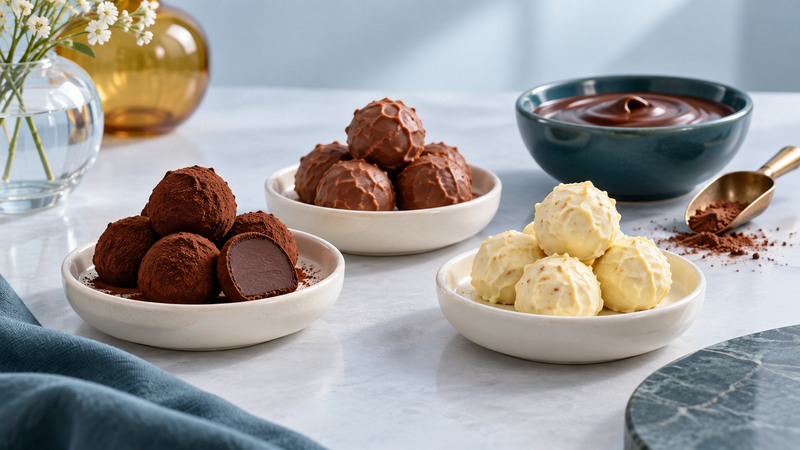
A truffle center starts as an emulsion of chocolate and cream. It becomes firmer as it cools. Choose a complete formula for the chocolate you have, then judge a chilled sample before adding extra ingredients.
Start with a small dark-chocolate batch
For about 22 centers of 15 g each, use 227 g semisweet or bittersweet chocolate and 113 g heavy cream, plus unsweetened cocoa for coating. This is a rounded half batch of the thickest option in King Arthur’s ganache recipe, with its optional corn syrup omitted. It is a source-derived starting recipe, not a Yenra kitchen-tested formula.
Chop the chocolate finely into a dry heatproof bowl. Heat the cream until steaming, pour it over the chocolate and wait five minutes. Stir until smooth. If solid pieces remain, rewarm very briefly and stir again. Spread into a shallow container and refrigerate until firm enough to scoop.
Use a scale, saucepan, spatula, shallow container, small scoop and parchment-lined tray. Write down the chocolate brand and cacao percentage; a substitution may change the result even when its weight stays the same.
Milk and white chocolate need their own plan
Scroll the table sideways. With a keyboard, focus it and use the arrow keys.
| Chocolate | Documented starting point | How to use it |
|---|---|---|
| Semisweet or bittersweet | The 227 g chocolate + 113 g cream batch above | A firm dark center; assess after chilling. |
| Milk chocolate | King Arthur’s tested all-purpose ratio: 3 parts chocolate to 1 part heavy cream, by weight | For example, 170 g chocolate + about 57 g cream. Chill and test one center. |
| White chocolate | Lindt specifies 150 g of its vanilla white chocolate, 60 ml double cream and 15 g butter | Use that complete product-specific recipe; cream volume and cream type matter. |
King Arthur’s ganache comparison shows how chocolate type, ratio and temperature interact. Its white-chip trials used flavored baking chips, so applying that result to every cocoa-butter white chocolate would be an assumption. Lindt’s white-truffle recipe combines heated cream and butter with chopped chocolate, chills the smooth mixture for about two hours and then shapes it. Follow its specified ingredients; double cream and US heavy cream have different fat contents.
Scoop when the center holds its shape
King Arthur’s truffle method uses a chilled, moldable ganache. Scoop a small portion and roll briefly between clean hands. If it smears immediately, chill the batch further; if it fractures, allow a small test portion to soften slightly. Work with a few portions at a time and keep the remainder chilled.
Roll centers in cocoa or a chosen dry topping, then return them to the tray. Keep nut-covered pieces separate and label them. For the dark batch, 227 + 113 = 340 g before bowl losses. Dividing by 15 gives 22 whole portions with about 10 g left; the coating adds weight. Smaller or larger centers change the count.
Record the actual usable ganache weight, portion size and result in the truffle batch notes. This makes the next batch easier to repeat.
Diagnose the texture before changing the recipe
Ganache with a visible oily layer and grainy texture has separated. King Arthur’s repair method adds warm water around 90–95°F (32–35°C), a teaspoon at a time, with vigorous stirring. This can restore the emulsion. Because the addition changes the formula and firmness, chill a sample before trying to roll it. A recovered soft batch may work better as a refrigerated sauce.
A smooth mixture that is simply warm needs chilling, not an immediate extra handful of chocolate. Conversely, a formula that remains too soft when fully chilled needs a recipe decision. Keep the original measurements so you can distinguish a temperature problem from a formulation problem.
For this home workflow, keep finished truffles covered in the refrigerator at 40°F (4°C) or below and plan to use them within three days. That is a conservative batch plan, consistent with Lindt’s stated storage period, rather than a tested shelf-life claim for every variation. Bring out only the portion being served; cream ganache needs refrigerated storage even inside a chocolate shell.