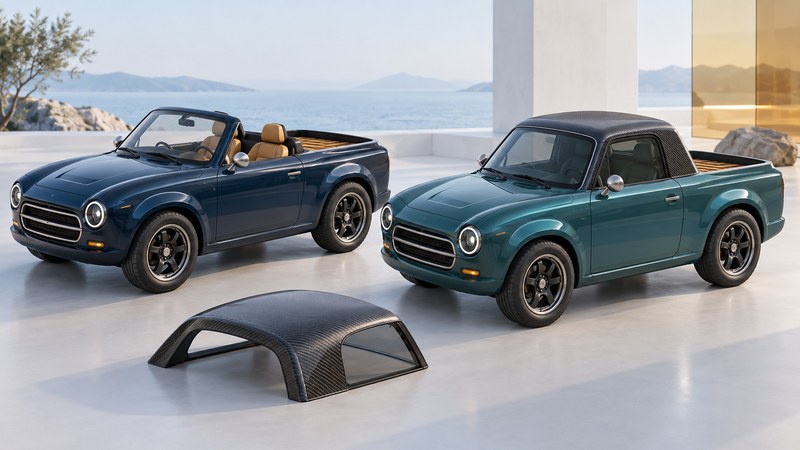
ASC’s Diamondback recast the Chevrolet SSR as a fixed-roof sport pickup. The useful comparison is architectural: what changes when a vehicle associated with a retractable roof becomes a coupe-like concept, and which performance claims are supported by the available record?
Place the Diamondback in its own timeline
ASC’s January 2005 Detroit show release said the Diamondback had first appeared at SEMA in November 2004. It described a fixed roof, carbon-fiber construction above the beltline, a supercharged 6.0-liter engine, six-speed manual transmission and a claimed 500 horsepower. ASC presented it as a showcase for its OMNICarbon technology and vehicle-integration work, and identified its own development and subassembly role on the production SSR. See ASC’s issuer release, reproduced by The Auto Channel.
That description belongs to a particular show vehicle. The production baseline below uses Chevrolet’s 2005 model-year documentation so that model years and engine specifications stay explicit.
Compare like items, with the source attached
Chevrolet’s 2005 SSR restoration kit (PDF), product-information page 1, describes the production retractable hardtop, a 6.0-liter LS2 rated at 390 horsepower, standard four-speed automatic and optional six-speed manual.
On a narrow screen, scroll the table sideways. Keyboard users can focus the table region and use the arrow keys.
| Item | Production SSR, 2005 model year | ASC Diamondback concept |
|---|---|---|
| Roof architecture | Power-retractable hardtop | Fixed upper body |
| Engine description | 6.0-liter LS2 V8 | Supercharged 6.0-liter V8 |
| Power in cited source | 390 horsepower rating | 500 horsepower claim |
| Transmission | Four-speed automatic; six-speed manual available | Six-speed manual described |
| Role of the document | Production product information | Supplier concept announcement |
The two power figures identify the sources’ stated configurations. They are not a matched instrumented comparison. Acceleration, braking or handling conclusions would need measurements under comparable conditions.
What a roof change asks of the vehicle
Packaging
Chevrolet described the production roof panels stacking behind the passenger compartment. A fixed-roof proposal changes the packaging problem because the upper body no longer needs that operating sequence. A useful drawing would show the resulting boundaries of the cabin, storage and cargo areas. The drawing, rather than the styling impression alone, should establish usable space.
Materials and joints
ASC’s carbon-fiber description identifies a material strategy. To evaluate the assembly, a reviewer would also ask about the attachment points, interfaces with the retained body and the manufacturing process. A carbon-fiber surface by itself does not quantify the mass or stiffness of the finished vehicle.
ASC described a weight reduction but did not give a measured vehicle mass in the cited release. Record that as an unquantified manufacturer claim. A meaningful comparison would identify which assemblies were removed and added and the conditions used for weighing both vehicles.
Purpose
The Diamondback can be read as a supplier’s demonstration of a different upper-body architecture and integrated modifications. That interpretation is more precise than treating every show-car claim as a production option. The roof treatment, engine changes and cabin packaging each deserve their own evidence entry.
A useful comparison sentence
Try this structure: “For the specified model or concept, the dated source describes this configuration; assessing this further outcome would require this evidence.” It keeps the historical vehicle interesting while making the limits of the comparison visible.
Build your version comparison
Download the SSR and Diamondback comparison record. It separates model year, body architecture, claimed output and measured results. For another example of connecting body design with material claims, explore the zaZen whole-vehicle study.
Explore Autos: vehicle guides, technology and design · Cars: buying, maintenance and ownership