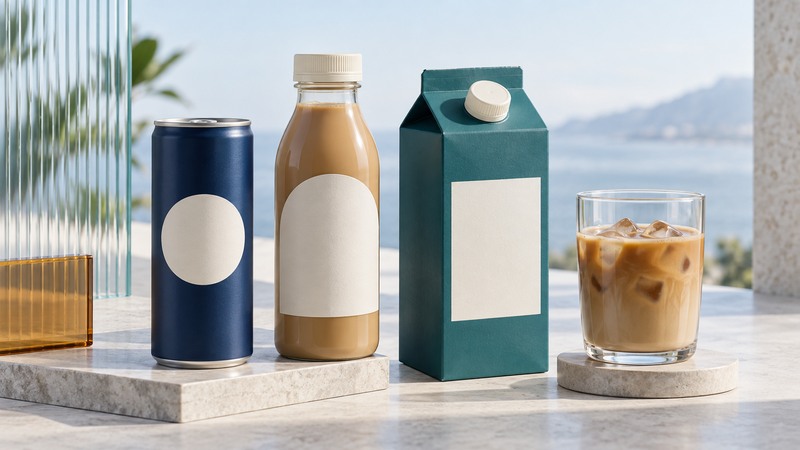
Ready-to-drink coffee is packaged for drinking as sold. Compare the amount you plan to consume, then read caffeine information, Nutrition Facts and storage directions. A similar-looking concentrate needs its own preparation and serving calculation.
Read the package in a useful order
- Preparation: confirm ready-to-drink or concentrate and any dilution instructions.
- Amount: compare container volume, labeled serving and the portion you will drink.
- Caffeine: find the stated amount and its per-serving or per-container basis.
- Nutrition: compare total sugars, added sugars and ingredients relevant to you.
- Storage: read unopened and opened instructions separately.
The FDA Nutrition Facts guide explains serving information and per-container columns. A serving is the label's reference quantity, not a recommendation for how much to drink.
An unstated caffeine amount remains unknown. The FDA caffeine guide notes that quantitative caffeine declarations are often voluntary. Ask the manufacturer for the exact product if you need the amount; coffee color and flavor are poor substitutes.
Compare what you will drink
On a narrow screen, scroll the table sideways. Keyboard users can focus the table region and use the arrow keys.
| Label detail | Drink A | Drink B |
|---|---|---|
| Container / serving | 250 mL / 250 mL | 400 mL / 200 mL |
| Servings consumed | 1 | 2 |
| Caffeine per serving | 100 mg | 75 mg |
| Caffeine per whole container | 100 mg | 150 mg |
| Added sugars per serving | 0 g | 6 g |
| Added sugars per whole container | 0 g | 12 g |
These invented labels illustrate the arithmetic. B lists fewer milligrams per serving yet supplies more per container: 75 × 2 = 150 mg. For concentration, A has 100 ÷ 250 × 100 = 40 mg per 100 mL; B has 150 ÷ 400 × 100 = 37.5 mg per 100 mL. For intake, the amount actually consumed is the relevant total.
Use amount consumed = amount per serving × servings consumed. Keep units consistent. Added sugars are already part of total sugars, so adding those two figures would count the added amount twice.
Handle concentrate as a separate calculation
Follow dilution instructions and establish whether caffeine and nutrition figures refer to concentrate or the prepared drink. Added water or milk changes volume and may add nutrients; it does not remove the caffeine measured into the drink.
Some labels describe the prepared drink. Check that serving basis before multiplying by a dilution factor.
Separate shelf-stable and refrigerated instructions
An unopened shelf-stable product and a product requiring refrigeration have different storage needs. Follow the label, including refrigeration after opening and its use-within period. Write the opening date on multi-serving containers if helpful.
The FDA food-storage guide recommends a refrigerator at 40°F (4°C) or below. For perishable food requiring refrigeration, its room-temperature limit is two hours, shortened to one hour above 90°F (32°C). Apply those limits to products requiring refrigeration and follow any more restrictive label directions.
Plan chilled transport when needed. Choose a size you can use within the opened-storage period. Replacing the cap after opening does not restore unopened shelf life.
Finish with ingredients and your routine
Read the full ingredient and allergen information when milk, soy, nuts or another ingredient matters to you. Flavored drinks can contain components less obvious from the front label. Recheck when packaging or formulas change.
Record the exact name, container size and caffeine statement of a preferred product. To understand sleep or feeling wired, use the caffeine observation guide. For wellness and added-botanical claims, use Healthy Coffee.