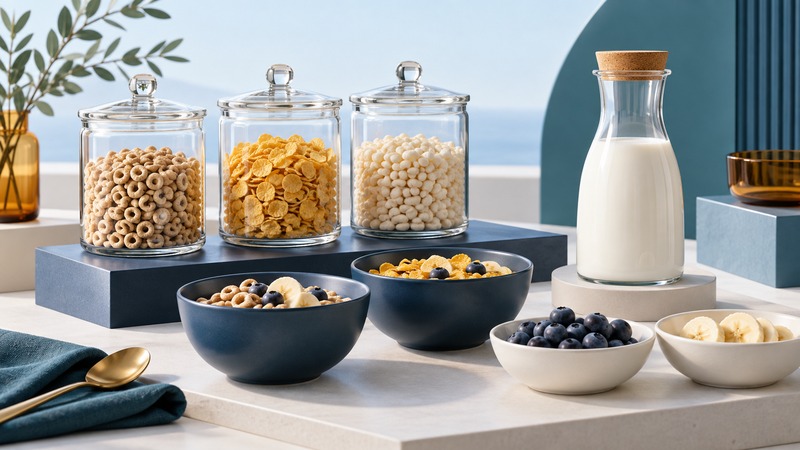
A cereal bar works best with a few distinct choices, visible ingredients and milk added at the last moment. Use the Cereality idea as a home breakfast format, then plan the actual amounts your guests will eat.
From cereal café to home breakfast
Cereality made familiar breakfast cereals the center of a customizable café experience. Kahala’s company history places its acquisition of Cereality in 2007. The plan below is an independent home adaptation; historical menus, prices and expansion announcements describe their own period.
Offer two contrasting cereals, one fruit and one crunchy topping to start. More choices mean more open packages and more serving utensils. Put the original boxes nearby so guests can check ingredients. Give each topping its own spoon and keep milk alternatives clearly identified.
Plan six first bowls
Use the following as a shopping exercise for six modest first servings. Appetite and cereal density vary, so keep unopened reserve food available if this is the main breakfast. Weigh cereal in grams: equal scoop volumes can hold different weights.
| Component | Per guest | Six guests |
|---|---|---|
| Dry cereal | 40 g total; for example 20 g of each of two kinds | 240 g total |
| Milk or chosen alternative | 150 ml | 900 ml |
| Prepared fruit | 40 g | 240 g |
| Dry topping | 10 g | 60 g |
Set out bowls, spoons and dry components first. Bring out small quantities of chilled ingredients near serving time. Pour milk after selecting cereal and toppings, so the first bowl stays crisp while the rest of the group decides.
Calculate everything that goes into the bowl
For each packaged component, multiply its label value by amount used ÷ label serving amount. Use matching units in that fraction. Add the component results. A cereal’s “with milk” column already includes the specified milk; choose the dry-cereal column when calculating your own milk separately.
| Component | Example label | Amount used | Calculated calories |
|---|---|---|---|
| Cereal A | 150 calories per 40 g | 20 g | 75 |
| Cereal B | 120 calories per 30 g | 20 g | 80 |
| Milk | 120 calories per 240 ml | 150 ml | 75 |
| Packaged fruit portion | 50 calories per 100 g | 40 g | 20 |
| Dry topping | 50 calories per 10 g | 10 g | 50 |
| Complete bowl | Add all five components | All quantities above | 300 |
Repeat the same arithmetic for a nutrient you are comparing, such as fiber, sodium or added sugars. Use the values printed on each exact package. Label rounding makes the total an estimate. A calorie total describes this constructed bowl; it does not establish an appropriate portion for every person.
Keep the station workable
Keep milk and prepared perishables refrigerated until needed. The FDA’s home food-handling guidance calls for refrigeration at 40°F or below and prompt chilling within two hours, or one hour above 90°F. Use small replenished servings for a longer gathering.
For a guest with an allergy, review every package and the serving arrangement with them beforehand. Separate bowls and spoons help organization, but a shared station can still transfer ingredients. Agree on an appropriate individually handled option when needed.
If a blend tastes too sweet, change the cereal ratio next time and record it. If the texture becomes soft, add the liquid later or keep the topping dry until the final spoonful. For a warm breakfast variation, see oatmeal toppings and portions.