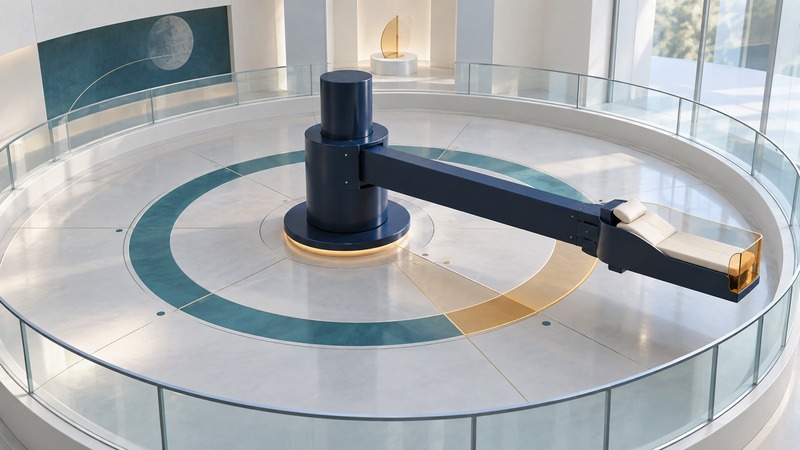
A short-radius centrifuge rotates a person around a nearby axis to study the effects of an imposed mechanical load. In artificial-gravity research, that load can be directed along the body, making the apparatus useful for investigating possible countermeasures to spaceflight deconditioning. Understanding a study requires knowing where the load was specified, how long it was applied and which outcomes were measured.
This is an explanation of research, not guidance for operating a centrifuge or conducting a human experiment. The physics calculation below illustrates geometry; it is not a suitable exposure prescription.
Connect rotation to radius
An object following a circular path needs inward centripetal acceleration. For steady rotation, its magnitude is a = ω²r, where r is distance from the rotation axis and ω is angular speed in radians per second. Convert revolutions per minute N using ω = 2πN/60.
The support applies the forces needed to keep the person moving in the circle. In the rotating frame, the person experiences an outward loading tendency. With a radially aligned reclined body, the feet can be farther from the axis than the head, producing a larger rotational acceleration at the feet. NASA's artificial-gravity research discussion explains why the geometry and human response must be considered together.
For the same target rotational acceleration, increasing radius permits a lower angular speed. A larger apparatus, however, has different space and engineering demands. Movement within a rotating system also introduces effects relevant to orientation and tolerance. The design tradeoff is broader than choosing one “g level.”
What bed rest can model
Strict head-down bed rest unloads much of the body and changes fluid distribution, allowing researchers to investigate selected effects associated with spaceflight. NASA's description of the :envihab facility explains its use for studying deconditioning and testing countermeasures.
Bed rest is an Earth-based analogue. Participants remain in gravity, and the environment differs from flight in movement, daily activity and other exposures. A well-designed analogue study answers a defined question under controlled conditions. Applying its findings to astronauts requires attention to those differences and, where possible, flight evidence.
Read the comparison group carefully. Centrifugation alone, exercise alone and exercise during centrifugation are different interventions. Their effects cannot be assigned to the same cause simply because all are discussed under artificial gravity.
A study result needs an outcome and a dose
On a narrow screen, focus this table and use the arrow keys to scroll.
| Detail | What to look for | Why it matters |
|---|---|---|
| Participants | Number, characteristics and allocation to groups. | Determines whom the evidence describes and how the comparison was made. |
| Loading | Rotation rate, radius and the body location used to specify acceleration. | A foot-level value differs from a center-of-mass value. |
| Exposure | Session length, frequency, continuous or intermittent delivery. | The same peak acceleration can accompany different interventions. |
| Outcome | The measured physiological or performance endpoint and timing. | A response during rotation differs from preserved function after bed rest. |
| Comparison | Control condition, uncertainty, adherence and adverse effects. | Allows the benefit and burden to be assessed together. |
A 2020 AGBRESA report examined daily centrifugation during 60 days of head-down bed rest in 24 participants. Heart rate increased during centrifugation, while oxygen uptake did not increase significantly. The authors recommended investigating combination with strenuous exercise for protecting physical performance. The result shows why “the heart responds” and “the intervention replaces exercise” require different evidence.
ESA's description of the BRACE study explains a comparison involving cycling in bed, cycling during centrifugation and a control condition. An announcement of that design establishes what researchers intended to compare; conclusions about efficacy should come from the resulting data.
Read a headline as a claim to be specified
When a report says artificial gravity “works,” ask which outcome improved, relative to which condition, in which people and over what time. Look for the size and uncertainty of the effect and for outcomes that changed little. A useful countermeasure may help one physiological system while leaving other risks to be addressed.
Save the study's setting, exposure schedule, reference location for acceleration, comparison and main endpoint in one short record. Then separate three questions: can the apparatus produce the load; can participants tolerate the intervention; and does it preserve the function that matters? This keeps the promise of artificial-gravity research connected to the evidence needed for its use in space.
Related science guides
- Evaluate controls and experimental comparisons
- Connect measurement settings to the question
- Explore astronomy resources
Explore all science guides. Sources reviewed September 11, 2026.