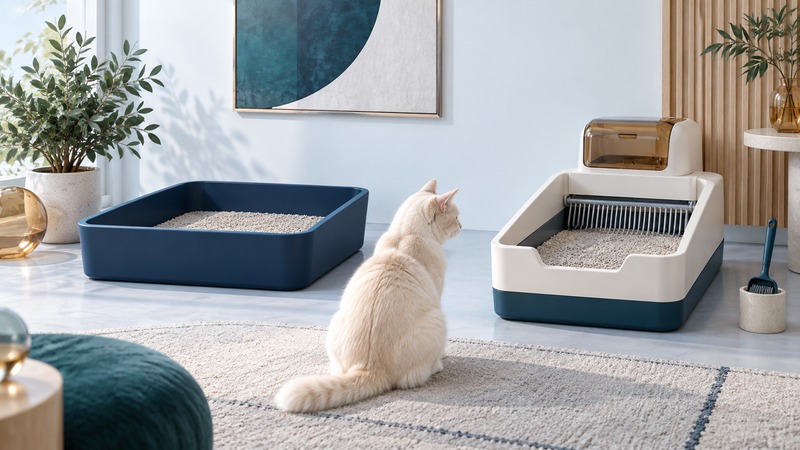
An automatic litter box is useful only if your cat can use it comfortably and you can maintain it correctly. Before buying, read the exact model manual, check age and other suitability limits, and plan daily observation. Motorized waste removal still leaves cleaning, supplies, and health monitoring to the caregiver.
Start with the cat and the manual
Measure the available space and check the entrance height, usable interior, permitted litter, power requirements, and access for disassembly. Ask how a cat enters, turns, and exits. For a kitten, a cat with mobility difficulty, or a cat with illness, discuss suitability with your veterinarian.
Model limits can be consequential. For example, the PetSafe Smart ScoopFree guide, document 400-2472, instructs owners to keep the unit unplugged for cats under six months and scoop manually. It also excludes cats whose condition or advanced age makes entry or exit difficult. Those are instructions for that product, not a universal age rule for every automatic box.
Check the manufacturer’s current support information for your exact model and revision. Read sensor checks, operating limits, cleaning precautions, and fault procedures before enabling automation. Do not bypass a sensor or adapt a mechanism to make it run.
Keep a usable familiar option
Place the new box where it is accessible and observe the cat’s response. Maintain a clean, familiar alternative during the transition; forcing a choice can conceal avoidance. Let the cat investigate at its own pace, and follow the manufacturer’s introduction procedure where it is compatible with the cat’s needs.
The Cat Friendly Practice guide recommends multiple litter resources, commonly one more box than the number of cats, with attention to location and individual preferences. An automated unit’s capacity claim does not resolve resource access or competition in a multi-cat household.
Track which cat uses which box where you can observe it. If one cat uses only the conventional tray, treat that as useful information about preference or access. Discuss new avoidance or elimination changes with the veterinarian.
Budget for care as well as consumables
List the recurring jobs: inspect waste and litter, refill or replace the required material, empty waste storage, clean the unit and sensors, and check for faults. Follow the model’s instructions for disconnecting power, approved cleaning products, drying, and reassembly.
The PetSafe guide above calls for unplugging before cleaning or handling parts and specifies its compatible crystal-litter trays. It also explains that humidity, use, and the cat’s health can change tray life. Use your observed replacement interval to plan supplies; a fixed monthly promise is a poor household budget.
Record actual replacement dates for several cycles. If the workload or cost exceeds what you can sustain, a conventional tray with a consistent cleaning routine may suit the household better.
Read the cat’s behavior as well as the app
Make a daily visual check of the cat, the litter resources, and the waste. A visit counter may help you notice a change, but counts can be difficult to attribute in a multi-cat home and do not establish a diagnosis.
Repeated straining with little or no urine needs immediate veterinary attention. Cornell’s feline urinary-tract guidance explains that urinary obstruction is an emergency. Do not spend time troubleshooting the box while a cat is struggling to urinate.
For a mechanical fault, keep a clean conventional tray available, stop automated operation as directed by the manual, and contact the manufacturer. For changes in urination, stool, appetite, comfort, or behavior, contact your veterinarian with a dated observation record.