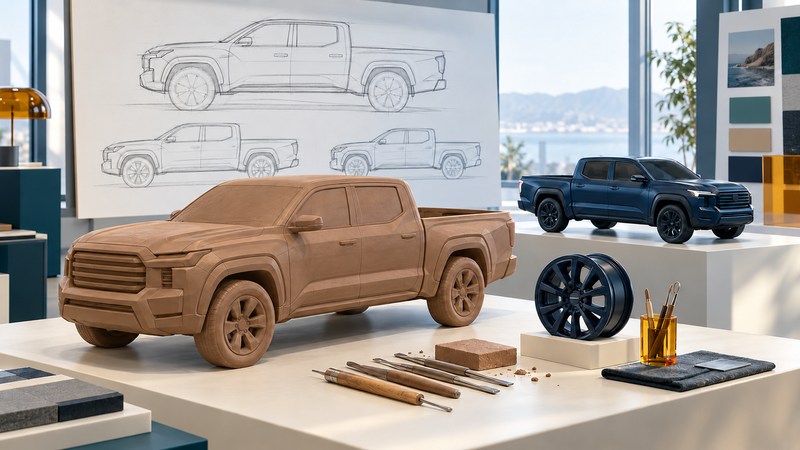
A finished car gives little indication of the work between an early sketch and a production design. Calty, Toyota's North American design organization, offers a documented way to examine that work: follow the studio's brief, models, collaborating specialists and decisions that survive into the vehicle.
Use this guide to read design histories more critically. Separate what a manufacturer documents from what you infer by looking at a car. Design credit is often shared among studios, engineers, modelers and other teams; an attractive sketch rarely tells the whole story.
From California experimentation to production work
Toyota established Calty in California in 1973. Its first production vehicle was the 1978 Celica. Toyota's 2023 anniversary history places the unveiling of Calty's Ann Arbor facility in 2004 and identifies the second-generation, 2007 Tundra as that studio's first production vehicle.
That history also provides a concrete concept-to-production example: the 2003 FJ Cruiser concept reached production in 2006. This establishes a documented project connection. It does not mean every concept feature was retained unchanged.
This page originally reported the Ann Arbor opening. The continuing reader question is what a production-oriented studio contributes once an idea must become a usable, buildable vehicle. Studying a named project makes that question more manageable than trying to infer a company's entire process from publicity images.
Read the process as a set of questions
On a narrow screen, scroll the table sideways. Keyboard users can focus the table region and use the arrow keys.
| Design evidence | Question it can help answer | What still needs evidence |
|---|---|---|
| Brief and research | Who is the vehicle for, and what character or use is intended? | Which requirements were actually adopted? |
| Sketch or rendering | Which proportions, shapes and visual ideas are being explored? | Does the image represent a proposal, a selected direction or a retrospective illustration? |
| Physical model | How do surfaces and proportions read in three dimensions? | What is its scale and stage, and what changed afterward? |
| Digital development | How is a design represented and reconciled with other requirements? | Which engineering and supplier constraints were documented? |
| Production vehicle | Which visible ideas reached customers? | Which differences reflect design decisions, equipment variants or market requirements? |
These questions can be revisited throughout a project. A photograph of clay work does not date every preceding or subsequent decision. When the source leaves a gap, label the stage unknown instead of drawing a smooth timeline through it.
A documented case: the 2024 Tacoma
In its August 2023 Tacoma design account, Toyota describes Baja racing trucks as a visual influence. It distinguishes California's future-design work from the Michigan studio's production role, and describes collaboration among designers, CAD specialists, clay modelers and research-and-development engineers.
The account also connects accessory readiness to work with Toyota's accessories team. This is a useful example of design developing alongside intended use, rather than being explained only through the shape of the body.
Try a focused reading exercise: choose one stated intention from the article, such as the truck's off-road character. Record the exact source and date, then describe one visible feature in your own words. Keep those two entries separate. “Toyota names this influence” is documented; “this surface makes the truck appear wider” is your visual interpretation.
A comparison becomes stronger when the images show the same grade and view. If a concept, a special edition and a standard production vehicle are mixed together, identify each before discussing what changed.
Look for the people between the sketch and the car
Toyota's February 2024 profiles of the Calty team make several contributions explicit. CAD team leader Luke Lauth describes working with engineers and suppliers. Exterior master modeler Dion Covelli discusses connecting design ideas with production feasibility. Lead designer Ai Keskeny's color, material and finish work helps distinguish an interior grade's atmosphere.
The same account describes interior designer Cristian Farcas working with engineering and CAD colleagues on the Tacoma's different manual- and automatic-transmission consoles. A console is a useful small-scale example: a styling intention must coexist with the configuration of the vehicle.
When taking notes, attach each contribution to the named person, team and project in the source. Do not turn “worked on” into “sole designer,” or assume that someone credited for one aspect directed every other aspect. A production vehicle is evidence of a resolved collaboration, while the published account may reveal only selected parts of it.
Build a design reading you can support
Download the Calty design reading record. Choose one project and one question. Gather a dated source, label the development stage, identify the documented contribution, and write your visual observation separately.
Finish with a short statement of what the evidence establishes and what remains unknown. For a broader method of evaluating a concept's proposals and production claims, continue with Automotive Design. The Calty case is most useful when it teaches you how to inspect the next design story.
Explore Autos: vehicle guides, technology and design · Cars: buying, maintenance and ownership