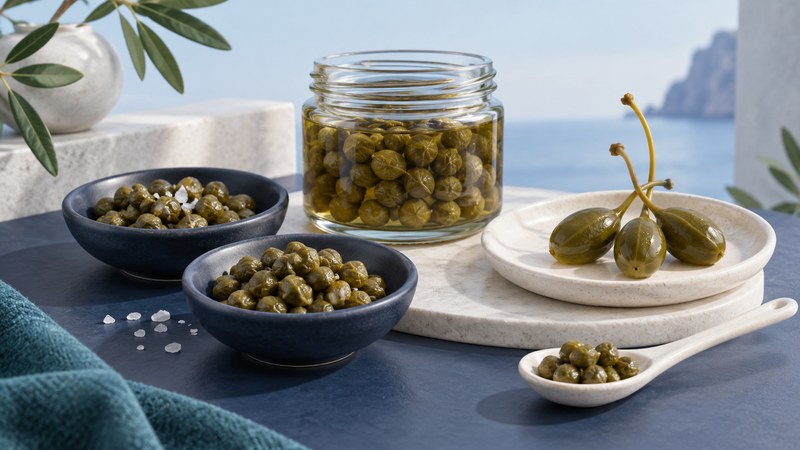
Capers bring concentrated salty, tangy flavor to a dish. Check whether yours are packed in liquid or dry salt, then prepare a small portion and taste it before seasoning the rest of the food. That sequence gives you control over both caper flavor and the salt already in the jar.
Read the packing style and size
Capers are the cured flower buds of the caper bush. Nonpareil and capote are size descriptions: DeLallo’s capote profile describes larger buds than its nonpareil type. Choose small buds for a scattered garnish or larger ones when you plan to chop them.
On a narrow screen, scroll the table sideways. Keyboard users can focus it and use the arrow keys.
| Product | What to expect | Practical choice |
|---|---|---|
| Capers in brine or vinegar | Ready-to-use buds with salty liquid; vinegar adds acidity. | Drain the portion for a recipe that calls for drained capers. |
| Capers in salt | Buds surrounded by dry salt. | Rinse or soak the portion according to the product instructions. |
| Caperberries | Larger fruits, often sold with a stem. | Use as a substantial garnish; remove stems before chopping into food. |
Inspect the actual ingredient list. For example, Roland’s Nonpareille Capers list water, salt and distilled vinegar alongside the buds. The liquid therefore changes both salinity and acidity when added to a sauce. Keep it separate unless the recipe calls for it.
Prepare only the portion you will use
- Lift out capers with a clean utensil. Leave the remaining jar contents in their original packing medium.
- For brined capers, drain in a small strainer. If the recipe calls for rinsing, rinse that portion; if you are adjusting your own dish, compare a drained caper with a rinsed one.
- For salt-packed capers, rinse off surface salt, then follow the maker’s soaking directions. Taste a prepared bud before deciding whether it needs more soaking.
- Drain well. Pat dry when unwanted water would thin a dressing or interfere with the recipe’s cooking step.
Roland’s instructions for its salt-packed capers suggest a brief rinse or a soak of 15 minutes to an hour. This is product-specific guidance: different packing styles and your intended dish can call for different treatment. Discard the soaking water and prepare the portion for immediate use.
Build the sauce before adding more salt
Chopping spreads caper flavor through more bites; leaving buds whole gives distinct bursts. Add the capers, stir, and taste the complete sauce before adjusting salt or lemon. Account for other salty ingredients such as olives, anchovies or cheese.
For a complete authored recipe, DeLallo’s chickpea puttanesca shows capers incorporated into a tomato-and-olive sauce. Follow its full method, then evaluate the combined seasoning.
Keep the jar instructions with the ingredient
Follow the label’s directions after opening, including refrigeration where specified. Dry salt-packed and liquid-packed products can have different storage instructions. Mark the opening date and keep the jar closed; use clean utensils each time.
Rinse the portion for today’s dish rather than washing the entire supply and returning it to storage. A yogurt sauce or cooked meal containing capers has its own storage requirements. The jar’s unopened shelf life does not describe that finished dish.
For another ingredient whose form changes the result, see whole and ground mustard. For pepper choices in a sauce, see sweet peppers and chiles.
Explore all seasoning and ingredient guides · Food, cooking and meal planning