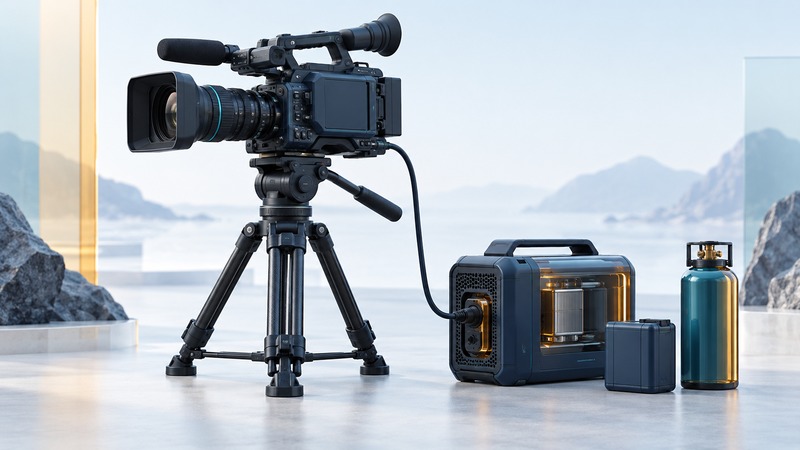
Camera fuel-cell runtime is meaningful only for a specified camera, accessories and recording pattern. A crew needs enough energy for the session, enough instantaneous power for the equipment and a supported way to keep recording during a source change. Evaluate those requirements before comparing hours or battery counts.
Keep the historical systems distinct
Early Jadoo camera-power announcements formed part of the search for longer field-video operation. A 2007 Millennium Cell filing describes Jadoo as supplying fuel-cell systems for broadcast video and surveillance and discusses their development relationship. That dated disclosure supports the application’s history. Current availability and compatibility require documentation for the exact product.
A separate Jadoo presentation to the 2010 DOE review proposed approximately 1 kW propane-fueled solid-oxide generators for media production and first-response trials. It identified camera positions and signal-conversion equipment among potential loads and reported an early development stage. Keep those targets separate from the smaller camera-mounted systems and from achieved field-test results.
Define the complete shooting load
On a narrow screen, scroll the table horizontally. Keyboard users can focus the table and use the arrow keys.
| Item | Record | Why it matters |
|---|---|---|
| Camera and recording mode | Exact model, input requirements and operating load | Different modes and peripherals can change demand |
| Monitor, receiver and accessories | Which devices share the source; average and peak watts | The camera body alone may understate total load |
| Power module and battery | Usable output energy, continuous limit and peak support | Energy capacity and instantaneous capability are separate |
| Fuel and changeover | Approved cartridge, swap procedure and reserve time | A long fuel duration is useful only with workable replenishment |
Use the exact equipment manuals and a representative rehearsal. Record the supported cable and connector, voltage range, polarity where applicable and the source’s protective behavior. A plug that physically fits is only one part of compatibility. Include the converter’s losses if the energy measurement is made before that converter.
Calculate the session before quoting runtime
Fictional shooting plan: a camera draws 28 W, a monitor 7 W and a receiver 5 W. Their combined 40 W load uses 240 Wh over six continuously powered hours. Reserving another 25% of that session energy adds 60 Wh, for a planning target of 300 Wh delivered to those loads.
If a candidate system has 360 Wh of verified usable output energy under comparable conditions, its energy-only runtime at 40 W is nine hours. A 30 W continuous-output limit would still leave a 10 W deficit during that load, requiring a separately assessed battery buffer.
This reserve is an invented planning choice, not a manufacturer’s recommendation. Replace the figures with measurements and the reserve appropriate to the production. If standby or recording periods differ, calculate each interval’s watts × hours and add the energy, including accessories left on between takes.
Check continuity and the working arrangement
A hot-swap claim needs a named procedure and evidence that the camera remains within its supported input conditions during the exchange. Rehearse the approved changeover with the intended recorder and accessories before a critical shoot, and inspect the resulting recording for interruption. Keep enough reserve for the exchange and a safe stop if it fails.
Record total carried mass, supported fuel supply, replenishment lead time, weather limits, ventilation requirements, noise and startup time. Follow the exact system’s instructions for placement, refueling and transport. A propane generator, a hydrogen cartridge system and a direct-methanol unit have different operating requirements.
A fair battery comparison uses the same camera settings, accessory load, ambient conditions and stopping point. Include both the fuel-cell module and its cartridges in the carried system, then compare useful session time and support needs. Use camera battery compatibility and runtime planning for approved battery options and fuel-cell technology differences for the wider context.
Use the evidence record
Download the field-video power session record (plain text). Save a copy, replace the blank fields with dated evidence and keep the fictional example separate from your own figures.
Explore more energy guides and case studies.