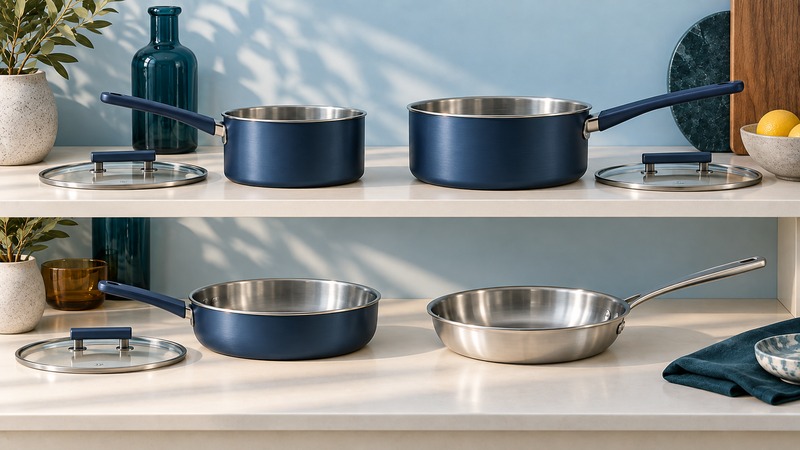
Calphalon space-saving cookware is worth evaluating when pan storage interrupts your cooking routine. Start with the exact collection and the pieces you need, then measure the cabinet and test access. A compact stack is useful when you can comfortably retrieve the pan you use most often.
Identify the collection and material
Write down the collection, material, model or set number, and individual pieces. Premier Space-Saving, Select by Calphalon Space-Saving and other Calphalon lines can have different care and temperature limits. Keep the packaging or product record with the instructions.
The Premier Space-Saving hard-anodized nonstick 10-piece set page describes matching-diameter stacking and flat glass covers. Its listed pieces include lids, so count actual cooking vessels as well as the advertised piece total. The Select Space-Saving set page describes a separate collection. Verify a replacement piece against your existing line before assuming interchangeability.
Compare the pan shapes with your normal meals: one broad frying surface, a useful saucepan and a pot large enough for your routine may matter more than several rarely used sizes. List the cooking tasks first and check which pieces answer them.
Measure a usable storage arrangement
Measure shelf width, depth, clear height and the door opening. Account for handles, hinges and any pull-out shelf mechanism. Mark the footprint of each proposed group on paper, including the handle projection; pan diameter alone understates the required space.
- Group only pieces whose stacking compatibility is explicitly documented. Same diameter is a condition in the cited range, not universal permission to mix unrelated cookware.
- Confirm the actual assembled height and footprint with the product information or an in-person check. Include lids.
- Place the frequently used group where you can reach and lift it comfortably. Confirm the cabinet or shelf's load capacity from its maker when needed.
- Practice retrieving a lower item and putting the other pieces somewhere stable. Daily access should work as well as the closed-cabinet arrangement.
Check the cooking surface and care limits
| Field | Where to confirm it |
|---|---|
| Cooktop compatibility | Exact product listing and base marking; check induction explicitly. |
| Oven and broiler permission | Instructions for both vessel and lid. |
| Utensils and washing | Collection-specific care guidance. |
| Stacking group | Documented line and diameter compatibility. |
| Warranty | Current applicable terms and proof of purchase. |
Calphalon's use-and-care guide separates hard-anodized nonstick, stainless steel and ceramic collections. It lists different induction and care characteristics. Verify the exact material and generation rather than applying a table row to every pan with a similar name. The induction guide explains the pan-base check.
Make care part of the storage routine
Calphalon advises letting pans cool before washing and using suitable nonabrasive cleaning tools. Dishwasher and metal-utensil permissions vary by collection. Follow the specific instructions and avoid putting a hot pan into cold water. Use the documented stacking method; for other nonstick cookware, its general care guide recommends protection between stacked surfaces.
Store clean, dry pieces and check handles, lids and rims during normal use. If something rocks, catches or looks damaged, identify the cause before continuing to stack it. Do not force a lid or pan into a group because its dimensions appear close.
For a warranty question, collect photographs, the exact product identity, purchase record and care history. Calphalon's warranty guidance identifies misuse such as overheating and unapproved cleaning methods. Read the applicable terms when making a claim.
A successful choice leaves you with the vessels you use, documented cooking compatibility and storage you can maintain without rearranging the kitchen at every meal.