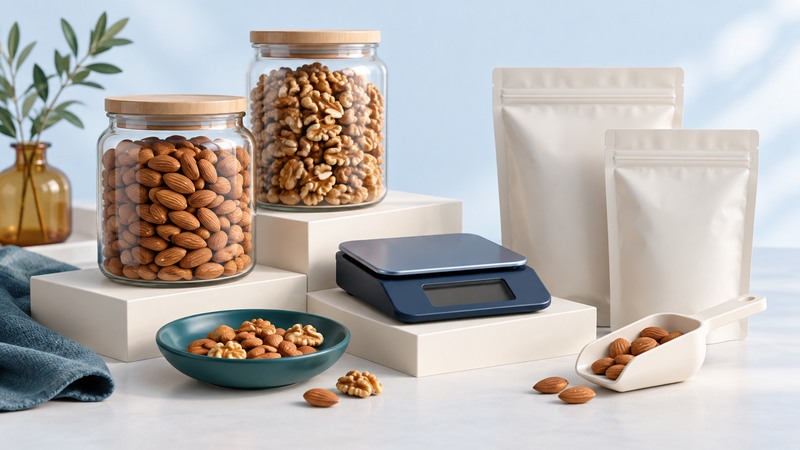
The best bulk quantity is the amount you can use and store well. Compare the same nut, processing and edible weight, then include delivery costs and likely waste. A low advertised price per pound can disappear when a large bag outlasts your plans.
Write the specification before comparing suppliers
- Food and form: nut type, whole or pieces, shelled or in-shell, raw or roasted, salted or unsalted, and any coatings. Pieces may suit baking where whole kernels add no value.
- Use: snacks, baking or a dated event. Confirm whether the product is ready to eat or requires further processing.
- Package: total edible weight, inner bag sizes, resealability, lot identification and the supplier’s date and storage information.
- Order terms: minimum quantity, delivery charge, tax, expected arrival, substitutions and returns for damaged or incorrect goods.
Ask for the actual label or specification sheet. Keep coatings and allergen statements in the comparison: two products called “roasted almonds” can have different added ingredients. For an event, confirm guest restrictions before buying and retain labels for serving.
Calculate landed cost per usable pound
Landed cost = product price + delivery + tax − discounts. Divide by edible weight for the first comparison. Then divide by the amount you realistically expect to use before quality loss for a second, more practical comparison. Keep pounds with pounds or kilograms with kilograms throughout.
Scroll the table sideways. With a keyboard, focus the table and use the arrow keys.
| Offer | Landed cost | Edible weight | Cost per edible pound | If only 8 lb of B will be used |
|---|---|---|---|---|
| A | $40 + $8 = $48 | 5 lb | $9.60 | All 5 lb used: $9.60/lb |
| B | $75 + $15 = $90 | 10 lb | $9.00 | $90 ÷ 8 = $11.25/lb |
Offer B saves $0.60 per pound only when the whole bag is useful. At eight usable pounds, it costs $1.65 more per used pound than A. In-shell nuts need an edible-yield estimate from the supplier or your own measured sample before comparison with shelled nuts; shell weight cannot be priced as edible kernels.
Estimate consumption and storage space
Household planning example: two people using 28 g each on five days a week for four weeks need 2 × 28 × 5 × 4 = 1,120 g, about 2.47 lb. This is a fictional usage pattern, not a recommended portion. Add measured recipe needs, subtract stock already on hand, and buy against the resulting total.
For an event, multiply the planned grams per guest by the guest count and add a buffer you can use afterward. Check the physical package size against your refrigerator or freezer before ordering. Ten pounds arriving in one bag may be harder to manage than the same weight in sealed smaller bags.
Protect quality after arrival
Inspect the delivery for damage and record the product, lot and supplier date. Divide a large bag into clean, airtight portions and label them, keeping the original label information. Use older stock first and keep nuts away from strong odors. Refrigeration at 40°F or below or freezing at 0°F slows quality loss; storage life varies with nut type, processing and packaging, so use the supplier’s instructions for the actual product.
The University of California guide to storing nuts explains how heat, moisture and oxygen affect quality. Freezing preserves quality but does not reliably eliminate Salmonella. A rancid smell is a quality problem; an ordinary smell cannot establish microbiological safety. Buy from a supplier with traceable lots and a clear process for handling problems.
Keep labels and lots through serving
Peanuts and several tree nuts are major food allergens under US labeling rules. Read ingredients and allergen information for the specific product, including seasonings and shared-processing statements. Plan a menu that avoids exposing guests with a known nut allergy; separate utensils alone cannot establish safety. Keep labels available and tell guests exactly what is offered. FDA’s food-allergy guidance explains label reading and why avoiding a known allergen matters.
If a recall concerns your product, compare the brand, size, lot and date with the notice and follow its instructions. Keep the nuts isolated while checking; do not serve an affected product. Use FDA’s recall and safety-alert listings and the supplier’s notice for current information.
Take a comparison sheet to the order
Open the printable bulk-nut buying worksheet. It has space for specifications, two delivered-price calculations, consumption, storage capacity and lot records. Fill the quantity plan before comparing discounts so the offer does not determine how much you need.