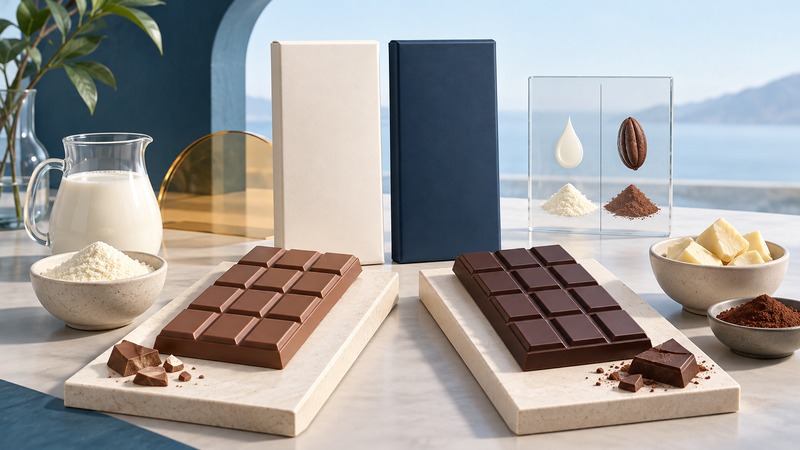
British chocolate includes many recipes and styles. To compare two bars, read their product names, cocoa and milk information, ingredients and tasting characteristics. The historical “chocolate wars” concerned how some products could be named and sold across borders; the dispute helps explain why labels carry these details.
What the chocolate wars were about
Some European countries allowed chocolate containing vegetable fats in addition to cocoa butter. Others required qualifying imported products to be sold under a name equivalent to “chocolate substitute.” This affected the ability to market a familiar product under the same name across borders.
In its 16 January 2003 judgment in Commission v Spain, C-12/00, the European Court of Justice found Spain’s restriction incompatible with the applicable free-movement obligations. The case concerned products meeting the relevant minimum cocoa-content rules and lawfully made in member states permitting the additional fats. The court considered ingredient information a way to inform consumers without forcing that change of product name.
The judgment answered a market-access and labeling question under the framework then in force. It did not rank national chocolate styles by taste or establish that every confection containing vegetable fat qualifies as chocolate.
Separate the historical decision from today’s label
The Cocoa and Chocolate Products (England) Regulations 2003, as originally made set out product descriptions, composition requirements and the statement “contains vegetable fats in addition to cocoa butter.” Their provisions allow specified additional fats within a defined limit while retaining minimum cocoa requirements. The original instrument is a historical legal source, not a complete consolidated compliance manual.
For a present-day starting point, UK government composition guidance explains that reserved descriptions, minimum ingredients and particular labeling requirements apply. It also explains cocoa-solids declarations and, where relevant, milk-solids declarations. Check the applicable destination market and current rules when selling a product; England-specific provisions should not be assumed to cover every jurisdiction.
Read two bars in a consistent order
Scroll sideways. With a keyboard, focus the table and use the arrow keys.
| Look for | What it tells you | Next question |
|---|---|---|
| Product description | The type of food being sold | Plain chocolate, milk chocolate, white chocolate or a filled product? |
| Cocoa declaration | A stated minimum composition measure | Are both labels describing the same type of product? |
| Milk information | Milk ingredients and any stated milk-solids proportion | Does it suit the recipe and the person eating it? |
| Fat ingredients | Cocoa butter and any other named fats | Is there an additional vegetable-fat declaration? |
| Nutrition panel | Values for a specified amount | Are you comparing equal weights? |
Cocoa mass contains both cocoa butter and other cocoa material; added cocoa butter is also a cacao ingredient. Cocoa percentage therefore gives a composition measure, while the ingredient list helps explain the recipe. Milk ingredients add another dimension. Compare these facts before drawing conclusions from how dark a bar looks.
Use history to ask better questions
Separate three questions: whether a product meets its applicable description, whether its ingredients fit your needs, and whether you enjoy it. The first relies on rules and product facts; the last is a tasting judgment. Origin can help tell a brand’s story, but it supplies neither a complete ingredient list nor a universal quality ranking.
Continue with chocolate ingredients and percentages or compare drinks with the drinking-chocolate tasting guide.