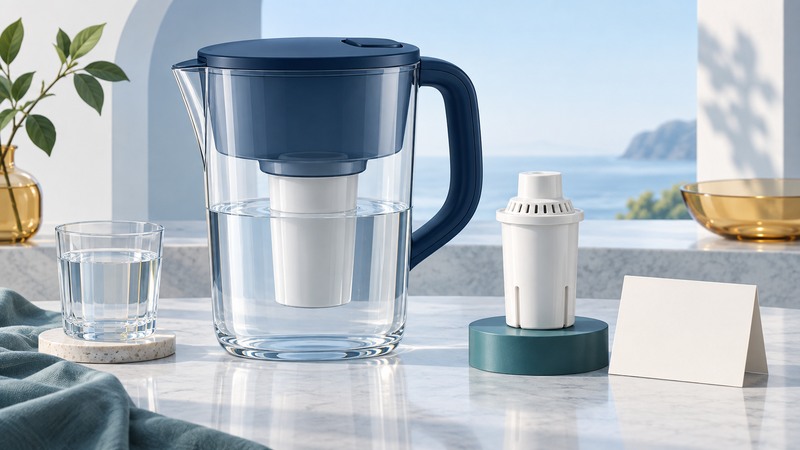
Identify the cartridge and pitcher before using a replacement schedule or contaminant claim. This guide concerns U.S. Brita products: packaging, manuals and names can differ in other markets. A useful filter record contains the system model, cartridge model, certified reduction you need and the date the cartridge entered service.
Identify the parts you actually own
Look beneath the pitcher, on its lid or packaging, and on the cartridge for identifying information. Photograph it before discarding the box. Match those details to the manufacturer's guide, then check the performance data sheet for the complete system.
Brita's U.S. support information calls its white Standard cartridge Original, with the same design. Its blue Elite cartridge has a different rated life. Stream uses its own system. Treat color as a useful clue and confirm the name and model in writing. Brita's replacement-filter FAQ links the relevant instructions and explains these distinctions.
Scroll the table horizontally on a narrow screen. Keyboard: focus the table region and use the arrow keys.
| U.S. cartridge family | Published replacement reference | What to verify on your equipment |
|---|---|---|
| Original, formerly Standard | 40 U.S. gallons; about 2 months | Pitcher compatibility and the Original setting on its indicator |
| Elite | 120 U.S. gallons; about 6 months | Compatibility, performance sheet and support for an Elite indicator mode |
| Stream | 40 U.S. gallons; about 2 months | The matching Stream system and its own preparation instructions |
These manufacturer references were checked in September 2026. Usage and the applicable instructions determine when replacement is due; keep both the time and volume guidance visible. Older indicator designs may need a separate reminder when an Elite cartridge is used.
Choose by the reduction you need
Start with the water concern. For taste, read the taste-related performance claim. For lead or another identified contaminant, find that substance in the exact model's performance data sheet and certification listing. Brita's performance-data directory provides the model-specific documents. Copy the system/cartridge combination into your record so a later replacement purchase preserves the intended performance.
If the starting concern is uncertain, use the water-testing and treatment guide before selecting a cartridge. A pitcher owner should be able to answer two distinct questions: “Does this replacement fit?” and “Does this system have the reduction claim I need?”
Brita instructs users to filter cold, potable water and to follow the stated precautions for water of unknown or unsafe microbiological quality. A household water advisory therefore needs its own response from the responsible authority; the ordinary pitcher routine is designed for a different starting condition. See the manufacturer's water-use and filter guidance.
Prepare and reset using the correct guide
Read the preparation steps for the cartridge in your hand. The linked Standard OB03 user guide (PDF) specifies washing hands, hand-washing the pitcher parts with mild detergent, rinsing the cartridge under cold tap water for 15 seconds, and seating it by aligning its groove with the reservoir ridge. Discard the first three pitchers, or the first dispenser fill, as that guide directs. Follow the matching lid's indicator instructions.
Brita's linked long-life cartridge guide (PDF), supplied through its Elite support link, uses older Longlast naming. Its preparation omits the cartridge pre-rinse. Confirm the supplied instructions for your current replacement and equipment, particularly any initial discarded-fill requirement. The date and naming on a manual are reasons to check applicability.
Before filling, check that the cartridge seats as the manual shows and that the reservoir is correctly assembled. After a change, record the date and the applicable capacity/time limit. Use the indicator procedure specified for your lid: button timings and modes vary. A calendar entry or written log is useful when the indicator cannot track the cartridge you selected.
Compare cartridge costs with explicit assumptions
Fictional cost example, not current prices: assume two compatible options both meet the household's chosen reduction requirement. Option A costs $7 and is rated for 40 U.S. gallons; option B costs $20 and is rated for 120 U.S. gallons. The household filters 240 U.S. gallons per year.
Scroll the table horizontally on a narrow screen. Keyboard: focus the table region and use the arrow keys.
| Calculation | Option A | Option B |
|---|---|---|
| Cartridges required by volume | 240 ÷ 40 = 6 | 240 ÷ 120 = 2 |
| Annual cartridge cost | 6 × $7 = $42 | 2 × $20 = $40 |
| Cost per rated gallon | $7 ÷ 40 = $0.175 | $20 ÷ 120 ≈ $0.167 |
Round cartridge counts up to whole units. Then check the calendar limit: a low-use household may replace on time before reaching rated volume, increasing cost per gallon actually used. The example excludes the pitcher, water, tax and shipping; real prices and performance requirements can change the choice.
Download the filter maintenance and cost worksheet (plain text) to keep the model, source documents, dates and arithmetic in one place.
Troubleshoot with observable checks
If filling slows, check the specific model's troubleshooting instructions and cartridge seating before assuming a new water-quality problem. If an indicator behaves unexpectedly, verify its selected mode and reset procedure. If a housing is damaged, stop using it and contact the manufacturer about a suitable replacement.
A change in taste is a reason to investigate the supply, cleaning and cartridge history; it is a weak substitute for a service record. Keep a spare only if it matches the documented system, and repeat the model check when a product name or package changes.