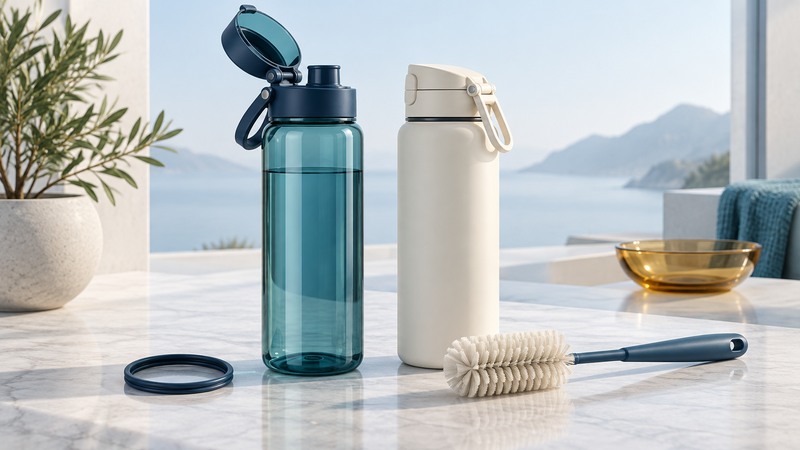
A flip-top bottle is a small system: body, cap threads, hinge, latch, drinking opening and seal. Choose one by how securely you can close it, how comfortably you can drink from it and how completely you can clean the parts. A convenient opening mechanism is most useful when it still works well after daily use.
Identify the exact bottle generation
Record the model, capacity and any molded identification before ordering a lid or following care advice. Products with similar names can use different materials and mechanisms. The polycarbonate specification in Nalgene's 2005 OTG announcement belongs to that historical model.
As checked in September 2026, Nalgene describes its 24 oz On-The-Fly Lock-Top bottle as made with Tritan Renew, with a locking lid and a 76 mm body diameter. That is an example of a documented current specification, not a description of every older bottle. Confirm the actual version and lid compatibility before buying parts.
Test the features that matter to you
On narrow screens, scroll the table sideways. Keyboard: focus the table and use the arrow keys.
| Use | What to check | A useful result |
|---|---|---|
| One-handed drinking | Reach and force needed to release, lift and close | You can operate it without an awkward grip |
| Carrying in a bag | Positive closure and any separate lock | You can tell when both are engaged |
| Cup holder or pocket | Body width, height and lid clearance | It fits your actual space and remains removable |
| Cleaning | Access beneath seals and around the spout | The specified care method reaches residue-prone areas |
| Long-term use | Exact replacement cap or seal availability | You can identify a compatible part |
A bottle advertised to fit cup holders may still sit poorly in yours. Measure the holder or try the bottle where practical. Check whether a carrying loop catches on a bag opening and whether the raised lid contacts your face. These are personal fit checks, not manufacturer performance tests.
If one-handed operation is important because of limited dexterity, try the actual latch and lock before purchase when possible. A large button can still require a difficult closing motion. Prioritize the motion you can repeat comfortably.
Establish a cleaning routine from the care guide
Nalgene's cleaning instructions describe dishwasher and hand-cleaning options and call out removable valve parts on certain lids. Use the directions for your exact bottle. A valve or seal shown in one model's guide may be fixed in another.
- Empty the bottle and separate the parts the manufacturer permits you to remove.
- Clean the body, drinking opening and accessible seal surfaces by the specified method. Use an appropriate soft brush where hand cleaning is directed.
- Rinse and inspect the parts in good light. Check for residue, cracks or a distorted seal.
- Allow the cleaned parts to dry before storage; reassemble them in the documented orientation.
- Check closure with cool water over a sink before returning the bottle to a bag.
Never pry out a bonded part or force a seal into a shape that merely looks right. If the guide is unclear, send the manufacturer the model and a description of the part. A replacement lid is often a more sensible solution than an improvised repair to a damaged latch.
Find the source of a leak
Use cool water and work over a sink. Dry the exterior, close the cap normally, engage its lock if present and gently tip the bottle. Observe whether moisture begins at the cap-to-body joint, drinking opening or a crack. This is a household check, not proof against every jolt in a packed bag.
At the threaded joint, check for debris, cross-threading and damage using the care guide. At the drinking opening, check the permitted seal position and latch closure. Persistent leakage after correct cleaning and assembly calls for a compatible replacement or manufacturer support. Keep electronics separate until the problem is resolved.
Match the contents to the bottle
Check the manufacturer's permitted contents and temperature limits before using hot or carbonated drinks. Dishwasher compatibility alone does not establish suitability for carrying boiling water. Follow specific care directions after flavored or sweetened drinks, and avoid leaving residue hidden beneath a closed lid.
Keep a short record of model, lid part number and care link. When the bottle is easy to fill, operate and maintain, it can support the routine described in daily hydration. For what goes inside a sports bottle, use the electrolyte mixing guide.