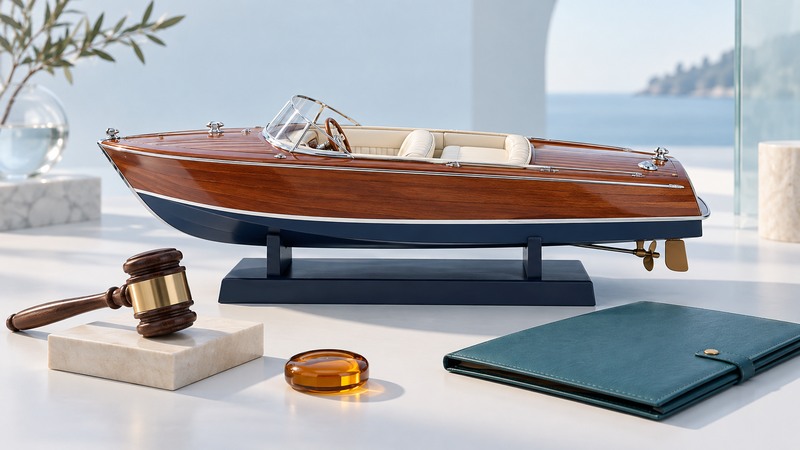
Set your maximum bid after you understand what you are buying, what the sale terms require and what it will cost to remove and make the boat usable. The winning bid is one component of the purchase. Unresolved ownership or condition questions can be a reason to pass.
For recreational boat bidders, with a US museum-auction example. Sale contracts, title processes and tax treatment vary; the calculations below use explicitly fictional assumptions.
Identify the sale format and read its terms
Establish whether the sale uses live bidding, online bidding, sealed bids or another process. Read the current lot description and all applicable conditions, including any amendments. Check registration, reserve or seller-acceptance rules, bidding increments, buyer’s premium, payment methods and deadlines.
The New Hampshire Boat Museum’s auction page, checked in September 2026, illustrates why lot-specific terms matter: its posted sealed-bid offering describes an as-is, where-is sale, encourages inspection and reserves the right to reject bids. That dated example is not a statement that a lot is still available. Obtain the current conditions for the sale you are considering.
Ask when the sale becomes binding, when responsibility for the boat transfers, what documents you receive and what remedies the contract provides. Keep the answers and the accepted terms with the lot record. A familiar auction name or charitable purpose does not resolve those questions.
Use the inspection opportunity
Arrange an inspection before bidding and find out which checks are permitted. Ask about access inside the boat, haul-out, engine operation and a controlled trial. If a check cannot be performed, record the limitation and decide whether you can accept the resulting uncertainty.
Request identifiers, service and repair records, equipment inventories and any prior survey. For a substantial purchase, commission appropriate independent advice using the survey process described by BoatUS. Agree the scope and exclusions in advance, especially if the auction schedule limits access.
Classic wooden boats deserve construction-specific expertise. Ask about repair and restoration records, storage, hull condition and what commissioning work is required. Photographs of a restoration help document work; a specialist still needs to assess its scope, condition and relevance to the boat you are buying.
Inspect any included trailer separately. Confirm ownership records, roadworthiness, compatibility and whether it can legally and practically carry the boat away. If that cannot be established, obtain a professional transport quotation instead of assuming you can tow it home.
On a narrow screen, scroll the table sideways. Keyboard users can focus the table and use the arrow keys.
| Area | Evidence to obtain | If it remains unresolved |
|---|---|---|
| Identity and ownership | Vessel identifiers, seller authority and transfer documents | Seek a qualified title or closing review; consider passing |
| Condition | Permitted inspection, records and specialist findings | Record the exclusion and budget uncertainty honestly |
| Included property | Lot inventory covering boat, engine, trailer and loose gear | Request written clarification |
| Removal | Deadline, location, lifting access and transport quotation | Arrange a feasible plan before committing |
| Total charges | Premium, taxes, administrative costs and payment fees | Calculate the invoice using the current terms |
Check the ownership route
Match the identifiers on the boat and equipment to the lot documents. Ask who will sign the transfer and how any outstanding finance, recorded claims or missing documents will be addressed. Have a qualified professional resolve concerns before bidding.
For US documented vessels, the Coast Guard National Vessel Documentation Center offers an Abstract of Title and related documentation services. Use the applicable state boating authority for state registration or titling questions. An auction invoice is one part of the evidence file; establish what your registration authority and insurer will actually require.
Confirm how the boat will be insured during collection and transport. Save documents and independently verify payment instructions using a trusted contact. Keep payment and collection deadlines visible; an avoidable delay can add storage or handling charges.
Calculate the invoice before setting a ceiling
List the costs that do not depend directly on the bid: inspection, transport, lifting, administrative charges, immediate repairs and a separate uncertainty reserve. Obtain quotations where possible. Then identify how the buyer’s premium and each applicable tax are calculated.
For a simplified example in which premium is a percentage of the hammer bid and tax applies to both bid and premium:
Total = hammer bid × (1 + premium rate) × (1 + tax rate) + other costs and reserve
Maximum hammer bid = (total budget − other costs and reserve) ÷ [(1 + premium rate) × (1 + tax rate)]
Use decimal rates, such as 0.10 for 10 percent. The formula must change if the tax base, fee structure or premium tiers differ. Ask the auctioneer and relevant authority about the actual treatment; invoice rounding can also differ.
Keep uncertainty separate from enthusiasm
Write your ceiling before bidding begins and stop when it is reached. A ceiling is a budget limit, not evidence that the boat is worth that amount. Compare it with condition, comparable evidence and alternatives such as buying through a conventional inspected transaction.
For uncertain repairs, build a scenario with a larger scope and see whether the purchase still works. If a major system has never been demonstrated and the potential loss exceeds what you can accept, a low opening bid does not remove the problem. Seek more evidence or pass.
After a successful bid, follow the payment and collection process, obtain the agreed documents and record condition at handover. Use the arranged lifting and transport service. Before the first outing, complete commissioning and required repairs with suitable professionals and obtain the operating instruction you need.
Take the worksheet with you
Boat-auction bid worksheet — editable plain text. Save a copy, open it in a text editor and fill in the blanks as you collect evidence. Keep unresolved items visible.